Already a member? Log into your account
Get instant access to millions of hours of recorded video from hundreds of traffic cameras in San Antonio, Texas.
Get Started TodayRoadProof is trusted by the best organizations across America.




















Are you part of a law enforcement agency? Get Roadproof now, for FREE. Click here to sign up.
With RoadProof, you can save thousands of dollars and hundreds of hours of time tracking down the video data you need, for whatever your end use case might be – whether it’s an accident case or criminal investigation.
Recorded video data that used to take days or weeks to find, can now be searched for, located and downloaded in a matter of minutes using the platform.
“The platform continues to be vital and a remarkable tool. It’s a great asset to our agency for all of our cases.”
Master Sergeant John A. Boos
Traffic Homicide Investigation, Florida Highway Patrol – Florida
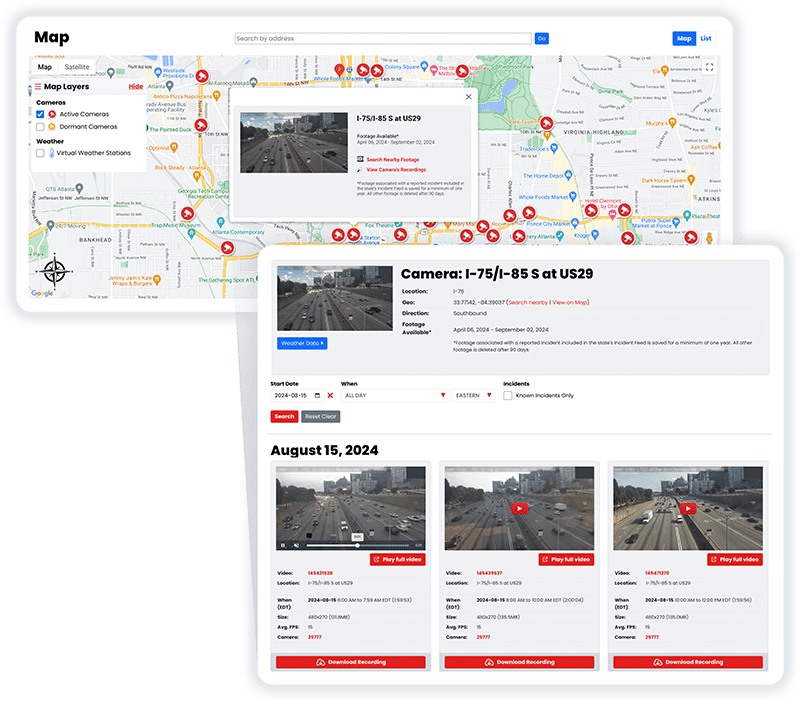
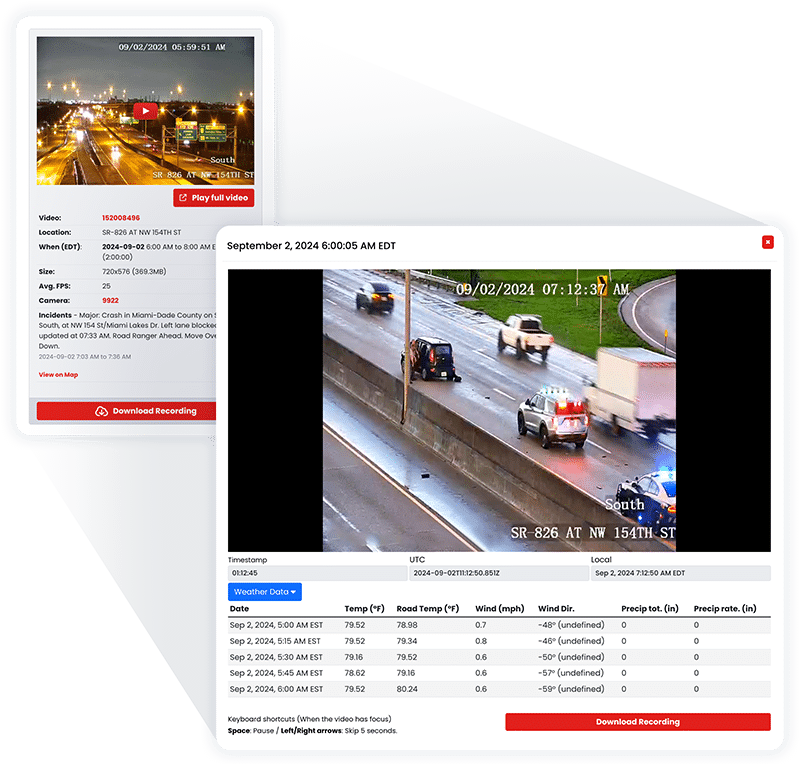
RoadProof offers a truly unique data set combining archived traffic video and a running incident feed available in most states on the system.
All of this data together allows you to get the whole picture, from the initial incident to the final outcome.
“IT WINS THE CASE. We saw the value of RoadProof immediately, you settle your cases 50% faster and for full value.”
Brian Labovick
Labovick Law Group – Florida
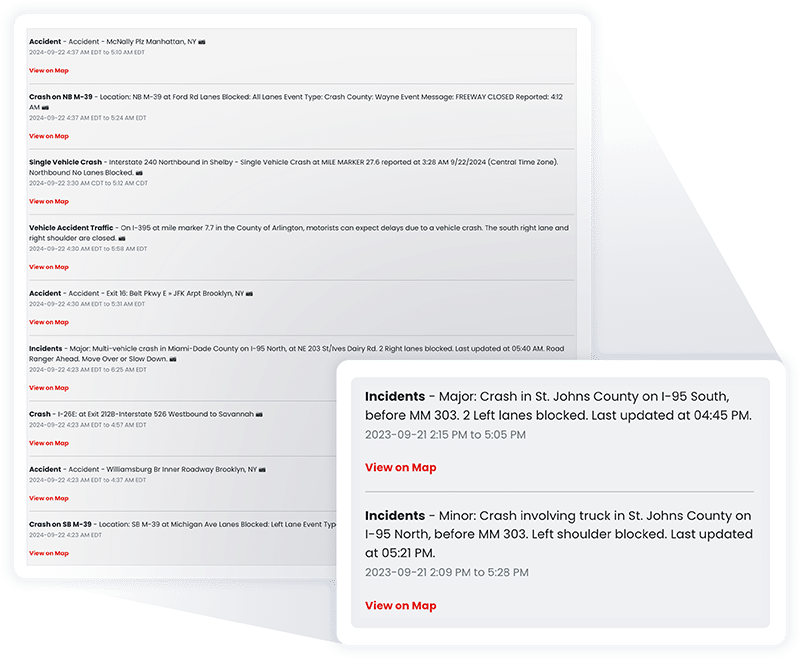
With our automated intelligence system, we’re able to match video footage from cameras nearby to any reported incident, and ensure that those vital video recordings are preserved in our archive for a minimum of one year.
While other systems only keep video footage for a couple of months, we keep the video footage that’s critical to your cases for much longer.
“Our case management department (which handles hundreds of cases each month) has nothing but praise for RoadProof.”
Kendra Fike
Bighorn Law – Nevada
Get started now to see how RoadProof can help you get the video data you need.
Get StartedAlready a member of RoadProof? Login here
“One of the first things I do when investigating a crash is obtain and preserve as much evidence as possible. Even before knowing all the parties involved, I immediately pull the RoadProof footage. Seeing the crash firsthand through the video is incredibly powerful. Having this video footage from the start really helps level the playing field between the plaintiff and the trucking company, which often delays or refuses to provide the truck camera video if at all.”
Jamie Mazzeo, Litigation Paralegal
The Truck Accident Law Firm – Florida


Get started now to see how RoadProof can help you get the video data you need.
Get StartedAlready a member of RoadProof? Login here
If you have been involved in a car accident on I-35 and have seen a close call at an intersection downtown, then we are sure you have thought the same thing. Were those vehicles being recorded by a traffic camera? San Antonio has hundreds of traffic cameras throughout all of the city’s roads (highways), intersections, and areas of highway construction. Most drivers are unaware of how these cameras function. This San Antonio traffic camera archive guide explains the difference between the live feed of the cameras currently being viewed and the archived footage from the cameras. The live feeds display what is occurring on the roadway at this moment. In contrast, archived footage of the cameras may or may not be available. It is also dependent upon a number of governmental agencies that are likely unfamiliar to most citizens.
This guide will assist anyone who has experienced a vehicle collision and wishes to determine whether there is video evidence, anyone engaged in an insurance dispute and anyone simply interested in understanding the operations of the cameras surrounding San Antonio. At the conclusion of this guide, you should be able to identify which agency owns each of the cameras, provide directions to access live feed(s) of the cameras, explain the use of crash footage in actual court cases, and explain the steps you need to take immediately following an accident to ensure the possibility of locating footage taken by cameras.
The traffic cameras in San Antonio are not as uniform in their function as one might think. The City of San Antonio has put together an assortment of various systems — some are made specifically for the city’s traffic management needs, while others were made for completely other uses.
Traffic monitoring cameras are set up to monitor vehicle movement to allow the agency to modify timing of traffic signals to assist in preventing or reducing congested traffic conditions. Most likely these cameras are the ones providing the real-time data to be displayed on TxDOT’s “live traffic” map.
Highway cameras are generally placed along highways and freeways for incident detection (stalls, debris, crashes) to provide quick response times for highway maintenance personnel, law enforcement and emergency services.
Intersection cameras are typically installed at high volume intersections; sometimes to enforce red light violations, sometimes simply to give traffic engineers additional insight into how intersections operate from a street-level perspective.
Construction cameras will typically be installed temporarily during construction periods in active work zones. Contractors or TxDOT will install them primarily to monitor safety and/or progress and most often remove them when the construction phase ends.
Incident Response Cameras are installed at strategic locations to aid First Responders in determining the nature of the incident prior to arriving on scene, such as a multi-vehicle crash or a large truck blocking a lane.
It is important to know the type of camera in proximity to where your accident occurred because this may determine if video existed and possibly who you would need to contact to obtain it.
This is the part that trips people up, and honestly, it’s the most important thing to understand if you’re looking for evidence after a crash.
A lot of San Antonio’s traffic cameras are live only. They stream a real-time feed for traffic management, but nothing gets saved. Once the moment passes, it’s gone. Other cameras do record, but recording isn’t universal, and it’s not consistent across agencies. Some systems save footage locally on a loop that overwrites itself every few days. Others push data to a server with a longer retention window. There’s no single rulebook that every camera in the city follows.
Retention also varies wildly depending on who owns the camera and what their internal policy says. A TxDOT highway camera might handle footage differently than a camera installed by the City of San Antonio’s Public Works department, and a county-owned camera might follow yet another standard entirely.
This is where a lot of people run into a wall. They know a camera was near their accident, but they don’t know if it recorded, who to ask, or how fast they need to move before that footage is deleted. That uncertainty is exactly why services built around aggregating and preserving traffic camera archives, like RoadProof, exist in the first place. Instead of guessing whether footage survived and chasing down five different offices to find out, platforms that specialize in matching incidents to nearby camera footage can save you the runaround.
While many people think traffic cameras capture video continuously (and therefore could be used as evidence), they typically provide real-time information to help manage traffic flow. The vast majority of these cameras only transmit a live feed; once the event has passed, there is generally no archived copy of the video. Although some cameras do store video records, this practice is not uniformly adopted among all agencies and/or departments.
Video storage times vary based on how each agency stores video. For example, an agency may have a local loop of stored video which automatically deletes when new video is captured. In other cases, agencies send their video to servers with extended timeframes.
No two agencies in San Antonio will have the same policies regarding how long they will retain the video from their cameras. This means a TxDOT traffic camera could potentially retain video much longer than a camera owned/installed by the City of San Antonio’s Public Works Department, and similarly, a County-owned camera could be retaining video under yet another set of guidelines.
Many people run into problems because they believe a traffic camera was present at the site of their incident. However, they may not know if that camera captured anything relevant, nor whom they should contact to inquire about obtaining the footage. More importantly, most people do not know how quickly those cameras will delete the footage.
This lack of certainty is precisely why companies such as RoadProof were created to aggregate and preserve the traffic camera archives so users do not have to spend time trying to determine if footage was retained and then go through a process of contacting multiple entities to obtain that footage.
Most definitely. More so than most people realize. Video evidence usually settles liability issues where the argument was simply one person’s word versus the other’s.
Video footage resolves many liability issues quickly because it shows which party received a green light, or whether one party made an illegal lane change. Courts, insurance adjusters, etc., all generally rely on video as opposed to two conflicting accounts from drivers involved in a collision.
The main reason individuals seek traffic camera footage after a crash is due to insurance claims. Whereby an individual’s insurance company is likely to assign the injured party (you) a portion of fault as determined solely by the opposing party’s version of events, but if the injured party has video supporting his/her side of the issue; this could greatly affect how much the injured party receives at settlement time.
Hit and run collisions are extremely difficult to resolve without a means of obtaining some type of visual documentation. The ability to obtain a license number, vehicle color, etc., of the hit and run vehicle through independent camera footage will provide investigating authorities with valuable information should the offending party not stop at the scene.
Truck/semi-trailer collisions are typically hotly contested between trucking companies and their respective insurers. In cases where independent camera footage exists that does not belong to the truck’s onboard system, this is often the determining factor in receiving a reasonable resolution versus being forced into prolonged litigation.
In motorcycle collisions, questions regarding visibility and right-of-way are common. As motorcyclist parties are often unfairly blamed for such incidents, independent camera footage can help show what really occurred.
Similar to motorcycle accidents, pedestrian accidents also involve serious injuries and thus have high stakes. Additionally, pedestrians’ versions of what occurred may be limited or disputed. Therefore, camera footage documenting vehicle speed, pedestrian cross walk signals, etc., can hold significant value.
In addition to highways with significant levels of cameras covering them, San Antonio’s major thoroughfares also include a number of cameras; however, the number of cameras is dependent upon each segment of highway.
There are cameras located along I-10 in both the central business district (CBD) area, and throughout the western part of the city, primarily due to the high volume of traffic that flows through major interchanges.
I-35 provides an excellent example of a highway that is heavily utilized for both commercial and commuter purposes, which in turn results in having among the highest levels of camera coverage within the entire metropolitan area. The areas surrounding downtown tend to have the heaviest concentrations of cameras.
Loop 410 encircles the City of San Antonio, with cameras present at virtually every interchange. However, this level of camera saturation tends to thin-out in lower traffic segments.
Loop 1604 is considered to be the outer-loop of San Antonio, and similar to Loop 410, camera usage has increased with the growth of the city into suburban areas.
US 281 runs from north-to-south through the City of San Antonio and includes camera coverage at many interchanges where traffic volumes are higher, such as those found on the northern side of San Antonio.
Similar to US 281, Highway 90 located in both western and southern parts of the City of San Antonio has relatively low levels of camera coverage when compared to the interstate system. However, there will still likely be cameras monitoring significant or busy intersections.
The steps you take in the first few minutes can affect whether footage of your crash is ever found.
If you were involved in a car wreck in San Antonio and are unsure if any cameras captured the wreck, time is running out. Camera footage gets deleted quickly. Finding the correct agency yourself can take weeks of time that you do not need.
At RoadProof, we work with attorneys and investigators to identify which reported incidents occurred near to active traffic cameras prior to those videos being deleted. If you currently have an attorney representing you, simply forward their contact information to us and we will assist them in identifying what video exists for your vehicle wreck.
Get started now to see how RoadProof can help you get the video data you need.
Get StartedAlready a member of RoadProof? Login here
We will review your request within 1-2 business days and will contact you by either phone or email, or both. In the meantime, learn more about your team!