Already a member? Log into your account
Get instant access to millions of hours of recorded video from hundreds of traffic cameras in Austin, Texas.
Get Started TodayRoadProof is trusted by the best organizations across America.



















Are you part of a law enforcement agency? Get Roadproof now, for FREE. Click here to sign up.
With RoadProof, you can save thousands of dollars and hundreds of hours of time tracking down the video data you need, for whatever your end use case might be – whether it’s an accident case or criminal investigation.
Recorded video data that used to take days or weeks to find, can now be searched for, located and downloaded in a matter of minutes using the platform.
“The platform continues to be vital and a remarkable tool. It’s a great asset to our agency for all of our cases.”
Master Sergeant John A. Boos
Traffic Homicide Investigation, Florida Highway Patrol – Florida
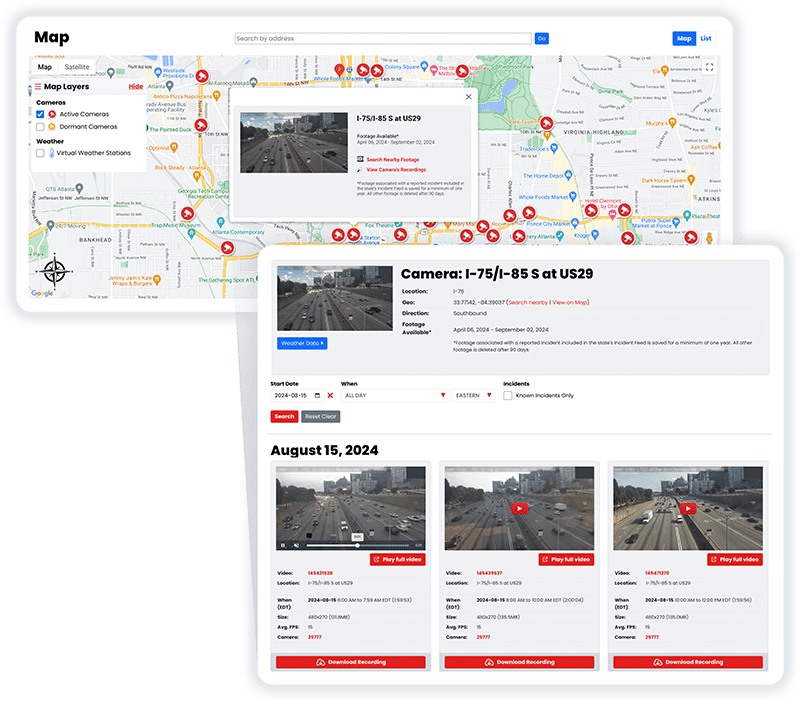
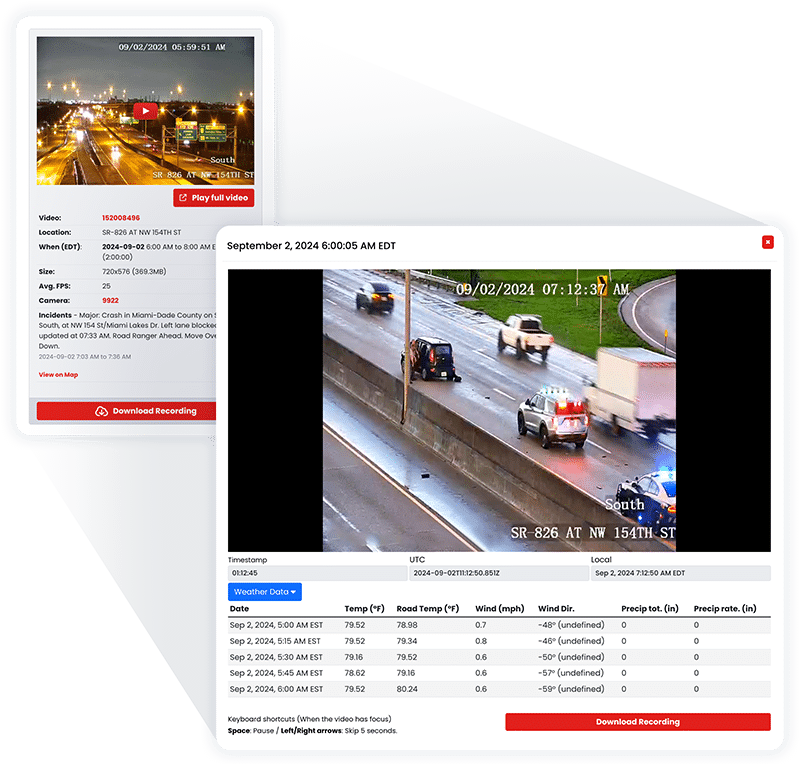
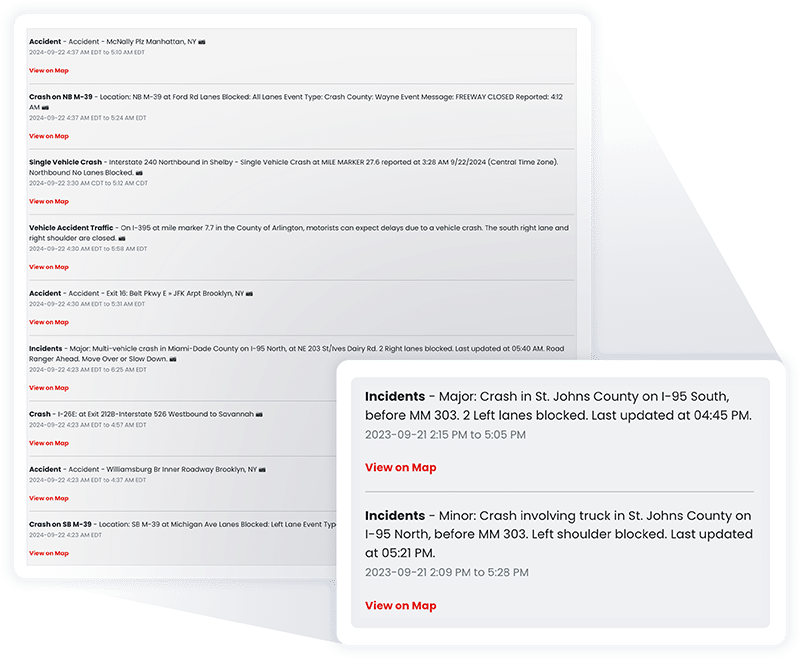
RoadProof offers a truly unique data set combining archived traffic video and a running incident feed available in most states on the system.
All of this data together allows you to get the whole picture, from the initial incident to the final outcome.
“IT WINS THE CASE. We saw the value of RoadProof immediately, you settle your cases 50% faster and for full value.”
Brian Labovick
Labovick Law Group – Florida
With our automated intelligence system, we’re able to match video footage from cameras nearby to any reported incident, and ensure that those vital video recordings are preserved in our archive for a minimum of one year.
While other systems only keep video footage for a couple of months, we keep the video footage that’s critical to your cases for much longer.
“Our case management department (which handles hundreds of cases each month) has nothing but praise for RoadProof.”
Kendra Fike
Bighorn Law – Nevada
Get started now to see how RoadProof can help you get the video data you need.
Get StartedAlready a member of RoadProof? Login here
“One of the first things I do when investigating a crash is obtain and preserve as much evidence as possible. Even before knowing all the parties involved, I immediately pull the RoadProof footage. Seeing the crash firsthand through the video is incredibly powerful. Having this video footage from the start really helps level the playing field between the plaintiff and the trucking company, which often delays or refuses to provide the truck camera video if at all.”
Jamie Mazzeo, Litigation Paralegal
The Truck Accident Law Firm – Florida


Get started now to see how RoadProof can help you get the video data you need.
Get StartedAlready a member of RoadProof? Login here
Have you tried to find an Austin traffic camera archive after being involved in a fender bender on I-35, or almost hit by another car at Riverside and Pleasant Valley? You may have experienced the same problem as many others: cameras abound, yet identifying who controls them, whether they record, and how to obtain recordings of events is nearly impossible. The purpose of this document is to explain exactly what exists; who is watching; and provide realistic options available to you when seeking video footage from Austin roadways subsequent to an event.
In the most literal sense, there is no singular Austin traffic camera archive. Rather, it consists of various systems operated by multiple entities (some public and some private), each with their own guidelines regarding both length and quality of video recording. The vast majority of the cameras installed on the signal poles throughout Austin are live feed only. These cameras assist in real-time monitoring of traffic conditions by traffic engineers; nothing else. Only a small portion of all cameras, those that tie back to private business or other specific types of recording networks, will store video records for later viewing.
The distinction between live view and stored records has more importance than most would believe; particularly within the first few minutes and/or hours after a collision. Live view provides an immediate snapshot of what is currently occurring. Stored records provide documentation of what occurred in the past – which is precisely what you require in order to establish responsibility for the collision; verify your insurance claims; or determine whose vehicle ran the red light.
This guide is intended for anyone attempting to understand the landscape of Austin’s traffic cameras: drivers recently in an accident; attorneys developing cases; insurance company representatives processing claims; and simply concerned citizens interested in determining if the camera on Lamar Street is functioning properly. We will detail here the organizations responsible for operating cameras in Austin; where these cameras exist; whether these cameras record activity; and what your options realistically are for obtaining video recordings of incidents after collisions occur.
Traffic cameras throughout the city of Austin do not run under the direction of a single entity. Austin has a variety of agencies that operate and maintain their individual sets of cameras. These entities include City of Austin departments, state departments, Travis County departments, and privately owned companies operating Traffic cameras as well.
The City of Austin Department of Transportation and Public Works maintains the majority of cameras located within the boundaries of the City of Austin. The cameras are installed at signalized intersections and along arterial roads to assist the engineers who manage Traffic conditions and timing of signals. These cameras have nothing to do with capturing an incident.
The Austin Mobility Management Center is Austin’s central location for managing Traffic operations. Engineers and technicians man the center during peak travel hours and often around the clock when large events occur. They use live feeds from cameras located across the city to identify congestion, incidents, or other problems requiring a response. This is a monitoring station; it does not serve as a video archiving facility.
Texas Department of Transportation (TxDOT) manages its own Traffic camera network on state highways and interstate freeways passing through the Austin metropolitan area. Examples of these locations include segments of Interstate Highway 35, U.S. Highway 183, and Texas State Highway 71. The live feeds from these cameras are transmitted into TxDOT’s statewide Traffic management system and are designed to provide a means for real-time viewing rather than long-term storage.
Travis County oversees certain types of Traffic infrastructure on county-maintained roads that are outside the city limits of Austin. However, there is relatively little Traffic camera coverage outside of the city limits compared to the coverage available inside the city limits.
Lastly, private individuals, such as gas stations, apartment buildings, shopping malls, homeowners utilizing doorbell-type cameras, etc., may also have cameras positioned near Austin roadways. Frequently, when investigating a vehicle accident, private cameras are ultimately the source of locating evidence. Since these systems are independent from any public networks, finding evidence may depend upon access to private sources.
Camera density varies a lot depending on which road you’re looking at. Here’s a breakdown of the major corridors and what kind of coverage each one has.
Austin’s busiest and most congested corridor also has some of the densest camera coverage in the region. TxDOT monitors long stretches of I-35 through downtown and the surrounding metro, largely because it’s ground zero for the city’s worst traffic and a frequent site of crashes, especially through the upper deck and the I-35/US 183 interchange.
MoPac runs the length of the city north to south and carries heavy commuter traffic every morning and evening. TxDOT and city cameras cover key segments, particularly around the express lanes and major interchanges like MoPac and 360 or MoPac and 290.
This highway connects Austin to the airport and southeast suburbs, and it sees camera coverage concentrated near the airport interchange and the intersections with SH 130 and I-35.
A major east-west and north-south route depending on which section you’re on, US 183 has TxDOT camera coverage along its busier stretches, especially where it crosses MoPac and I-35.
Known locally as Capital of Texas Highway, Loop 360 has lighter camera coverage than the interstates, concentrated mostly near its intersections with MoPac and 183.
As a toll road that bypasses much of central Austin, SH 130 has its own camera and monitoring system tied to the toll authority, separate from the standard TxDOT network.
There are many crash locations on surface streets that have relatively little camera coverage. The majority of this camera coverage is through Austin’s City Signal System and not from Highway Systems.
This is the question almost everyone asks eventually, and the honest answer surprises most people: no, not in the way you’d hope.
Live viewing is the norm. Austin’s Transportation & Public Works cameras and TxDOT’s highway cameras exist to give engineers and traffic managers a real-time picture of what’s happening on the road. That’s their entire purpose.
Archived footage is the exception, not the rule. The City of Austin’s own traffic camera dataset states plainly that these cameras are used to monitor live traffic conditions only and that video is not recorded or retained. TxDOT says essentially the same thing about its statewide camera network. If a camera isn’t recording, there’s nothing to pull up after the fact, no matter how badly you need it.
Agency policies leave a narrow exception. Austin’s Arterial Management division has noted that footage from some cameras may be recorded if there’s a specific traffic issue or pattern engineers are actively tracking, but this isn’t standard practice for day-to-day traffic and isn’t something you can count on for a random accident.
Retention, when it exists at all, is short. Even in the rare cases where footage gets captured, storage costs money, and most government systems overwrite old files within days.
The practical limitation: if your accident happened at a spot with only a public traffic-management camera watching, there’s a good chance no recording of it exists anywhere within that system. This is exactly why other sources, like nearby business cameras or specialized recording networks, end up mattering so much.
If you’re dealing with the aftermath of an accident and this uncertainty is adding stress, know that footage isn’t your only path forward, and a licensed attorney can help you sort through what evidence is actually available in your specific case.
Sometimes, but it depends heavily on where the accident happened and what kind of camera was nearby.
Government cameras are the least reliable source, for the reasons covered above. Since most city and TxDOT cameras aren’t recorded, there’s often nothing to request even if you go through the proper channels.
Private cameras are frequently your best shot. Gas stations, retail stores, restaurants, and apartment complexes near busy intersections often run their own security systems that do record and retain footage, sometimes for weeks.
Businesses near an accident scene are worth checking even if it’s not obvious they’d have a relevant angle. A store’s parking lot camera pointed at the street, or a doorbell camera on a nearby home, can capture more than you’d expect.
Nearby security systems in general, whether commercial or residential, tend to have shorter retention windows than you’d like, which is why speed matters here.
Timing matters enormously. Most private systems overwrite footage on a rolling basis, sometimes within a week or two. If you wait a month to start looking, footage that existed on day one may already be gone by the time you ask.
The introduction of video as evidence greatly assists accident investigations.
Proving fault is easier using the video evidence than it would be relying solely upon the verbal testimony of each driver involved; rather than hearing two differing versions of events, video provides an unbiased version of what occurred.
Footage from traffic cameras can provide clear and concise identification of hit-and-run drivers. Video will allow the investigator to identify such things as the license plate number, the make and model of the vehicle, and even the direction the vehicle traveled prior to leaving the scene of the crash.
Video reduces ambiguity associated with accidents by providing insurance companies with evidence to determine liability. As a result, claims are resolved much faster and at a fairer price for those making a claim because liability is no longer being disputed by the parties involved.
Juries consider video evidence to be substantial evidence that weighs heavily against the oral statements provided by witnesses to a crime. In general, juries tend to place greater reliance on visual evidence than on the conflicting oral statements made by two (or more) individuals involved in a particular incident.
In addition to helping investigators identify who caused the crash, video allows for better determination of how fast vehicles were traveling prior to colliding. This enables experts to reconstruct crashes by determining such things as where the vehicles collided, how fast they were going, and the order in which they entered into contact.
Do Austin traffic cameras record? No. According to the City of Austin, all of their traffic cameras are set up for real-time monitoring only; therefore, none of the cameras record video that is added to the general public database.
Are there red light cameras in Austin? No. As a result of a ban passed by the Texas legislature in 2019, no red-light cameras will be found at Austin intersections.
Will police review footage of a traffic camera? Although rarely will footage exist from a public traffic camera (as opposed to private security footage), if footage were to exist, then yes, the police may be able to view and review it.
Can I request to view footage from a traffic camera? The city has a process called “public records requests” which allows you to ask for footage from any number of sources. However, since most of our city’s traffic cameras and those operated by TxDOT are primarily used for live monitoring purposes and do not record, usually there will not be anything to request.
Are highway cameras different than city cameras? Both are different types of cameras, but they operate identically: live viewing without standardized recording.
For how long is footage available when recording does occur? Typically not very long. Usually no more than a few days. Private businesses that have cameras near traffic cameras may keep their own footage for extended periods of time (although even they may not retain footage for an extended period).
Can insurance companies use footage captured by traffic cameras? Yes. Regardless of who captures it, when footage exists and shows how the accident happened, it is generally accepted as strong objective proof of what occurred, resulting in faster resolution of insurance claims.
Are all cameras monitored 24/7? While the Mobility Management Center is manned during peak travel times and many times during large events, they are not manning it every hour of every day.
Can license plates be captured with traffic cameras? Some newer models of traffic cameras can capture images of license plates. These are high-definition systems that are placed directly in front of or above roadways. Most standard traffic monitoring cameras, however, are neither placed nor designed to capture images of license plates clearly.
What roads in Austin have the most cameras installed on them? While most areas of Austin are covered by cameras, the highest concentrations are along I-35, MoPac, and other main arterial roads such as Lamar Blvd., Burnet Rd. And Riverside Dr.
All information above explains how public traffic cameras in Austin, TX. provide little to no evidence when involved in an accident. This is where RoadProof comes into play.
RoadProof provides access to a national database of over 25,000 traffic cameras located throughout the United States and many locations within Texas. The cameras’ video archives are stored for up to 365 days; this is far greater than the limited archival storage times provided by most governmental agencies and departments.
Additionally, users may search for footage based upon a variety of criteria including the exact location, date, and time. Users do not need to guess which agency owns a camera or file multiple requests. Instead, users will receive direct links to reviewable video footage as well as download capabilities via their web browsers.
The primary difference between RoadProof and the various government-sponsored and monitored live public traffic cameras used in Austin, TX, is the fact that government owned/operated cameras are designed primarily for real-time monitoring purposes and do not maintain archives of the recorded events. In contrast, RoadProof has been developed to capture and store those recordings prior to their deletion. Once identified, RoadProof then searches nearby cameras to identify additional footage related to an incident. Additionally, RoadProof stores this data for extended periods of time, allowing it to be utilized during an insurance claim process, court proceeding, or investigative activity.
To ensure RoadProof is being used for its intended purpose (i.e., legitimate accident investigations), access to the platform has been restricted to law enforcement agencies, insurance companies, and licensed attorneys.
For individuals who have been involved in an accident but are not currently working with an attorney, RoadProof will provide them with contact information for a local attorney specializing in accident litigation and/or insurance claims who can assist with identifying potential footage sources and guiding the user through the process with his/her insurance company.
Get started now to see how RoadProof can help you get the video data you need.
Get StartedAlready a member of RoadProof? Login here
We will review your request within 1-2 business days and will contact you by either phone or email, or both. In the meantime, learn more about your team!