Already a member? Log into your account
Get instant access to millions of hours of recorded video & incident data from thousands of traffic cameras in New York City.
Get Started TodayRoadProof is trusted by the best organizations across America.


















Are you part of a law enforcement agency? Get Roadproof now, for FREE. Click here to sign up.
With RoadProof, you can save thousands of dollars and hundreds of hours of time tracking down the video data you need, for whatever your end use case might be – whether it’s an accident case or criminal investigation.
Recorded video data that used to take days or weeks to find, can now be searched for, located and downloaded in a matter of minutes using the platform.
“The platform continues to be vital and a remarkable tool. It’s a great asset to our agency for all of our cases.”
Master Sergeant John A. Boos
Traffic Homicide Investigation, Florida Highway Patrol – Florida
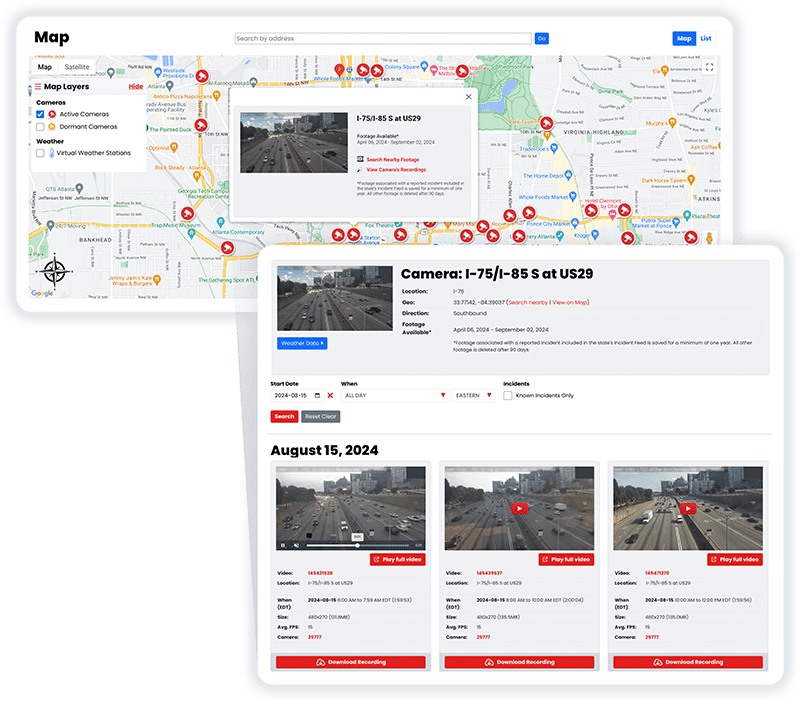
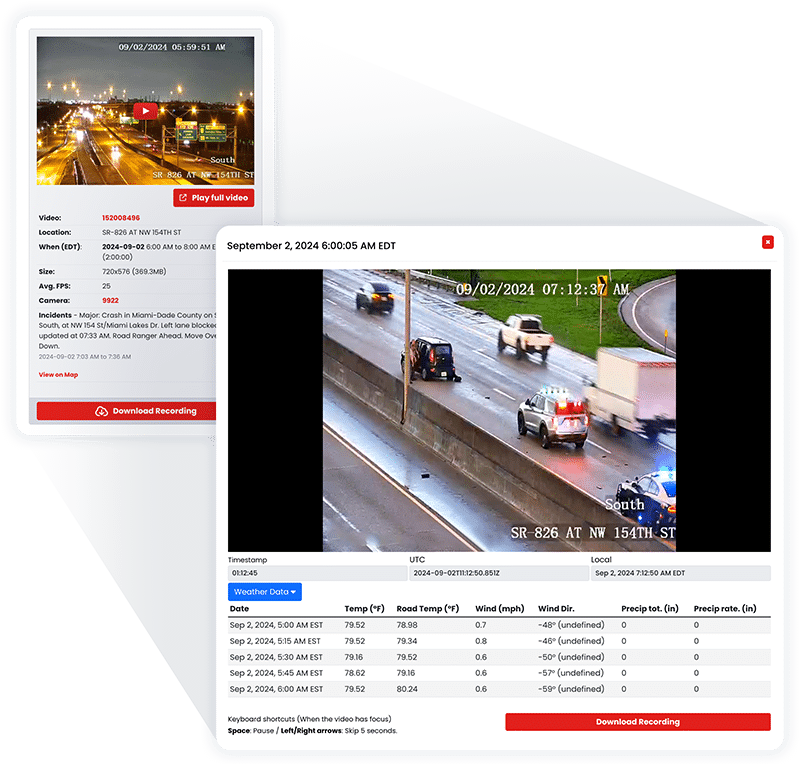
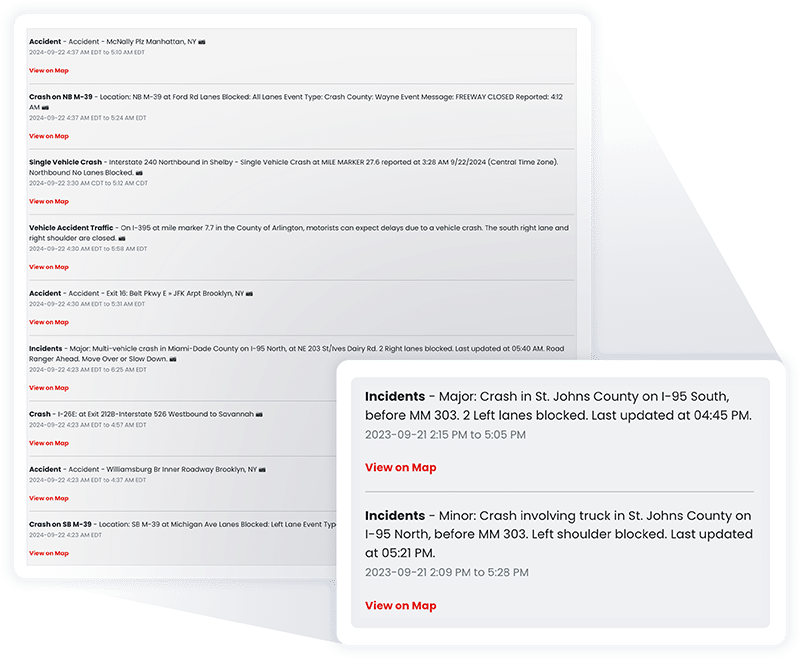
RoadProof offers a truly unique data set combining archived traffic video and a running incident feed available in most states on the system.
All of this data together allows you to get the whole picture, from the initial incident to the final outcome.
“IT WINS THE CASE. We saw the value of RoadProof immediately, you settle your cases 50% faster and for full value.”
Brian Labovick
Labovick Law Group – Florida
With our automated intelligence system, we’re able to match video footage from cameras nearby to any reported incident, and ensure that those vital video recordings are preserved in our archive for a minimum of one year.
While other systems only keep video footage for a couple of months, we keep the video footage that’s critical to your cases for much longer.
“Our case management department (which handles hundreds of cases each month) has nothing but praise for RoadProof.”
Kendra Fike
Bighorn Law – Nevada
Get started now to see how RoadProof can help you get the video data you need.
Get StartedAlready a member of RoadProof? Login here
“One of the first things I do when investigating a crash is obtain and preserve as much evidence as possible. Even before knowing all the parties involved, I immediately pull the RoadProof footage. Seeing the crash firsthand through the video is incredibly powerful. Having this video footage from the start really helps level the playing field between the plaintiff and the trucking company, which often delays or refuses to provide the truck camera video if at all.”
Jamie Mazzeo, Litigation Paralegal
The Truck Accident Law Firm – Florida


An independent NYC Traffic Camera archive allows qualified professionals to identify and retrieve recorded video after a collision or other incident on roadways in New York City. While NYC DOT provides live traffic imagery for public viewing purposes, the Department states it does not record those streams. This is where RoadProof comes into play. In addition to archiving traffic cameras with its support, RoadProof makes available the archived footage of each camera searchable by location, date, and time.
It is very important to note. Simply seeing a traffic camera at or adjacent to an intersection indicates that there may have been a recording made of what occurred at the intersection; however, this means absolutely nothing. It does NOT indicate whether the city will provide you access to that recording.
Additionally, simply having a traffic camera located near the area where your vehicle collided with another vehicle or object does NOT mean that RoadProof had video of the area. And most importantly, even if you see that there is a camera near the incident area, we cannot guarantee that the camera was pointed towards the location of the incident. First and foremost, it is imperative to check the exact location (camera view) and timing (date/time) of the footage within the RoadProof platform.
Yes, old footage taken from previous NYC traffic cameras will likely be available for viewing. However, how much you are able to find will depend on where the camera is located (the borough), when it was used (date and time), and the direction it was pointed.
The NYC Department of Transportation has live video feeds of various street intersections throughout all five of New York’s boroughs. According to the NYC DOT, their traffic cameras offer live views only. They state they do not store or save any video from these cameras. Therefore, if an attorney, insurance company representative, or law enforcement officer were to go back to the NYC DOT website to review the “live” feed of a particular intersection, there would normally be nothing to look at.
Attorneys, Insurance representatives, Law Enforcement Agencies, and other approved parties may use RoadProof to search our database of traffic cameras, which we have organized and saved as well as recorded the supported feeds.
The possibility of finding this type of evidence will still vary depending on the exact circumstances surrounding your individual incident. In many cases, a traffic camera may be positioned close to your accident scene; however, it may be pointed in a different direction than your accident, out of order at the time of your accident, obstructed by a vehicle or building, or possibly changing video feeds every few minutes.
The primary function of cameras used in real-time traffic monitoring is to display current activity to support traffic management decisions. In addition to providing a visual representation of real-time conditions (to support the identification of traffic congestion; the location of incidents; etc.), the use of real-time cameras supports responsive decision-making by traffic managers. Many drivers have access to views of cameras through nycdot.gov or 511ny.com as they plan their routes.
Archives serve a very different function than real-time cameras. Archives maintain archived versions of content from supported feeds and organize the archives so an authorized user may enter a specific date and time to retrieve a copy of what was occurring at that point. The archive capabilities of RoadProof fulfill this need.
Traffic management cameras capture live video feed data that assists traffic managers in responding to changing roadway conditions. These cameras do not record specific events such as violations. For example: Red light cameras capture violation-specific information for red-light enforcement programs; speed cameras capture violation-specific information for speeding enforcement programs; bus lane cameras capture violation-specific information for bus-lane enforcement programs. Therefore, there is no interchangeability between the cameras viewed in real-time on the NYC Traffic Map and those that capture violation-specific information.
According to NYC311, a person receiving a Red-Light Camera “Notice of Liability” will be able to view the relevant evidence associated with the violation through the website listed on the “Notice of Liability”. This does not provide a general public archive of all activity at the subject intersection.
For individuals seeking to investigate a past incident, the most productive question is not simply whether a camera existed at the subject location but rather did a usable image or recording exist, was it saved, and if so, how was it accessed through a suitable source?
In a single platform designed for investigators and their professional work, RoadProof collects all the traffic video archives and information about incidents in the area where the incident occurred.
An investigator who has been approved to use the site will search for the incident and the location/time associated with it on the site instead of searching through each public page for a traffic camera and then finding out if there was a feed from this same camera on the day prior to the date you are investigating.
This is how simple the main steps involved are:
Additionally, RoadProof links any reported incidents with any nearby cameras; therefore, important footage can be saved for longer periods of time. RoadProof stores its overall archive video for up to 1 year, and any video linked to a report will remain stored for at least 1-year. As previously stated, availability remains based upon which camera(s) were used to capture the footage and what type of incident was being captured.
For law firms, insurance teams, reconstruction professionals, and law enforcement agencies that have cases in all Five Boroughs of New York City, the greatest advantage lies within one central database where you can easily locate potential evidence to support a claim before investing hours to contact various government agencies.
You will want to use as much information about the incident as possible to get the best search results.
As an example: Two Intersections are only a block away in NYC, but there are cameras that cover each one. Cameras view vehicles from the front, sides, and backs depending on which direction they are coming from. Searching several minutes around the incident time could give you more than searching just the exact second of the crash.
The camera that looks like it’s closest to the point of your accident isn’t always going to be the best one to look at.
For example, if you were involved in an accident as you turned onto a busy street from a side street, the camera at the main intersection might have been pointing toward another entrance or blocked by something at the time of the accident. Another camera one or two streets down could potentially capture a vehicle turning into the road, changing lanes, or driving away from the scene after the accident. If you are near a bridge or tunnel entrance, or if you are on a multi-lane highway, there may be another camera with a better view of traffic heading into the area.
In cities such as New York, which has many tall buildings, large numbers of buses, delivery vehicles, and construction scaffolding along the sides of roads; in addition to very heavy traffic, other cameras will likely be needed to get a clear view of what was happening before and during the accident. In fact, multiple cameras may need to be reviewed to see how events unfolded over time, even though none of them captured the whole incident.
By using RoadProof’s search feature, users can review all nearby cameras easily, without having to rely solely on the camera that is visually located closest to the reported location.
If you want access to records already held by government entities in NYS, then NY’s Freedom of Information Law (FOIL) allows you to submit a request. However, as with all laws, there are exceptions. In fact, the New York State Committee on Open Government states “the freedom of information law applies only to records maintained by state and local government agencies”. Thus, for requests directed at a NYC Agency, they can typically be made using NYC Open Records; whereas the MTA uses its own system.
It should also be noted that simply because an agency provides an unrecorded feed of a public traffic camera does not obligate the agency to provide a video of previous actions taken at that location. This is why an independent archival service such as RoadProof may be important. Even though RoadProof may not have been able to get a copy of footage directly from the city, they may have had a copy of the footage. Therefore, a RoadProof search, along with a records request, may be two different methods depending upon who owns/operated the camera being searched, and/or if the camera operator maintains records.
Only licensed attorneys, state and local law enforcement agencies, insurance agencies, and authorized personnel (i.e., competent accident reconstruction specialists) are able to directly view the archives of RoadProof. Law enforcement agencies are eligible to receive access to RoadProof at no charge.
Individuals cannot obtain direct access to the archives for general viewing, traffic citations/traffic tickets, or non-injury accidents. If someone is injured in a car crash and they have legal representation, they can request their attorney to review RoadProof to determine if there is footage of the incident. If someone is injured but does not have legal representation, they can send the details of their vehicle accident to RoadProof, which will then attempt to refer them to a licensed personal injury attorney, so that he/she may contact RoadProof to find out if footage exists of the incident.
If your search for RoadProof videos did not produce a useful result, then that does not mean there are no records available.
Look at other sources in the surrounding area such as local businesses’ parking lots, residential buildings, public transportation (buses/taxis), delivery vehicles, and any witness who may have recorded the event using a dashboard cam.
In many cases, you will find a record of both vehicles prior to, during, or immediately following the event, although they may not have captured the actual collision.
Also look at where you placed the map point. It may be at the wrong location. Also try increasing the time frame (i.e., increase the number of hours) of the search. This may provide additional results.
The RoadProof service is just one tool in searching all of these different types of video archives. The main benefit of this product is providing professional investigators with a quick method to verify whether or not a particular archive has been previously searched before going out looking for less structured, but potentially available video evidence.
Get started now to see how RoadProof can help you get the video data you need.
Get StartedAlready a member of RoadProof? Login here
We will review your request within 1-2 business days and will contact you by either phone or email, or both. In the meantime, learn more about your team!