Already a member? Log into your account
Get instant access to millions of hours of recorded video & incident data from thousands of traffic cameras in Buffalo, New York.
Get Started TodayRoadProof is trusted by the best organizations across America.


















Are you part of a law enforcement agency? Get Roadproof now, for FREE. Click here to sign up.
With RoadProof, you can save thousands of dollars and hundreds of hours of time tracking down the video data you need, for whatever your end use case might be – whether it’s an accident case or criminal investigation.
Recorded video data that used to take days or weeks to find, can now be searched for, located and downloaded in a matter of minutes using the platform.
“The platform continues to be vital and a remarkable tool. It’s a great asset to our agency for all of our cases.”
Master Sergeant John A. Boos
Traffic Homicide Investigation, Florida Highway Patrol – Florida
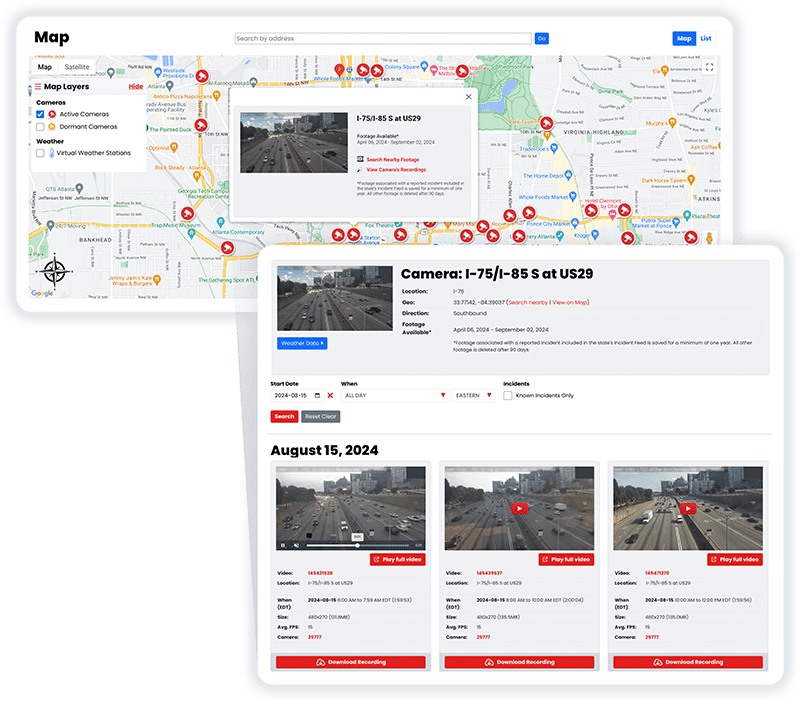
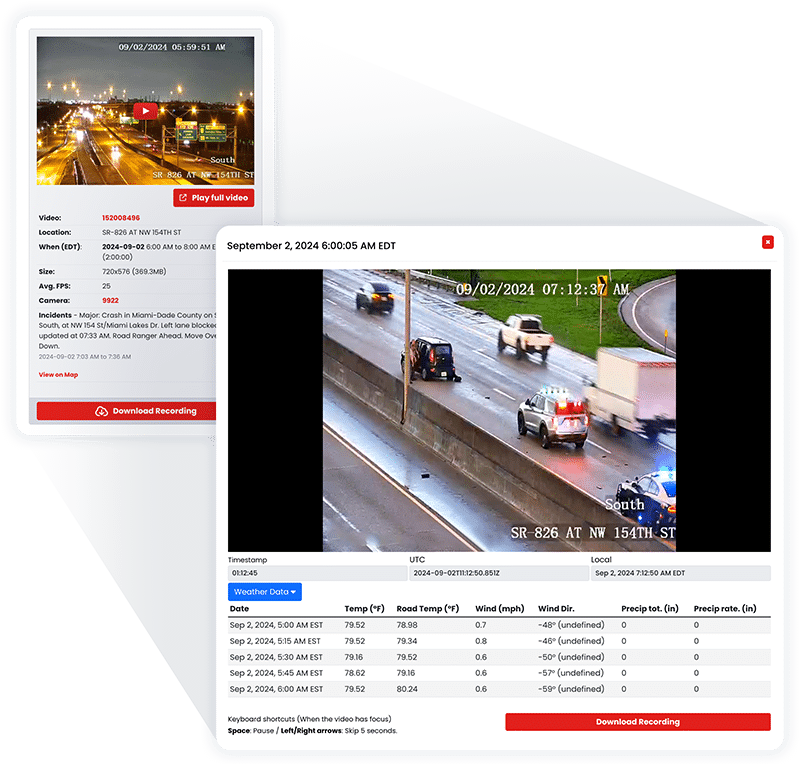
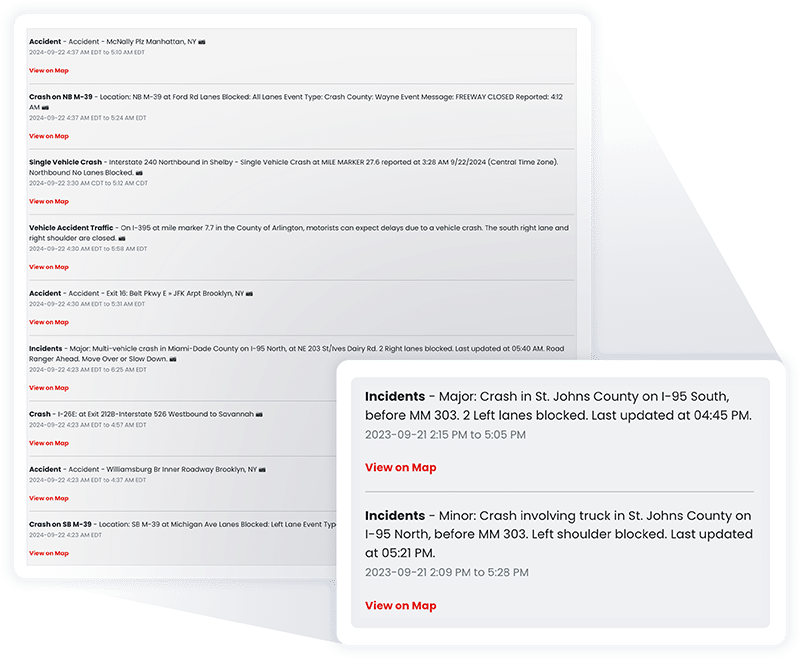
RoadProof offers a truly unique data set combining archived traffic video and a running incident feed available in most states on the system.
All of this data together allows you to get the whole picture, from the initial incident to the final outcome.
“IT WINS THE CASE. We saw the value of RoadProof immediately, you settle your cases 50% faster and for full value.”
Brian Labovick
Labovick Law Group – Florida
With our automated intelligence system, we’re able to match video footage from cameras nearby to any reported incident, and ensure that those vital video recordings are preserved in our archive for a minimum of one year.
While other systems only keep video footage for a couple of months, we keep the video footage that’s critical to your cases for much longer.
“Our case management department (which handles hundreds of cases each month) has nothing but praise for RoadProof.”
Kendra Fike
Bighorn Law – Nevada
Get started now to see how RoadProof can help you get the video data you need.
Get StartedAlready a member of RoadProof? Login here
“One of the first things I do when investigating a crash is obtain and preserve as much evidence as possible. Even before knowing all the parties involved, I immediately pull the RoadProof footage. Seeing the crash firsthand through the video is incredibly powerful. Having this video footage from the start really helps level the playing field between the plaintiff and the trucking company, which often delays or refuses to provide the truck camera video if at all.”
Jamie Mazzeo, Litigation Paralegal
The Truck Accident Law Firm – Florida


If you are trying to find a Buffalo traffic camera archive after an accident or roadside collision, there isn’t a public site that archives all recordings – until now. The city has multiple entities operating cameras, and most public sites will show either live or recent traffic information, along with where the cameras are located.
To locate a recording, first identify who owns/operates the nearest camera. Then figure out if they record, how long they retain video, and how to obtain it. Time is of the essence when searching for video, as most systems automatically delete video after a certain amount of time.
RoadProof is a quicker method for attorneys, law enforcement agencies, insurance agents, and accident reconstructionists to search for archived traffic video. Rather than contact each individual entity separately to ask about video availability, RoadProof allows approved users to look through our library using date/time/location parameters.
Yes, there are archives of old Buffalo traffic footage; however, they are in multiple places. What you need to know is what system(s) were in place when the incident happened and what cameras near the location existed.
Additionally, knowing how each of the camera websites provides information can help too. A map of camera locations will indicate if there is a camera at your location. Live feeds from these cameras will give you some indication of today’s road conditions. Neither will confirm whether or not there is historic video.
Historic video, otherwise known as “archival footage,” is the stored video of a previous date and/or time. This type of video can be viewed as part of an investigation, insurance claim, or court case. Whether this video exists depends upon the camera, the camera’s view, the camera’s recording options, and how long the video is kept by the owner of the camera.
Buffalo has several overlapping camera networks. Identifying the correct operator can save valuable time when footage may be approaching deletion.
The City of Buffalo publishes a BPD camera location dataset that identifies police surveillance cameras throughout the city. The dataset includes camera locations, police districts, installation information, and geographic coordinates.
This is useful for determining whether a BPD camera may have been close to an incident. It is not a public video archive, however, and it does not show whether a particular camera was operating or pointed toward the roadway at the relevant time.
BPD cameras are primarily part of a public safety and law enforcement system. That makes them different from cameras installed mainly to help drivers monitor congestion.
The New York State Thruway Authority operates cameras along I-190 and other major highways around Buffalo. Its I-190 camera page identifies cameras by interchange, nearby street, mile marker, and direction of travel.
These pages are helpful when an incident occurs near locations such as the Route 5 Skyway, Church Street, Niagara Street, the Peace Bridge, Scajaquada Expressway, Sheridan Drive, or the Grand Island bridges. The public images are intended for current travel conditions. They are delayed by about twenty seconds, and new images are generally available every two minutes.
That does not mean older video can be replayed through the public page. Anyone seeking a previous recording must determine whether the Authority retained the relevant footage or whether it was preserved elsewhere.
The Niagara International Transportation Technology Coalition provides current camera views and traffic information for Western New York and Southern Ontario. Its map can help identify cameras near Buffalo roads, border approaches, and surrounding communities.
NITTEC is useful for locating possible cameras and checking current conditions. Its public map should not be mistaken for a complete historical archive.
The Buffalo and Fort Erie Public Bridge Authority displays traffic camera views around the Peace Bridge, inspection areas, and border approaches. These cameras are designed to help travelers understand current crossing conditions.
An incident near the bridge may involve cameras controlled by more than one organization. The exact location and direction of travel will help determine whether the Bridge Authority, Thruway Authority, customs authorities, or another operator should be contacted.
Government cameras are only part of the picture. Businesses, parking facilities, apartment buildings, homes, buses, delivery vehicles, and commercial fleets may also capture an incident.
Private security systems often overwrite recordings on short cycles. If a nearby business may have useful video, contact it promptly and provide the exact date, time, and location. A vague request is much harder to review before footage is erased.
A live Buffalo traffic camera will tell you what is going on right now in terms of traffic. A live feed of a specific time frame of past footage (archive) will tell you what was going on at a certain time in the past at a specific place.
The difference in types of questions being asked is important after a vehicle accident has taken place. Just because there is a camera listed on your current map does not mean the camera has been recording continuously. Many traffic cameras are taking pictures at set times. Other cameras may have panning capabilities, tilting capabilities, and/or zooming capabilities. Therefore, they could take pictures from an entirely different direction than the direction they are showing as of today.
Additionally, a traffic camera could be down for some reason (temporarily), weather conditions may prevent the camera from capturing video properly, or the camera’s positioning could make it difficult to see where the point of impact actually was. Even if footage is available for review, each of those items previously mentioned can affect how useful the footage is to assist with reviewing and investigating the accident.
No specific timeline is established for each type of Buffalo camera system.
According to published Buffalo Police Department policy, surveillance footage may be kept on file until a reasonable amount of time has elapsed for the purpose of observation; however, footage shall typically be removed no later than twenty-eight (28) days unless such footage is being utilized as part of an active criminal investigation. Footage which is not necessary for investigative purposes will likely be automatically erased.
Cameras operated by Thruway, other regional transit entities, bridges, and private businesses, etc., may have varying policies and possibly do not record at all, or they may only save the video for brief periods unless an individual identifies and saves a segment related to their incident.
RoadProof was developed based upon this problem. The RoadProof National Platform has more than 36 Million Hours of Video Data and ties together both existing video archives and incidents. If relevant Buffalo area footage is stored within RoadProof’s System, qualified users can search for such footage using location and date/time without having to request multiple agencies’ assistance.
Thus, the simplest way to minimize your exposure is to start early. Do not wait until you have a developing claim before determining if there is video of your incident.
Start by collecting the information a camera operator or RoadProof search will need:
Next, check the BPD camera dataset and the appropriate highway or regional camera maps. Look beyond the exact point of impact. A nearby camera may have captured a vehicle approaching the scene, leaving the area, or moving through an earlier intersection.
Once you identify a possible operator, request the footage and ask whether additional action is needed to preserve it. Do not assume that submitting a records request automatically stops routine deletion.
RoadProof can reduce this search burden for approved professionals. A user can search around the incident location and review footage associated with the relevant date and time. This is especially useful when several nearby cameras or agencies may be involved.
New York’s Freedom of Information Law allows the public to request existing government records, subject to legal exemptions. A FOIL request can be submitted to the City of Buffalo for potentially responsive BPD records or to the Thruway Authority for records maintained by that agency.
Be as specific as possible. Include the date, a narrow time range, exact location, travel direction, camera identifier if known, and the related incident number. Ask for video covering a reasonable period before and after the event rather than requesting every recording from an entire day.
A FOIL request does not guarantee that footage exists or that it can be released. An agency may no longer possess the video, and some records may be withheld or redacted under an applicable exemption. The Thruway Authority also notes that an agency is not required to create a new record in response to a request.
If time is critical, contact the appropriate records office and ask whether a separate preservation request is recommended. Keep copies of the request, confirmation, and any response you receive.
Useful footage does not always show the collision itself. A camera may still document details that help investigators understand what happened, including:
Video should not be described as automatically proving fault. Its significance depends on what it shows, what it leaves out, and whether its source and timing can be authenticated. In many cases, it works best alongside police reports, physical evidence, witness accounts, vehicle data, and professional reconstruction.
Tracking down traffic footage through individual agencies can take days or weeks. By then, a short retention period may have expired. RoadProof gives qualified professionals a single place to search millions of hours of recorded traffic video by location, date, and time.
The platform is designed for attorneys, law enforcement agencies, insurance companies, and accident reconstruction professionals. Users can search available cameras, review relevant recordings, and download needed footage without working through a separate public records process for every possible source.
RoadProof also combines video with incident and weather information. That added context can help an investigator understand what was happening around the scene and identify cameras that might otherwise be overlooked.
For privacy and security reasons, RoadProof does not provide direct footage access to members of the public seeking video for traffic tickets, non injury disputes, or general curiosity. If you were injured in a crash and do not have an attorney, RoadProof may connect you with a licensed attorney who can investigate whether footage is available. If you already have an attorney, ask the firm to search RoadProof as soon as possible.
State and local law enforcement agencies can receive access at no cost. Other professional users can get started with RoadProof to check coverage and search options.
Not through most public live camera pages. Those pages generally show current or slightly delayed conditions. Footage from yesterday may be available through the camera operator, a public records request, or an archive such as RoadProof, depending on the camera and location.
No. The OpenData Buffalo resource identifies BPD camera locations. It does not allow users to watch or download recordings.
Published BPD policy generally limits retention to twenty-eight days unless images are being used for a criminal investigation. Because footage may be deleted automatically, requests should be made promptly.
The Thruway Authority publicly displays current or delayed camera images, but the public viewer is not a historical archive. Recording and retention may vary. Contact the appropriate operator or check RoadProof for the specific location, date, and time.
You can request existing government records through FOIL. That does not mean every camera records, that footage has been retained, or that every recording must be released.
Can a camera be near an accident but fail to capture it?
Yes. The camera may have been pointed in another direction, blocked, offline, too far away, or configured to capture occasional images instead of continuous video.
The most useful details are the exact date, approximate time, precise location, time zone, and direction of travel. A police report number and scene photos may also help narrow the search.
RoadProof limits direct access to approved professional users, including licensed attorneys, law enforcement agencies, insurance organizations, and accident reconstruction professionals. An injured person may be referred to a licensed attorney who can investigate available footage.
The sooner you start searching, the better the chance that useful footage can be found and preserved. Gather the date, time, exact location, and direction of travel before contacting an agency or searching an archive.
For legal, insurance, reconstruction, and law enforcement professionals, RoadProof provides a faster way to search recorded traffic video without contacting every possible camera operator separately. Get started with RoadProof and check whether footage is available for your Buffalo incident.
Get started now to see how RoadProof can help you get the video data you need.
Get StartedAlready a member of RoadProof? Login here
We will review your request within 1-2 business days and will contact you by either phone or email, or both. In the meantime, learn more about your team!