Already a member? Log into your account
Get instant access to millions of hours of recorded video & incident data from thousands of traffic cameras in Miami, Florida.
Get Started TodayRoadProof is trusted by the best organizations across America.


















Are you part of a law enforcement agency? Get Roadproof now, for FREE. Click here to sign up.
With RoadProof, you can save thousands of dollars and hundreds of hours of time tracking down the video data you need, for whatever your end use case might be – whether it’s an accident case or criminal investigation.
Recorded video data that used to take days or weeks to find, can now be searched for, located and downloaded in a matter of minutes using the platform.
“The platform continues to be vital and a remarkable tool. It’s a great asset to our agency for all of our cases.”
Master Sergeant John A. Boos
Traffic Homicide Investigation, Florida Highway Patrol – Florida
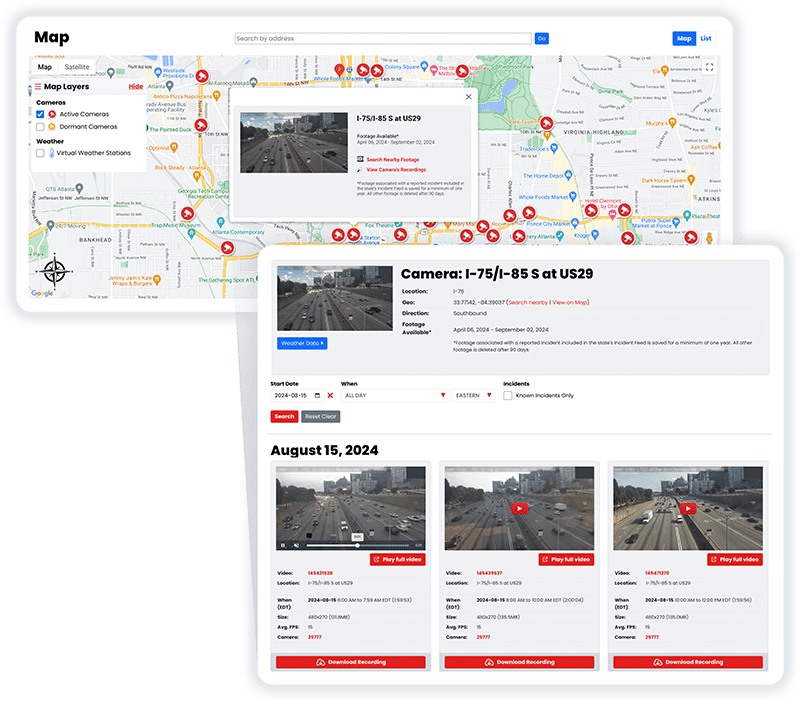
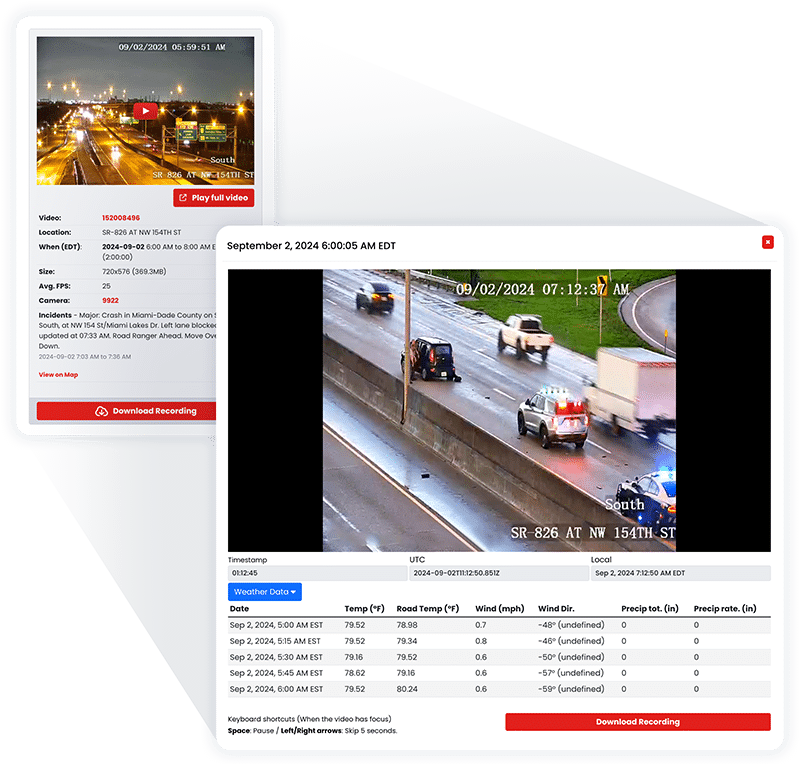
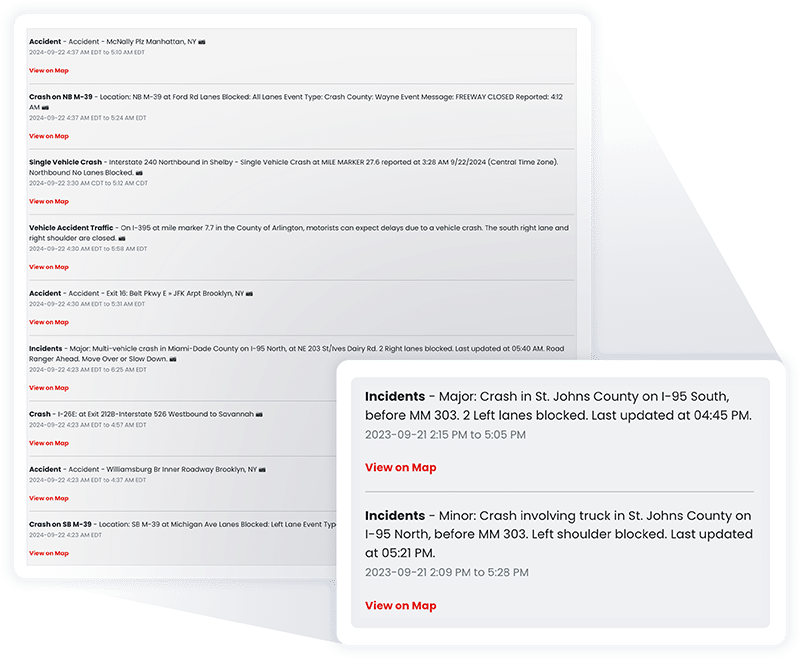
RoadProof offers a truly unique data set combining archived traffic video and a running incident feed available in most states on the system.
All of this data together allows you to get the whole picture, from the initial incident to the final outcome.
“IT WINS THE CASE. We saw the value of RoadProof immediately, you settle your cases 50% faster and for full value.”
Brian Labovick
Labovick Law Group – Florida
With our automated intelligence system, we’re able to match video footage from cameras nearby to any reported incident, and ensure that those vital video recordings are preserved in our archive for a minimum of one year.
While other systems only keep video footage for a couple of months, we keep the video footage that’s critical to your cases for much longer.
“Our case management department (which handles hundreds of cases each month) has nothing but praise for RoadProof.”
Kendra Fike
Bighorn Law – Nevada
Get started now to see how RoadProof can help you get the video data you need.
Get StartedAlready a member of RoadProof? Login here
“One of the first things I do when investigating a crash is obtain and preserve as much evidence as possible. Even before knowing all the parties involved, I immediately pull the RoadProof footage. Seeing the crash firsthand through the video is incredibly powerful. Having this video footage from the start really helps level the playing field between the plaintiff and the trucking company, which often delays or refuses to provide the truck camera video if at all.”
Jamie Mazzeo, Litigation Paralegal
The Truck Accident Law Firm – Florida


Miami is among the most congested cities in this nation. With a population of over 2.7 million residents within Miami-Dade County, and thousands more tourists, temporary residents, and daily commuters entering the county from adjacent jurisdictions each day, driving in Miami can be a nightmare. In 2024, the average motorist in Miami wasted approximately 75 hours per year stuck in traffic – equivalent to nearly two full weeks of work time spent just waiting!
It’s no wonder then that accidents occur regularly on our congested roads. When an accident does occur, one of the first questions asked by everyone involved is simply: “Were there cameras?”
In all likelihood, the answer is yes. However, whether those cameras captured a usable image of the incident and whether such images remain retrievable today is an entirely different matter.
There are numerous entities operating the traffic camera networks throughout Miami. The Florida Department of Transportation (FDOT), via its FL511 system, operates the largest network of highway cameras in the area. Additionally, local governments (i.e., Miami-Dade County) as well as municipal governments individually operate their respective intersection cameras. Red light camera programs at various intersections are managed independently by private companies. Each of these systems was designed to assist with managing traffic flow, not preserving evidence. Therefore, understanding how they function and to what extent they serve as limitations will likely benefit anyone involved in either litigation, law enforcement investigations, or merely commuting to another destination.
FDOT’s District Six is the entity responsible for the operation of highway cameras within Miami-Dade and Monroe counties. The total number of CCTV cameras maintained by FDOT totals over 400 and provides coverage for the major highways and urban areas of the region.
CCTV cameras feed into the FL511 Traveler Information system, which provides travelers with real-time traffic information and traffic congestion conditions in addition to providing access to video feeds from many of Florida’s highways. Have you ever looked up traffic on I-95 prior to departing your workplace? Then you have most likely utilized FL511.
However, it is important to note that FL511 is a traffic management tool. Highway cameras assist with identifying slowdowns, responding to incidents, and coordinating emergency responses. Cameras are not part of a surveillance system and therefore do not capture images for future viewing.
Highway cameras operated by FDOT do not record. Images captured by the highway cameras are streamed in real-time to the SunGuide Transportation Management Center. Once an event occurs on I-95 at 8:15 AM, the camera that captures the event may have had a direct view of it. However, once that event passes, so too do the captured images. There is nothing to subpoena, download or request.
Many attorneys and investigators are surprised when they learn that while a camera existed at the scene of an incident on a highway owned/operated by the state of Florida, there typically is no recording available. It should be noted that this is true in virtually all incidents occurring on Florida state-owned highways.
Important traffic cameras in Miami include:
A second tier of cameras exists on a city/municipality level. Local government agencies maintain cameras primarily at intersections. Signal coordination cameras are used by local government agencies to coordinate the timing of traffic signals, and red-light enforcement cameras are used pursuant to Florida’s Mark Wandall Traffic Safety Act.
Red-light enforcement cameras only capture violations when a vehicle enters an intersection after the light has turned red. This type of camera never operates continuously. Consequently, if an incident occurred during green-light travel time or at an interchange where no red-light camera existed, none of these systems would have captured such an incident.
Retention periods for locally operated cameras vary greatly depending on the municipality. Many retain video footage for several days. Others retain it for up to 30 days or longer. In most cases, however, retention periods are not sufficient for video footage to remain available until someone determines that an accident did occur at that location.
FDOT District Six also maintains a mobile CCTV program consisting of portable pan-tilt-zoom camera units. These units are dispatched to major Events, emergency road repairs, or situations where additional monitoring is required. Like fixed highway cameras, mobile camera units are a useful tool for managing traffic flow – they are not recording for archival purposes.
Miami’s camera network is most dense along its major expressways. Here’s a quick breakdown based on aggregated data from TrafficVision.Live:
| Corridor / Area | Approximate Camera Coverage | Notable Details |
| I-95 (Mainline & Express Lanes) | 100+ cameras | Backbone of the region; Golden Glades and the Dolphin interchange are the biggest bottlenecks during rush hour |
| Palmetto Expressway (SR-826) | 85+ cameras | Circles western and northern Miami; heavy truck traffic near the airport and Medley |
| Dolphin Expressway (SR-836) | 60+ cameras | Connects Miami International Airport with downtown; consistently heavy commuter volume |
| Florida’s Turnpike & Homestead Extension | 60+ cameras | Main toll route linking Miami with the rest of Florida; Homestead Extension handles suburbs like Kendall and Homestead |
| Causeways (MacArthur, Julia Tuttle, Venetian) | Several cameras each | Limited access points to Miami Beach; drawbridge openings create unpredictable backups |
A note on terminology: When individuals refer to “mdot cameras” in a Miami setting, they typically are referring to the Miami-Dade Department of Transportation and Public Works, not the Department of Transportation in the state of Maryland (the two share the same acronym).
The primary function of the local transportation department’s cameras in Miami-Dade is for managing traffic signals and coordinating the movement of buses along designated busways. In addition, they assist in managing traffic flow at important county intersections. As such, they tend to be isolated from the statewide FL511 network and focus on operational management, rather than incident detection.
As with the state cameras, the majority of the local systems are used for real-time viewing. Whether the footage will remain stored for future reference varies depending on the individual system and the applicable retention policy of the relevant agency.
Florida Department of Transportation highway cameras do not record. FDOT does not retain an archive of video footage. If you or someone else involved in an accident occurred on I-95, the Palmetto Expressway, or the Dolphin Expressway, FDOT does not have any video footage related to the incident.
FDOT may be able to provide screenshots from a live feed if someone requests them immediately after an incident occurs; however, this window is very short. Generally, by the time most individuals consider asking for footage from a highway camera after a crash, the opportunity has passed.
One of the largest evidentiary voids faced by victims of accidents, attorneys, and investigators throughout Florida is a lack of video Evidence.
That is where RoadProof comes into play.
Roadproof continually collects and stores video footage from thousands of traffic cameras located throughout the United States, including those in Miami-Dade County. This includes both captured video footage as well as incident reports related to each vehicle stop. Historically, RoadProof retains captured footage for up to one year, which is significantly greater than any public entity retains it.
After a vehicle stops due to a crash, RoadProof’s automated system identifies and preserves surrounding traffic cameras’ footage relative to the incident.
At the point an attorney or investigator seeks the footage, it remains intact.
Traffic safety cameras in Florida are governed by the Mark Wandall Traffic Safety Act. Although red-light cameras are specifically designed to identify vehicles violating certain traffic rules, they are limited in their ability to support the investigation and/or reconstruction of crashes.
In some cases, attorneys may obtain camera footage via a public records request. While Florida has robust public records statutes requiring governmental agencies to respond to public records requests, many governmental entities do not maintain footage for extended periods of time. Once camera footage is removed or replaced, it cannot be retrieved.
Was the crash on a state highway? That’s FDOT. At a city or county intersection? That falls to the local municipality or Miami-Dade County. At a red-light camera location? That may be a private vendor operating under a city contract. Knowing who owns the camera determines who you’re making the request to.
You need the exact date, time, and location of the crash. “Southbound I-95 near exit 12B at approximately 7:45 AM on [date]” is more useful than a general description. The more precise, the better.
FDOT has a public records portal where you can submit requests. Local agencies each have their own process. For FDOT cameras, it’s worth calling the District Six SunGuide center directly as well, since they may be able to confirm whether a camera was operational and positioned to capture the incident location.
Most camera systems overwrite footage within 24 to 72 hours. Some systems hold it for a few weeks. Very few hold it longer than 30 days. The day after the crash is not too soon to start this process.
RoadProof’s platform is available exclusively to licensed attorneys and law enforcement agencies. If you were in a crash and need footage, the right move is to contact a qualified personal injury attorney who can access RoadProof on your behalf. If you don’t have an attorney yet, RoadProof can connect you with one in your area who handles these cases. Reach out through roadproof.com.
There is a big difference between knowing that a crash occurred and understanding what contributed to it. Live feeds allow us to see what is currently happening. Archived video allows us to see what previously occurred.
For attorneys seeking compensation for their clients due to injuries sustained in car wrecks, this enables them to enter a meeting with more than just video clips. It provides them with opportunities to demonstrate prevailing conditions at ground zero at the time of impact. Comprehensive Evidence such as this tends to alter negotiations with insurance claims representatives and defense counsel rapidly.
For law enforcement officials investigating car wrecks, RoadProof provides them with options enabling them to recreate an accident scene without having been physically present when it occurred. Investigators have stated that accessing RoadProof is now one of their first actions when investigating serious motor vehicle collisions.
Brian Labovick, an attorney utilizing RoadProof, states: “It wins the case. Cases are resolved 50% quicker for full value.” This is no coincidence. Compelling evidence accelerates resolution.
Roadproof – the platform for attorneys and law enforcement agencies needing archived traffic camera footage and documentation relative to incidents, is free for state and local law enforcement agencies; law firms and other organizations can schedule a demonstration at www.roadproof.com. Contact welcome@roadproof.com for sales inquiries.
For additional resources concerning Florida traffic laws and crash statistics, visit www.FLHSMV.gov, which contains public crash reports and statistical data maintained by the Florida Department of Highway Safety & Motor Vehicles (FLHSMV).
Get started now to see how RoadProof can help you get the video data you need.
Get StartedAlready a member of RoadProof? Login here
We will review your request within 1-2 business days and will contact you by either phone or email, or both. In the meantime, learn more about your team!