Already a member? Log into your account
Get instant access to millions of hours of recorded video & incident data from thousands of traffic cameras in Tampa, Florida.
Get Started TodayRoadProof is trusted by the best organizations across America.














Are you part of a law enforcement agency? Get Roadproof now, for FREE. Click here to sign up.
With RoadProof, you can save thousands of dollars and hundreds of hours of time tracking down the video data you need, for whatever your end use case might be – whether it’s an accident case or criminal investigation.
Recorded video data that used to take days or weeks to find, can now be searched for, located and downloaded in a matter of minutes using the platform.
“The platform continues to be vital and a remarkable tool. It’s a great asset to our agency for all of our cases.”
Master Sergeant John A. Boos
Traffic Homicide Investigation, Florida Highway Patrol – Florida
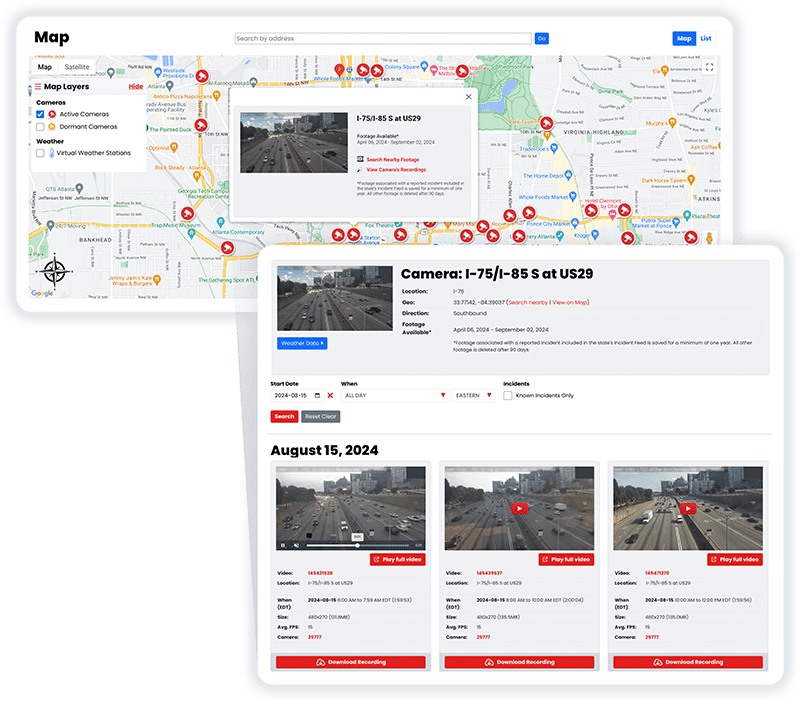
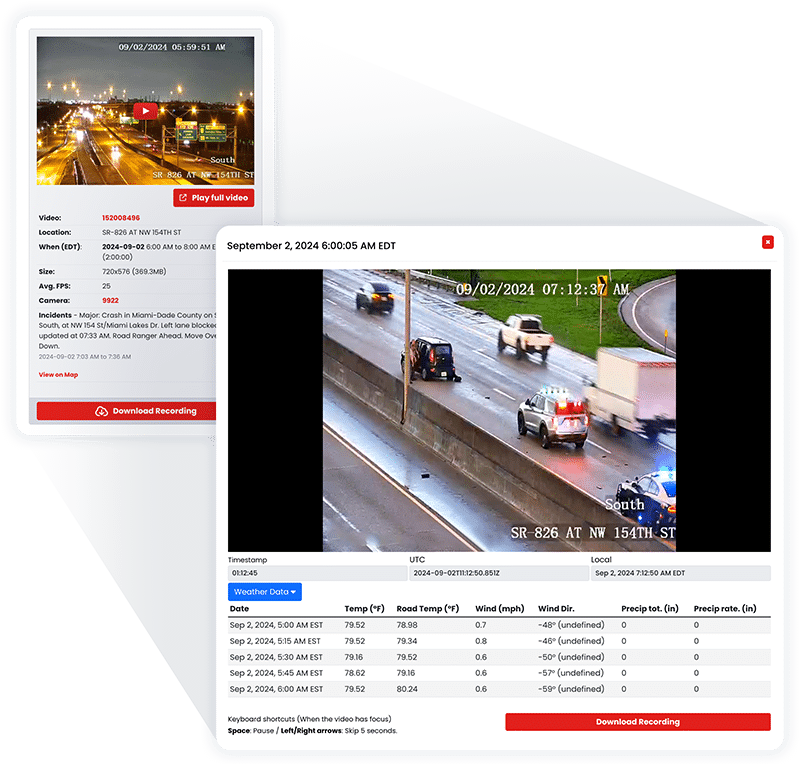
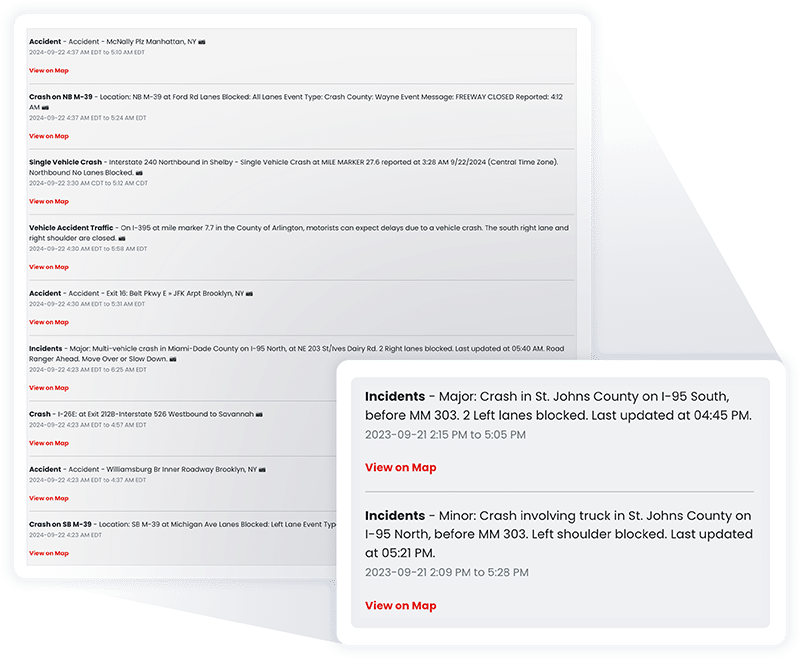
RoadProof offers a truly unique data set combining archived traffic video and a running incident feed available in most states on the system.
All of this data together allows you to get the whole picture, from the initial incident to the final outcome.
“IT WINS THE CASE. We saw the value of RoadProof immediately, you settle your cases 50% faster and for full value.”
Brian Labovick
Labovick Law Group – Florida
With our automated intelligence system, we’re able to match video footage from cameras nearby to any reported incident, and ensure that those vital video recordings are preserved in our archive for a minimum of one year.
While other systems only keep video footage for a couple of months, we keep the video footage that’s critical to your cases for much longer.
“Our case management department (which handles hundreds of cases each month) has nothing but praise for RoadProof.”
Kendra Fike
Bighorn Law – Nevada
Get started now to see how RoadProof can help you get the video data you need.
Get StartedAlready a member of RoadProof? Login here
“One of the first things I do when investigating a crash is obtain and preserve as much evidence as possible. Even before knowing all the parties involved, I immediately pull the RoadProof footage. Seeing the crash firsthand through the video is incredibly powerful. Having this video footage from the start really helps level the playing field between the plaintiff and the trucking company, which often delays or refuses to provide the truck camera video if at all.”
Jamie Mazzeo, Litigation Paralegal
The Truck Accident Law Firm – Florida


If you were injured in a Tampa car or truck crash and believe a camera saw it, act now. A Tampa traffic camera archive may contain useful video even though the live feed you saw online cannot be replayed. A licensed attorney can check RoadProof for available footage, identify other likely video sources, and send preservation requests before recordings disappear. RoadProof does not provide legal representation or release footage directly to individuals. It connects injured people with licensed attorneys who can evaluate the claim and search for available video.
Video can clarify how a collision happened, but it does not replace the rest of an injury investigation. Medical records, witness statements, vehicle data, and proof of financial loss may also be necessary.
Traffic in Tampa is monitored by multiple, unrelated camera systems. Each system has its own unique operator, purpose, and whether it saves recordings. Just because you see one near the point of impact doesn’t necessarily mean there is a saved recording from it, or that the lens was even pointed at your collision.
Florida’s Department of Transportation (FDOT) monitors traffic and shares real-time traffic conditions using cameras provided through FL511. As stated on their official FL511 camera page, “video and images displayed on this site are not captured, recorded, or stored.”
The City of Tampa provides links to pages for accessing City Records; Police Video; Traffic Crash Reports; and making requests for Crash Reports and Body Cam Video on their Tampa Police Department Public Records Page. However, if your collision occurred outside of the City Limits of Tampa, then the relevant records would likely fall under the jurisdiction of Hillsborough County or some other Local Agency.
Red Light Cameras were specifically designed to collect evidence of red-light infractions, which can trigger them only based on specific criteria. The City of Tampa lists all intersections where Safety Cameras are located. Listed intersections include those along Fowler Ave., NE Blvd., Hillsborough Ave., Kennedy Blvd., Dale Mabry Hwy., and Gandy Blvd. The presence of a Safety Camera at an intersection does not confirm that a full-length crash video exists.
There are many potential private video recording devices that may capture evidence of the crash, including private security cameras in residential areas, business premises, bus video equipment, ride-share vehicle cameras (e.g., Uber/Lyft), delivery fleet cameras, etc. Additionally, commercial trucks often contain either inward-facing cameras (i.e., what the driver sees) or outward-facing cameras. The use of these types of recordings can be particularly useful if there is no video footage available from an FL511 traffic monitoring system and/or the video stream was simply a real-time view at the time of the incident.
A preservation request for additional video, as noted above, requires the requested party to preserve video evidence of the incident. However, this is NOT a requirement to provide the video upon request. It is possible you will need to issue formal discovery requests and/or obtain a court-issued subpoena before receiving copies of such videos once litigation has commenced.
Video recordings will provide images of how vehicles were positioned at the time of the accident (including the lanes they were traveling in), if traffic control devices such as signals were activated and what color, when pedestrians were present, where the parties crossed each other’s paths, and the order in which all vehicles impacted one another. In addition, even though a single camera might have been pointed away from contact, it is likely to have captured a vehicle entering into contact just prior to or after the point of contact; it should also contain the immediate post-accident scene.
Insurance companies compare the drivers’ statements about the events surrounding the crash, the physical damage to both vehicles, the police report and/or investigation, along with witness testimony. The video provides an independent, time-stamped, visual representation of what happened. This may clarify issues regarding whether a driver entered onto a red light, failed to yield, crossed a center or edge line of travel, followed another vehicle too closely, or was reacting to a disabled vehicle.
This is important under Florida’s “modified” comparative fault statute. According to Section 768.81 of the Florida Statutes, general damages for personal injuries will be reduced based upon your percentage of fault. If you are determined to be more than fifty-one percent (51%) at fault for causing your injury, you will be barred from receiving any compensation in a negligence action arising out of said injury. Sometimes, just a few seconds of video footage will make a material difference in determining fault percentages.
In truck accidents, there may be evidence held by the truck driver, the motor carrier, the cargo company, the maintenance provider(s), or the shipper. Your lawyer may also want to obtain dash cam videos, electronic log entries, event data recorder information, dispatch records, and maintenance records.
Likewise, while video footage shows what happened, it does not necessarily explain why a vehicle could not stop in time. Similarly, although video footage may show the loading of cargo, it may not reveal why the cargo was loaded improperly. Likewise, if a vehicle had a known mechanical failure, this may not be evident from review of the video alone. However, your lawyer may use a combination of physical evidence and documentation from those companies listed above in conjunction with review of the video footage.
The clip you have obtained must be verified. According to Florida Statute Section 90.901, sufficient evidence must exist to prove that the document in your possession represents the document presented by its author (proponent).
Store both the original file and all of the associated information, including the file source, date/time created/requested, request history, and store an exact copy of the document without cropping, annotating, or converting multiple times. Create a duplicate file to review and leave the original in its state when it was received.
A car accident victim can file a lawsuit as a driver, passenger, pedestrian, bicyclist, or a surviving family member if they were harmed as a result of someone else’s actions. A claimant will need to prove that another party was negligent (careless), that there was sufficient liability insurance coverage for their injuries, and that their injuries were directly related to the automobile accident. There are several elements that will need to be established; simply having video footage of the accident does not establish all of the necessary elements.
The majority of vehicle owners purchase Personal Injury Protection (PIP) coverage with their Florida vehicle insurance policy. The PIP coverage provided under Florida law (FL Stat § 627.736) will provide medical and disability benefits up to $10,000.00. However, this benefit is subject to the limitations and requirements listed in the statute. In general terms, PIP coverage pays 80% of your medical bills incurred due to the automobile accident and 60% of lost wages, while the maximum amount you may receive for medical reimbursement if the injured person did not have an emergency medical condition at the time of treatment is $2500.00.
If it is determined that a party was negligent in causing a Tampa area car accident, a claimant may be entitled to recover monetary damages that include unreimbursed medical expenses and anticipated future medical needs, lost income and reduced earning capacity, property damage, and other forms of tangible harm which occurred as a direct result of the automobile accident. Additionally, non-economic losses such as pain, suffering, mental anguish, and inconvenience are eligible for recovery under Florida law (FL Stat § 627.737). To qualify for these damages, the injured person must experience one of the following: a permanent loss of use of an organ system or member; a permanent injury within any reasonable degree of medical probability; significant and permanent scarring or disfigurement; or death.
Recovery also depends upon whether the liable party has adequate insurance coverage, who the liable parties are, and the existence of proof demonstrating that each loss resulted from the automobile accident.
It is impossible to determine a single date by which all video footage from a Florida surveillance camera will still be accessible. Each of the systems have their own objective and methods of disposal. The real-world practical deadline could be measured in terms of hours or days; however, there are many cases where the statutory time limit of the applicable law is far greater than the measurement of the time it takes to establish the applicable liability.
In addition to providing a limited time frame for medical treatment for Personal Injury Protection (PIP) benefits, Florida provides a similar limitation with regard to medical treatment for PIP benefits. Generally, initial treatment and service for injuries sustained in a motor vehicle accident must occur within fourteen (14) days of the accident pursuant to Section 627.736. It is important to note that this does not mean that all claims based upon injury will terminate after fourteen (14) days. However, if the injured party fails to receive timely medical treatment, he/she may lose eligibility for these benefits.
The majority of personal injury and Wrongful Death claims must be commenced within two (2) years of the incident according to Section 95.11 of the Florida Statutes. In cases where the plaintiff intends to bring a claim against a governmental agency, there may be additional requirements prior to commencing litigation, including written notice and/or filing requirements, as set forth in Section 768.28 of the Florida Statutes. Therefore, do not wait until you reach your statute of limitations deadline before conducting your evidentiary search.
Most frequently, there are disputes over whether evidence of a record even exists. Additionally, insurers have also disputed who had control of the device in which the video evidence was recorded, whether the time stamp on the recording was correct, what lanes were being filmed by the camera lens of the recording, if the entire length of the clip was filmed, and whether the recording has been edited.
Even though an insurance company may agree that the video evidence presented is legitimate, they still could argue with respect to its interpretation. The perspective from one viewpoint could eliminate information such as distance traveled at a certain rate of speed, whether a traffic signal was activated at the appropriate time, or if there was something obstructing the view. Lawyers will often use multiple views and combine this with testimony and vehicle-related data to make their arguments.
The RoadProof archive is available for use by licensed attorneys, law enforcement agencies, or selected professionals. Authorized users of the RoadProof Platform have access to archived traffic video in conjunction with incident data. Users can search within a given area relative to the reported incident location. RoadProof indicates that it preserves all video related to an incident (i.e., “matched”) for at least one year; this could be an alternative method to obtain past video from the same location if the original public video did not record the incident.
A legal representative using the RoadProof Archive has options including searching, investigating additional cameras, sending preservation requests to third parties, requesting public records, formally requesting production of documents, as well as identifying potential defendant(s) and gathering documentation regarding injuries/damages sustained in order to counteract comparative negligence claims.
No. A police crash report is documentation of the investigative findings and will not, on its own, obligate each camera owner to keep their recordings. It is up to you to get the report and separately to save the video.
We do not send recorded video directly to an individual. If you were hurt, you may be able to enter your accident information into the website and consent to being referred to one attorney (in your jurisdiction) who can call you to see what video might be available for your case.
The time frame in which the accident occurred, the general direction the vehicles were traveling, where the vehicles stopped after impact, closest cross-street or off-ramp, description of all involved vehicles, how long after the accident the police arrived at the scene, as well as when possible, any phone location or messaging timestamp that would assist in establishing the approximate time of the incident.
Generally no. Videos alone usually will not support compensation owed for injury claims. Usually, medical records, bills, income documents, expert opinions if necessary, and/or testimony from witnesses are required to determine the extent and amount of money owed due to injuries sustained.
If you were injured and believe traffic footage could help, start a Tampa traffic camera archive search as soon as possible. Submit your accident details to RoadProof to request a referral to a licensed attorney in your area who can discuss the claim and check for available video. RoadProof is not a law firm, does not provide legal advice, and does not promise that footage or compensation will be available.
This page provides general information and is not legal advice.
Get started now to see how RoadProof can help you get the video data you need.
Get StartedAlready a member of RoadProof? Login here
We will review your request within 1-2 business days and will contact you by either phone or email, or both. In the meantime, learn more about your team!