Already a member? Log into your account
Get instant access to millions of hours of recorded video & weather data from thousands of traffic cameras in Tennessee.
Get Started TodayRoadProof is trusted by the best organizations across America.


















Are you part of a law enforcement agency? Get Roadproof now, for FREE. Click here to sign up.
With RoadProof, you can save thousands of dollars and hundreds of hours of time tracking down the video data you need, for whatever your end use case might be – whether it’s an accident case or criminal investigation.
Recorded video data that used to take days or weeks to find, can now be searched for, located and downloaded in a matter of minutes using the platform.
“The platform continues to be vital and a remarkable tool. It’s a great asset to our agency for all of our cases.”
Master Sergeant John A. Boos
Traffic Homicide Investigation, Florida Highway Patrol – Florida
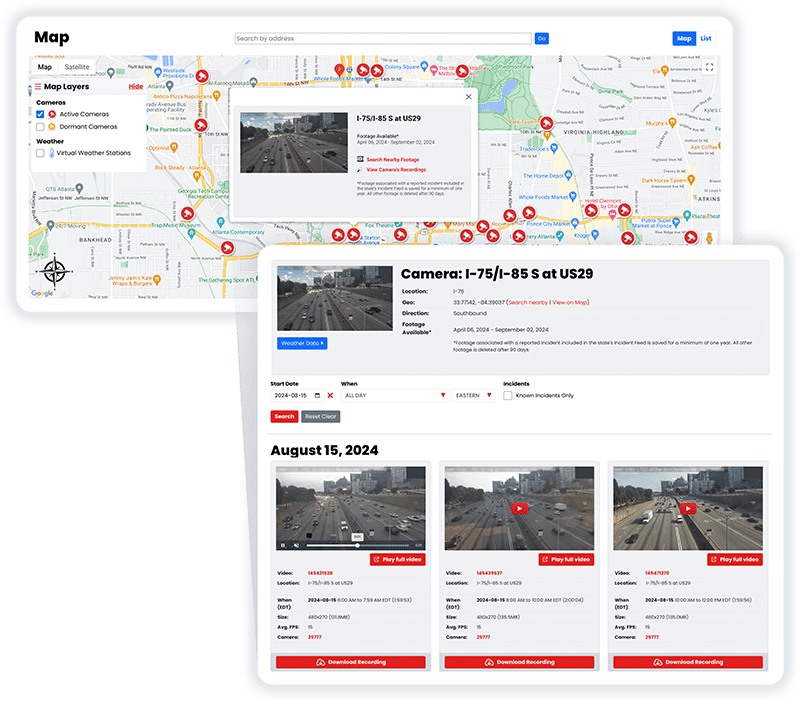
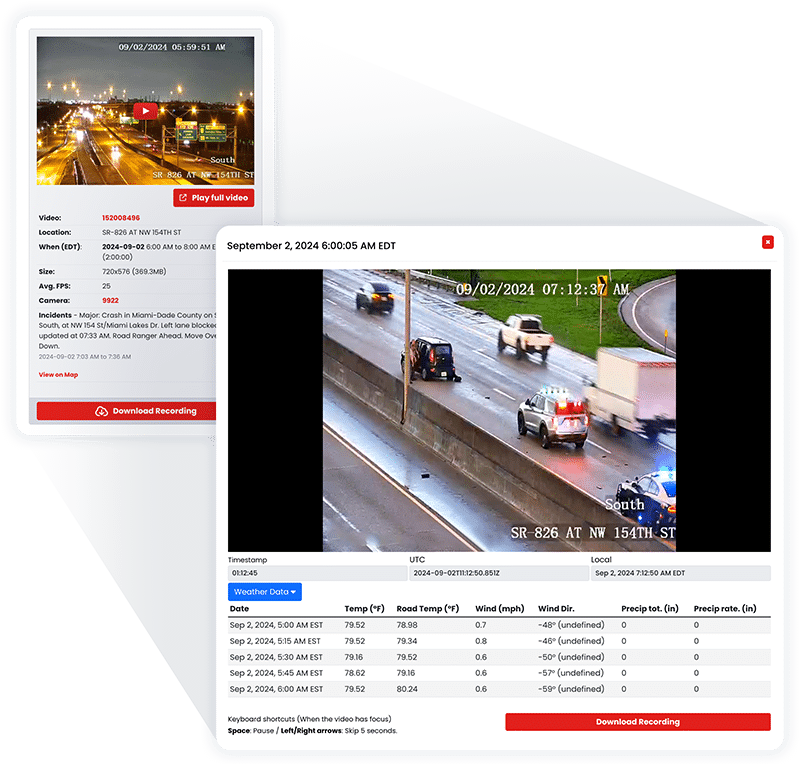
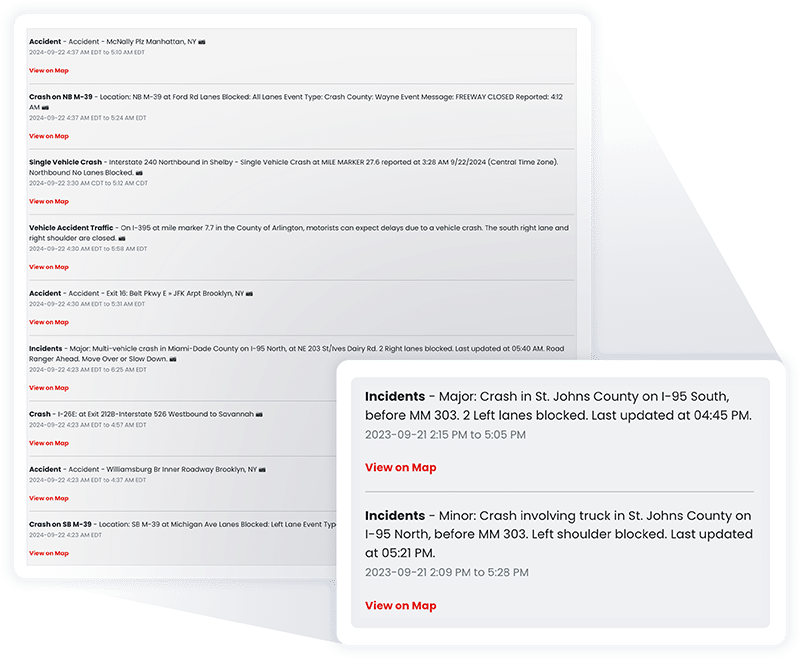
RoadProof offers a truly unique data set combining archived traffic video, real time and archived weather data, and a running incident feed available in most states on the system.
All of this data together allows you to get the whole picture, from the initial incident to the final outcome.
“IT WINS THE CASE. We saw the value of RoadProof immediately, you settle your cases 50% faster and for full value.”
Brian Labovick
Labovick Law Group – Florida
With our automated intelligence system, we’re able to match video footage from cameras nearby to any reported incident, and ensure that those vital video recordings are preserved in our archive for a minimum of one year.
While other systems only keep video footage for a couple of months, we keep the video footage that’s critical to your cases for much longer.
“Our case management department (which handles hundreds of cases each month) has nothing but praise for RoadProof.”
Kendra Fike
Bighorn Law – Nevada
Get started now to see how RoadProof can help you get the video data you need.
Get StartedAlready a member of RoadProof? Login here
“One of the first things I do when investigating a crash is obtain and preserve as much evidence as possible. Even before knowing all the parties involved, I immediately pull the RoadProof footage. Seeing the crash firsthand through the video is incredibly powerful. Having this video footage from the start really helps level the playing field between the plaintiff and the trucking company, which often delays or refuses to provide the truck camera video if at all.”
Jamie Mazzeo, Litigation Paralegal
The Truck Accident Law Firm – Florida



Get started now to see how RoadProof can help you get the video data you need.
Get StartedAlready a member of RoadProof? Login here
Tennessee road cameras record thousands of accidents daily on I-40, I-75, and major highways.
When an accident happens on Tennessee’s busy highways, every second of recorded footage matters. Tennessee road cameras monitor thousands of miles of interstate and state routes, capturing accidents, near-misses, and traffic incidents that could make or break your insurance claim or legal case. The challenge is knowing which cameras recorded your incident and how to get that footage before it’s automatically deleted.
Tennessee operates an extensive network of traffic cameras across the state, particularly along major corridors like I-40, I-75, and I-24. These cameras serve multiple purposes: traffic management, incident response, and public safety monitoring. Most drivers pass dozens of these cameras every day without realizing the footage exists or understanding how to access it when they need it most.
Yes, Tennessee has one of the more developed traffic camera systems in the Southeast. The Tennessee Department of Transportation (TDOT) operates hundreds of cameras across the state, with the highest concentration around major cities and along interstate highways.
Tennessee’s camera network includes several types of surveillance systems. TDOT traffic cameras provide real-time traffic monitoring on interstates and major state routes. These cameras help manage traffic flow and alert authorities to accidents or congestion. Many of these cameras record continuously, though storage policies vary by location and system.
The Tennessee Highway Patrol also uses cameras for law enforcement purposes, particularly on high-traffic corridors where accidents frequently occur. Cities like Nashville, Memphis, Knoxville, and Chattanooga maintain their own camera systems at busy intersections. Some of these record continuously while others only capture still images or are activated by specific triggers like red-light violations.
Most Tennessee road cameras operate 24/7, recording everything from rush-hour traffic to late-night accidents. However, what many people don’t realize is that this footage doesn’t stay available forever. Most systems automatically overwrite old recordings within days or weeks. If you need footage from a camera that recorded your accident, time is of the essence.
Interstate 40 runs east to west across Tennessee for 455 miles, making it one of the state’s busiest highways. From the North Carolina border through Knoxville, Nashville, and west to Memphis, I-40 sees heavy commercial traffic, tourist vehicles, and daily commuters.
TDOT has installed traffic cameras at regular intervals along I-40, with the highest concentration in urban areas. In Nashville, cameras are positioned every few miles, monitoring traffic conditions through downtown and surrounding suburbs. The Knoxville corridor has similar coverage, particularly around major interchanges.
West of Nashville, cameras become less frequent but still cover major interchanges and areas known for accidents or congestion. The Memphis segment of I-40 has robust camera coverage through the city and approaching the Mississippi River bridge.
These I-40 cameras capture a variety of incidents. Multi-vehicle accidents during rush hour. Weather-related crashes when fog rolls in. Commercial truck accidents shut down lanes for hours. If your accident happened on I-40 near a populated area, there’s a strong likelihood that a camera recorded it.
However, cameras on I-40 through rural stretches of Tennessee are spaced farther apart. The mountainous sections between Knoxville and the North Carolina border have fewer cameras due to terrain and lower traffic volumes. Similarly, rural sections west of Jackson have less coverage than urban corridors.
Interstate 75 enters Tennessee from Kentucky near Jellico and runs south through Knoxville and Chattanooga before entering Georgia. This 161-mile stretch carries enormous traffic volumes, particularly around Knoxville, where I-75 and I-40 merge.
The Tennessee section of I-75 has extensive camera coverage, especially through Knoxville’s urban core. The junction where I-75 and I-40 meet is one of the most heavily monitored stretches of highway in the state, with cameras positioned to capture multiple angles of this complex interchange.
South of Knoxville, I-75 continues to have good camera coverage through Cleveland and approaching Chattanooga. The Chattanooga metro area has particularly strong coverage as I-75, I-24, and US-27 converge.
Like I-40, the more rural sections of I-75 have cameras positioned at strategic locations rather than continuous coverage. Major exits, known accident sites, and areas prone to congestion receive priority for camera placement.
If your accident occurred on I-75 near Knoxville or Chattanooga, the chances of camera footage are high. Even some rural sections have cameras at key locations where accidents frequently occur.
Tennessee Road Cameras Map
Finding the specific camera that recorded your accident requires knowing where cameras are located across Tennessee. Several resources can help identify camera positions along your route.
The Tennessee Department of Transportation maintains a SmartWay traffic monitoring system that includes live camera feeds. While the public-facing website shows real-time traffic views, not all cameras on their system are displayed publicly. Some cameras used for incident management and investigation purposes don’t appear on public maps.
The Tennessee Highway Patrol and local law enforcement agencies also access cameras not shown on public mapping systems. These cameras might be positioned at intersections known for accidents or along routes where enforcement activities are frequent.
Professional services like RoadProof maintain databases of camera locations that go beyond what’s available on public websites. When investigating an accident, having access to complete camera location data saves days or weeks of calling different agencies trying to find out who owns which camera.
Camera locations change over time as new cameras are installed and old systems are upgraded. A map from two years ago might be missing dozens of newer cameras that could have recorded recent accidents. Staying current with camera network changes is part of what makes footage retrieval complex.
How to Get Traffic Camera Footage in Tennessee
Getting traffic camera footage in Tennessee involves navigating multiple agencies, each with different procedures and requirements. The process is often more complicated than drivers expect.
If a state highway or interstate camera recorded your accident, you’ll need to request footage from the Tennessee Department of Transportation. TDOT handles requests through their public records process, which requires specific information about the date, time, and location of your incident.
For accidents at city intersections, you’ll contact the local traffic management department. Nashville, Memphis, Knoxville, and Chattanooga each have their own systems and procedures. Smaller cities might contract traffic management to the county or state, adding another layer of complexity to your request.
The Tennessee Highway Patrol has access to some camera systems used for law enforcement. Depending on your accident’s location and circumstances, you might need to seek footage through THP rather than TDOT or local authorities.
RoadProof saves all recordings from traffic cameras for a minimum of 90 days. After 90 days, RoadProof will save footage from all cameras within one mile of an incident, from the date of the incident, if it is reported to the state database… for an entire year.
Processing times vary widely. Some agencies respond to footage requests within a few days. Others take weeks or even months, especially if they’re backlogged with requests. You might pay fees for processing and copying, which can range from nothing to several hundred dollars depending on the agency and the amount of footage you need.
The bureaucratic maze of requesting traffic camera footage leads many accident victims to give up. They call one agency, get transferred to another, are told to fill out forms, wait weeks for a response, and then discover the footage they need was deleted before their request was processed.
This is where professional footage retrieval becomes valuable. RoadProof works directly with law enforcement, attorneys, and accident reconstruction experts to secure camera footage quickly. Instead of navigating multiple agencies yourself, professionals with established relationships and access to archived footage can locate and download the video you need within days instead of weeks.
What Tennessee Road Cameras Record
Not every Tennessee road camera records footage that’s useful for accident investigation. Understanding what different cameras capture helps set realistic expectations about available evidence.
TDOT traffic management cameras primarily monitor traffic flow and detect incidents. Most of these cameras record continuously, capturing everything that happens in their field of view. Video quality varies by camera age and model. Newer cameras provide high-definition footage that can show license plates and vehicle details. Older cameras might only provide grainy images that show basic vehicle movements.
Red-light cameras at intersections only activate when a vehicle enters an intersection after the light turns red. These cameras won’t record accidents that happen during green lights or accidents that don’t involve red-light violations.
Some Tennessee cameras take snapshots every few seconds rather than recording continuous video. These time-lapse cameras help monitor traffic patterns but might miss the exact moment of impact during an accident. However, they can still show the positions of vehicles before and after a collision.
The angle and position of each camera determine what it can see. A camera mounted high on a pole overlooking an interchange might capture a wide view of traffic but miss detailed ground-level action. A camera focused on a specific lane might record that lane clearly but miss adjacent lanes.
Weather affects camera quality. Heavy rain, fog, or snow can reduce visibility even on high-quality cameras. Night accidents might have limited visibility depending on lighting conditions and camera capabilities. These factors don’t make footage useless, but they might limit what can be seen clearly.
Once you obtain camera footage from your Tennessee accident, that video becomes powerful evidence for insurance claims and legal cases. Clear video footage removes ambiguity about who caused an accident and what actually happened.
Insurance adjusters in Tennessee often rely on driver statements when investigating accidents. If both drivers have different stories about who ran a red light or who failed to yield, the adjuster might assign partial fault to both parties. This reduces your settlement significantly.
Traffic camera footage eliminates the debate. If the video clearly shows that the other driver ran a red light, the insurance company can’t argue about fault. If the footage shows you had a green light and the right of way, your version of events is proven accurate.
Attorneys use Tennessee traffic camera footage to strengthen personal injury cases. When a case goes to court, video evidence is often the most persuasive tool available. Juries trust what they can see with their own eyes more than they trust conflicting witness statements.
Accident reconstruction experts analyze traffic camera footage to calculate speeds, reaction times, and points of impact. This technical analysis, backed by actual video evidence, makes expert testimony more credible and harder to dispute.
The earlier you secure traffic camera footage, the more options you have. If you wait until weeks after your accident to start looking for footage, you might find that the recordings have been automatically deleted. Starting the footage request process immediately, even while you’re still recovering from injuries, protects your ability to prove what really happened.
RoadProof partners with Tennessee law enforcement and maintains access to traffic camera footage across the state. Instead of calling multiple agencies and waiting weeks for responses, attorneys, accident reconstruction experts, and law enforcement professionals use RoadProof’s platform to search for, locate, and download footage within minutes.
The platform combines archived traffic video with weather data and incident reports, giving investigators the complete picture of what happened during an accident. If your accident occurred during a rainstorm or fog, weather data shows the conditions drivers faced. If multiple accidents happened in the same area around the same time, incident reports provide context.
RoadProof’s automated intelligence system matches video footage from cameras nearby to reported incidents across Tennessee. When an accident is reported on I-40, I-75, or any monitored highway, the system preserves relevant camera footage for a minimum of one year. This extended retention period means footage remains available long after most government systems would have deleted it.
For Tennessee residents involved in accidents, getting camera footage through RoadProof means working with an attorney who has platform access. If you’re not already working with an attorney, RoadProof can connect you with legal professionals in Tennessee who can help you access any available footage and handle your insurance claim or lawsuit.
The difference between searching for footage yourself and having professional access is measured in both time and success rates. Self-requests often take weeks and frequently result in “footage not available” responses because recordings were already deleted. Professional requests through established systems like RoadProof typically locate and secure footage within days, dramatically improving the chances of getting the evidence you need.
If you’ve been in an accident on a Tennessee highway or intersection, every day matters when it comes to securing camera footage. Most Tennessee road cameras automatically overwrite old recordings on regular schedules. A camera that recorded your accident today might delete that footage in two weeks.
Different agencies in Tennessee have different retention policies. Some keep footage for 30 days, giving you a month to request it. Others delete recordings after just 2 days. A few systems overwrite footage even faster, keeping only the most recent week of recordings.
The complexity of Tennessee’s camera network means you might not know which agency controls the camera that recorded your accident. By the time you figure out whether to contact TDOT, the Tennessee Highway Patrol, the city traffic department, or the county sheriff’s office, the footage you need might already be gone.
This time pressure makes immediate action important. Right after an accident, while you’re still dealing with injuries and vehicle damage, footage preservation should be on your priority list. Contact an attorney who can immediately request footage preservation, or work with professionals who have systems in place to secure recordings before automatic deletion occurs.
RoadProof’s automated systems address this time-sensitive problem by continuously archiving footage from thousands of cameras across Tennessee. Even if the original government system has deleted a recording, RoadProof’s archived copy remains available. This extended retention turns a time-limited window of opportunity into a stable, long-term evidence source.
Traffic camera coverage across Tennessee varies significantly by region, with urban areas having much denser networks than rural communities.
The Nashville metro area has the state’s most extensive camera network. Interstate highways, major state routes, and busy city intersections are heavily monitored. If your accident happened anywhere in Davidson County or the surrounding counties on major roads, camera coverage is likely.
Memphis has strong coverage along I-40, I-55, and I-240, as well as major city streets. The Knoxville area monitors I-40, I-75, and I-640 extensively, with additional cameras throughout the city. Chattanooga covers I-24, I-75, and downtown areas with traffic cameras.
Mid-sized cities like Clarksville, Murfreesboro, and Jackson have more limited camera networks, typically focused on major intersections and highway access points. Small towns across Tennessee generally don’t operate their own traffic camera systems, relying instead on state highway cameras on routes passing through their communities.
Rural highways across Tennessee have strategic camera placement rather than continuous coverage. Cameras are positioned at known accident locations, major intersections, and areas where traffic management is challenging. If your accident occurred in a rural area, camera coverage is less certain but not impossible.
Geographic features affect camera placement, too. Mountain regions in East Tennessee have cameras at key points along challenging routes, but terrain makes continuous coverage impractical. The relatively flat terrain in
Middle and West Tennessee allows for more consistent camera spacing along major highways.
For most Tennessee accident victims, accessing traffic camera footage means working with an attorney who has the resources and relationships to secure recordings quickly.
Attorneys experienced in Tennessee accident cases know which agencies control different cameras, what procedures each agency requires, and how to submit effective footage requests. They understand Tennessee’s public records laws and know how to navigate bureaucratic obstacles that often stop individual requests.
Legal professionals also know that footage requests alone aren’t always enough. Sometimes, agencies need subpoenas or court orders to release footage, especially if multiple parties are requesting the same recordings. Attorneys can obtain these legal documents when necessary, ensuring that footage reaches their clients even when agencies are reluctant to release it.
The relationship between legal professionals and services like RoadProof creates efficient pathways to evidence. Instead of starting from scratch with each footage request, attorneys with platform access can search for cameras, locate footage, and download recordings in minutes. This efficiency means footage can be secured and preserved before retention periods expire.
Your attorney will use Tennessee traffic camera footage throughout your case. During initial case evaluation, the footage helps determine liability and assess the strength of your claim. During settlement negotiations, the video provides leverage to secure fair compensation. If your case goes to trial, the footage becomes the centerpiece of evidence that juries find compelling and credible.
Tennessee continues expanding and upgrading its traffic camera network. As technology improves and becomes more affordable, more cameras are being installed across the state, particularly in areas that previously had limited coverage.
Smart city initiatives in Nashville, Memphis, and other Tennessee cities are driving camera network expansion. These initiatives use technology for traffic management, public safety, and urban planning, which means more cameras recording more hours of footage across the state.
Camera quality is improving dramatically. High-definition cameras that can clearly capture license plates and vehicle details are replacing older, lower-resolution systems. Night vision capabilities are getting better, meaning nighttime accidents are recorded more clearly than before.
Despite these improvements, the fundamental challenge remains: knowing which camera recorded your accident and securing that footage before it’s deleted. Professional services that continuously monitor and archive footage from thousands of cameras will become increasingly valuable as camera networks expand.
When an accident happens on a Tennessee highway or at a busy intersection, your actions in the immediate aftermath affect your ability to secure evidence and build a strong insurance claim or legal case.
Your immediate priority is safety. If you’re able to move, get to a safe location away from traffic. Turn on hazard lights. Call 911 to report the accident and request medical assistance if anyone is injured. Do not skip calling the police even if the accident seems minor. The police report becomes an important document for footage requests and insurance claims.
While waiting for the police, look around for cameras. Tennessee road cameras are typically mounted on tall poles at intersections or along highway corridors. Look for camera housings at traffic signals, on light poles, or on dedicated camera poles. Take photos of these cameras with your phone, capturing enough detail to show their location and direction.
Document the accident scene thoroughly with your phone. Photograph all vehicle damage from multiple angles.
Capture skid marks, vehicle positions, traffic signals, street signs, and any other details that might be relevant. These photos help investigators identify which cameras would have the best view of your accident.
Exchange information with the other driver, but don’t admit fault or make detailed statements about what happened. Emotions run high after accidents, and statements made at the scene can be used against you later.
Stick to exchanging insurance information and contact details.
If there were witnesses, get their contact information. Witness statements can corroborate your version of events and might help locate additional evidence sources like dashcam footage from other vehicles.
Contact an attorney as soon as possible after the accident, preferably within days. The attorney can immediately begin the process of requesting traffic camera footage, preserving evidence before retention periods expire.
Waiting weeks to seek legal help might mean losing access to video that could prove your case.
The challenge with Tennessee road cameras isn’t that the footage doesn’t exist. It’s that accessing footage requires navigating complex bureaucracies, meeting tight deadlines, and knowing which agencies control which cameras. For most accident victims, this process is overwhelming and often unsuccessful.
RoadProof solves this problem by providing direct access to archived footage for legal professionals, law enforcement, and accident reconstruction experts across Tennessee. What used to take weeks of phone calls and paperwork now takes minutes of searching and downloading.
The platform preserves footage from Tennessee cameras for a minimum of one year, far longer than most government systems retain recordings. This extended preservation means that even if your case takes months to develop, the video evidence remains available.
RoadProof combines video footage with weather data and incident reports, creating a complete record of conditions during your accident. This comprehensive data set helps build stronger cases by showing not just what happened, but the environmental factors that contributed to the accident.
For Tennessee accident victims, the path to camera footage runs through legal professionals who have RoadProof access. If you’ve been in an accident and need traffic camera footage, contact an attorney who can access the platform and secure the evidence you need. If you’re not working with an attorney yet, RoadProof can connect you with experienced legal professionals in Tennessee who handle accident cases.
Traffic camera footage can make the difference between an insurance company denying your claim and accepting full liability. It can mean the difference between partial fault and complete vindication. In a state where Tennessee road cameras record thousands of accidents every day, making sure your accident is documented and preserved is too important to leave to chance.
Get started now to see how RoadProof can help you get the video data you need.
Get StartedAlready a member of RoadProof? Login here
We will review your request within 1-2 business days and will contact you by either phone or email, or both. In the meantime, learn more about your team!