Already a member? Log into your account
Get instant access to millions of hours of recorded video & incident data from thousands of traffic cameras in Las Vegas, Nevada.
Get Started TodayRoadProof is trusted by the best organizations across America.

















Are you part of a law enforcement agency? Get Roadproof now, for FREE. Click here to sign up.
With RoadProof, you can save thousands of dollars and hundreds of hours of time tracking down the video data you need, for whatever your end use case might be – whether it’s an accident case or criminal investigation.
Recorded video data that used to take days or weeks to find, can now be searched for, located and downloaded in a matter of minutes using the platform.
“The platform continues to be vital and a remarkable tool. It’s a great asset to our agency for all of our cases.”
Master Sergeant John A. Boos
Traffic Homicide Investigation, Florida Highway Patrol – Florida
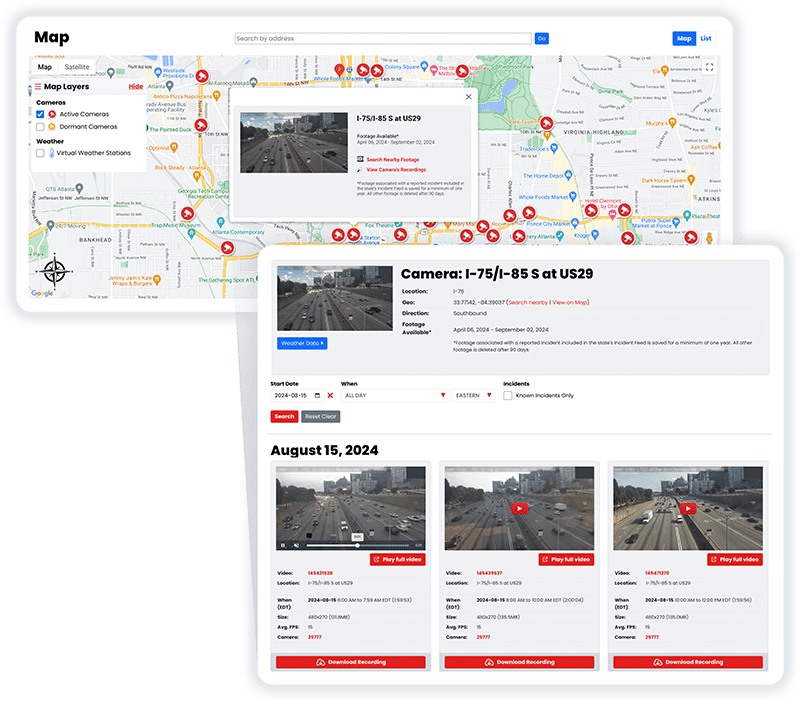
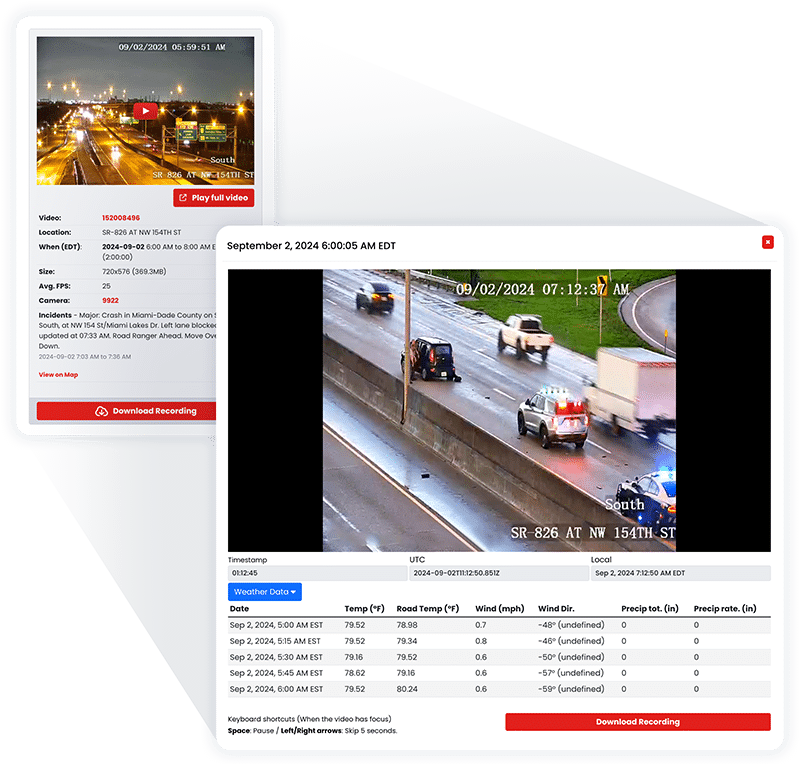
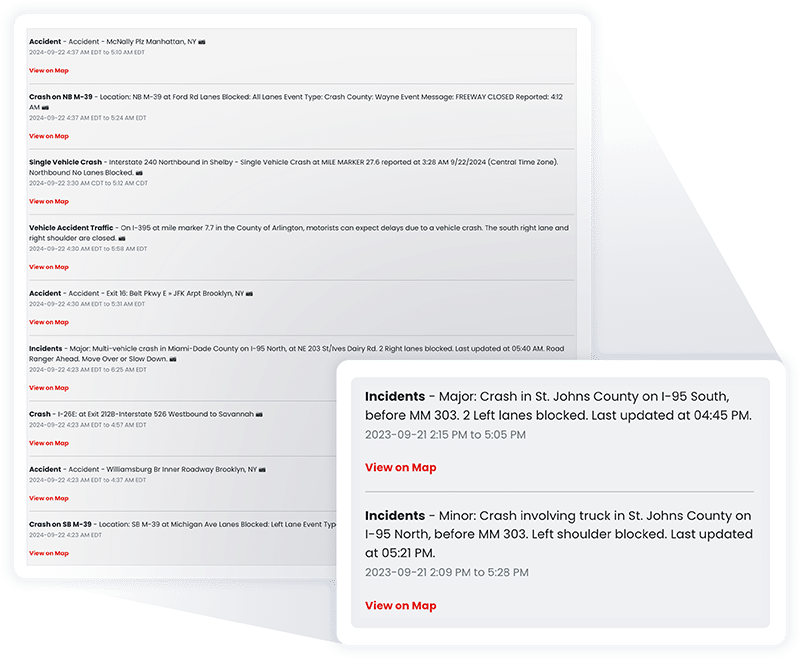
RoadProof offers a truly unique data set combining archived traffic video and a running incident feed available in most states on the system.
All of this data together allows you to get the whole picture, from the initial incident to the final outcome.
“IT WINS THE CASE. We saw the value of RoadProof immediately, you settle your cases 50% faster and for full value.”
Brian Labovick
Labovick Law Group – Florida
With our automated intelligence system, we’re able to match video footage from cameras nearby to any reported incident, and ensure that those vital video recordings are preserved in our archive for a minimum of one year.
While other systems only keep video footage for a couple of months, we keep the video footage that’s critical to your cases for much longer.
“Our case management department (which handles hundreds of cases each month) has nothing but praise for RoadProof.”
Kendra Fike
Bighorn Law – Nevada
Get started now to see how RoadProof can help you get the video data you need.
Get StartedAlready a member of RoadProof? Login here
“One of the first things I do when investigating a crash is obtain and preserve as much evidence as possible. Even before knowing all the parties involved, I immediately pull the RoadProof footage. Seeing the crash firsthand through the video is incredibly powerful. Having this video footage from the start really helps level the playing field between the plaintiff and the trucking company, which often delays or refuses to provide the truck camera video if at all.”
Jamie Mazzeo, Litigation Paralegal
The Truck Accident Law Firm – Florida


Although the Las Vegas traffic camera archive may include video of your car or truck during the accident, it depends on many factors, including the camera’s location, the date of the accident, and the angle at which it captured the scene. If you were hurt in a vehicle collision, RoadProof can help you find a qualified personal injury attorney to review the availability of any relevant footage and review your claim.
Injury attorneys that work through the RoadProof traffic video platform are able to access video footage, but they cannot give you legal advice or represent you. So, while you may see a camera near where your collision occurred, seeing the camera does not mean anyone recorded anything from it, nor does it guarantee that you saw everything that happened.
RoadProof is a provider of video footage for attorneys representing their clients as well as for law enforcement agencies and insurance companies. Only those involved in investigating injury traffic collisions will be assisted by RoadProof’s individual inquiry process. Therefore, property damage claims and traffic citation inquiries will not be addressed.
If you have an attorney currently representing you, ask them about possible videos. If you don’t have an attorney yet, complete our injury inquiry form. This allows us to get enough basic information about your accident so that we may forward you to a qualified local attorney.
An archive search is done to identify if any video recordings exist from the cameras at the time of the incident. An injury investigation identifies which parties were responsible for causing the accident, what type(s) of injuries were suffered by the person who was injured and how much they can receive compensation. In essence, an attorney will explain to you how this evidence relates to your case prior to taking any action on your behalf.
The Nevada Department of Transportation (NDOT) offers live images of traffic cameras so motorists can see what is happening on highways in real-time. NDOT clearly states that their traffic cameras are primarily for viewing in real-time as opposed to recording. Therefore, simply being able to view an image via the public feed does not confirm that NDOT has captured a video of the accident prior to when you viewed the feed.
In addition to NDOT, the Regional Transportation Commission of Southern Nevada also confirms that they do not capture video footage from their Traffic Image Detection Cameras located throughout Southern Nevada. Therefore, while these cameras could be useful for supporting the operation of traffic signals, etc., there will typically not be a video file produced that could be obtained by an accident victim.
There is always a possibility that a separate archive exists to maintain footage from available feeds. For example, RoadProof markets archived Nevada traffic videos. However, the mere existence of a camera on a public map does not confirm that RoadProof actually captured the desired footage at the time you need it.
You should have your lawyer verify the actual time frame of coverage; the direction and position of the camera; and the field of view available. A functioning camera today does not mean that the camera was operational or had the same orientation as it did at the time of your accident.
To begin a successful search, give the search location and time as accurately as possible. “Near the strip” provides too much margin of error.
A good starting point for a search should be at the location of the collision, then describe how both vehicles were traveling (direction) and what you know about when this happened.
When doing a search on Interstate 15 or the 215 beltway, try to make sure which part of the highway is being searched (main roadway), whether it was an entry ramp, exit ramp, or one of the many connecting roads. When searching near Las Vegas Blvd., attempt to find out what cross streets or driveways are associated with the area. These roads are discussed within RoadProofs’ Nevada coverage section; however, there will likely need to be some verification done to confirm the recording(s).
Provide the following information to your attorney:
If you have determined the time based upon a cell call, picture, or ride share receipt, please specify where this determination came from. Providing a short time frame surrounding an incorrect time may cause you to miss video evidence. Explain why you believe the time you provided is uncertain rather than providing an inaccurate exact time.
You can use the Nevada 511 Camera Map to locate cameras near the collision site. This website is helpful as a reference guide for your search, and although it lists all cameras currently operating in Nevada, it does not list past recorded images.
Liability for accidents typically involves proving that one party’s actions resulted in harm to another. In Nevada, claims for damages caused by another party’s actions (whether intentional or negligent) are recognized under NRS 41.130. This could result in a visual record helping to connect the issue of whether a particular driving action was related to a collision, especially where there is a dispute regarding which party was at fault.
One type of video that could potentially provide some value would be footage showing vehicles moving into lanes already occupied by other vehicles; footage showing a tractor-trailer turning into the path of an approaching vehicle; and/or sequential videos showing collisions involving multiple vehicles. The same principle applies with regard to movement prior to impact. Videos taken prior to impact could provide insight as to why a motorist suddenly stopped or turned away from his/her course.
It is essential to understand limitations of the video evidence. For example, a video shot from afar may clearly show the intersection but fail to show the traffic signals facing the motorists. In addition, the physical location of the camera (e.g., a truck blocking the view) and/or the duration of the clip (i.e., the portion of time omitted may have shown how the emergency began) may all affect its usefulness.
Instruct your attorney to review the entire video alongside all available photographic evidence, witnesses’ testimony, and any damaged vehicles, so that your attorney can advise you based upon your total exposure. Do not assume that the most sensational piece of film provides sufficient evidence to answer questions relating to who was at fault.
Comparative Negligence (NRS 41.141) permits recovery unless your own negligence exceeds that of the defendant(s). Your proportionate amount of negligence will reduce the award. For example, if a plaintiff has $100,000 in provable damages and is found to have been 20% responsible for the negligence resulting in her/his injuries, she/he would receive no more than $80,000 before other reductions were made. While a video can assist in evaluating the conduct supporting allegations of shared fault, it does not necessarily resolve issues of percentage responsibility.
While video can help describe how a collision occurred, you still need medical records, pay stubs, and other forms of evidence to document what your injury has cost you.
Possible damages to be recovered may consist of:
Federal Court Ruling on Nevada Jury Instruction No. 5.1 describes categories of damages and evidentiary requirements.
Continue maintaining medical records, billing statements, work restriction orders, and documentation of lost wages. Document specific ways that daily activities have changed due to your injury (e.g., difficulty completing domestic chores) rather than simply stating “I’m hurt.”
Act Before Recordings Disappear and Legal Deadlines Pass
There are two timing issues: obtaining whatever footage remains available and meeting the deadline for legal action. Treat both as priorities from the beginning.
There is no single retention period covering every archive, business camera, and vehicle recording. If a recording exists, ask about obtaining and preserving the file with its identifying information. Keep any video you already possess, including the original download or dash camera file, and tell your attorney where it came from.
There are two time constraints to consider: getting all remaining video evidence and taking legal action before statutes of limitation expire. Consider both time constraints as high-priority issues from the beginning.
There is no single statute of limitations applicable to all archives, business cameras, and vehicle recordings. If there is any existing video recording, find out how to obtain and preserve the file along with identification data.
Save any video you currently own that includes the original download or dash cam files and inform your attorney of the source.
In general, a plaintiff has two (2) years to bring a claim for damages in a tort case (personal injury case) in Nevada under NRS 11.190(4)(e). The typical time measurement will be when the injury occurred in an ordinary car accident case. There may be exceptions and special circumstances to this time frame. Therefore, have your attorney calculate the appropriate date for purposes of determining the statute of limitations.
A submission of a query regarding footage does not constitute commencement of a lawsuit. According to the Nevada Rules of Civil Procedure, a civil action commences upon filing a complaint with the court.
Do not consider your pending request for footage as protection against missing the deadline to file your civil lawsuit.
The services of a lawyer can be particularly valuable where the issue of who was at fault in an auto collision is disputed; you are unable to perform your job because of an injury resulting from the crash; and there were other vehicles (and/or companies) involved in the incident. In addition to documenting a traffic camera’s view of the accident scene with regard to how the automobiles collided, in a truck accident case, a lawyer may determine if other types of evidence (such as vehicle recorder tapes, corporate documents, etc.) should be obtained.
For example, a lawyer may contact a recording entity and advise them to preserve their recording(s), which does not require the recording entity to deliver the recording. In connection with litigation, Nevada RCP 45 allows for the use of a subpoena process to obtain copies of documents and electronically stored data, which are subject to objection and applicable protective orders.
Nevada Revised Statutes (“NRS”) 239.0107 requires that all governmental agencies produce responsive records within five (5) business days after receipt of a written request for those records. Although this statute establishes the time frame for responding to requests for records, it does not establish a right to receive requested records within that time frame. Therefore, a governmental agency may respond to a written request for its records in one of four ways: by providing the requested records, by advising the requesting party that they will have the requested records ready for pickup/production by a certain date, by informing the requesting party that someone else has custody of the requested records, or by stating the reason why production of the requested records would violate law.
To ensure that video can be admitted into evidence during trial, it must meet standards regarding authenticity. Pursuant to NRS 52.015, evidence may be offered by a witness only upon adequate proof being presented that the evidence offered by him/her is genuine. To help satisfy this requirement, maintain possession of the original video file and documentation related thereto. If you must edit or alter a video prior to presenting it in court, do not delete anything from the original version, but rather create a second version with changes made thereto.
Your attorney will discuss with you all of the other possible types of evidence, such as video footage from neighboring businesses, videos taken by witnesses using their own car’s dash cam, photos taken at the scene of the incident, and/or damage to both vehicles.
An archived traffic video is one piece of a puzzle for investigators — it does NOT mean that you are responsible for causing the accident because it is not available.
The answer to this question is “only if” there is sufficient usable information in the record. Depending upon distance from the camera, light conditions, and quality (resolution) of the image, it may be impossible to identify the license plate number from the image, even though the vehicle itself is identifiable.
Share the original recorded file with your attorney so he/she can assess its value. Do not rely solely upon a hypothetical license plate number that has been estimated.
Yes, but only if the record contains some useful information. The record may contain helpful details concerning the positioning of the two vehicles, traffic conditions at the time of the incident, and/or who was first to arrive at the accident scene. However, whether or not a particular record has any value will depend entirely upon what it actually shows.
If you were injured and need a lawyer, submit your accident details through RoadProof to request an attorney connection. If you already have representation, ask your attorney to check the Las Vegas traffic camera archive and discuss how any available recording may support your claim.
Get started now to see how RoadProof can help you get the video data you need.
Get StartedAlready a member of RoadProof? Login here
We will review your request within 1-2 business days and will contact you by either phone or email, or both. In the meantime, learn more about your team!