Already a member? Log into your account
Get instant access to millions of hours of recorded video from hundreds of traffic cameras in Detroit, Michigan.
Get Started TodayRoadProof is trusted by the best organizations across America.

















Are you part of a law enforcement agency? Get Roadproof now, for FREE. Click here to sign up.
With RoadProof, you can save thousands of dollars and hundreds of hours of time tracking down the video data you need, for whatever your end use case might be – whether it’s an accident case or criminal investigation.
Recorded video data that used to take days or weeks to find, can now be searched for, located and downloaded in a matter of minutes using the platform.
“The platform continues to be vital and a remarkable tool. It’s a great asset to our agency for all of our cases.”
Master Sergeant John A. Boos
Traffic Homicide Investigation, Florida Highway Patrol – Florida
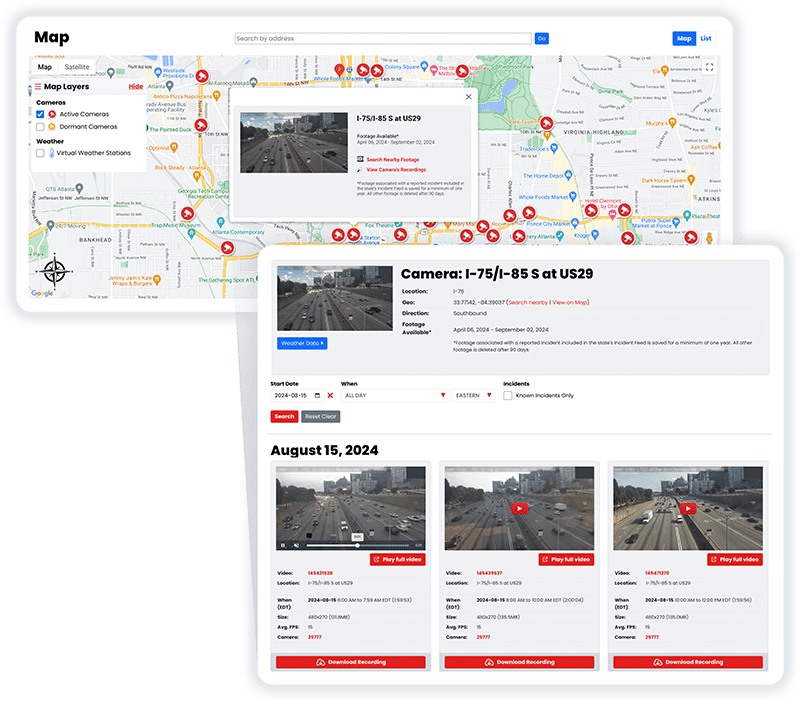
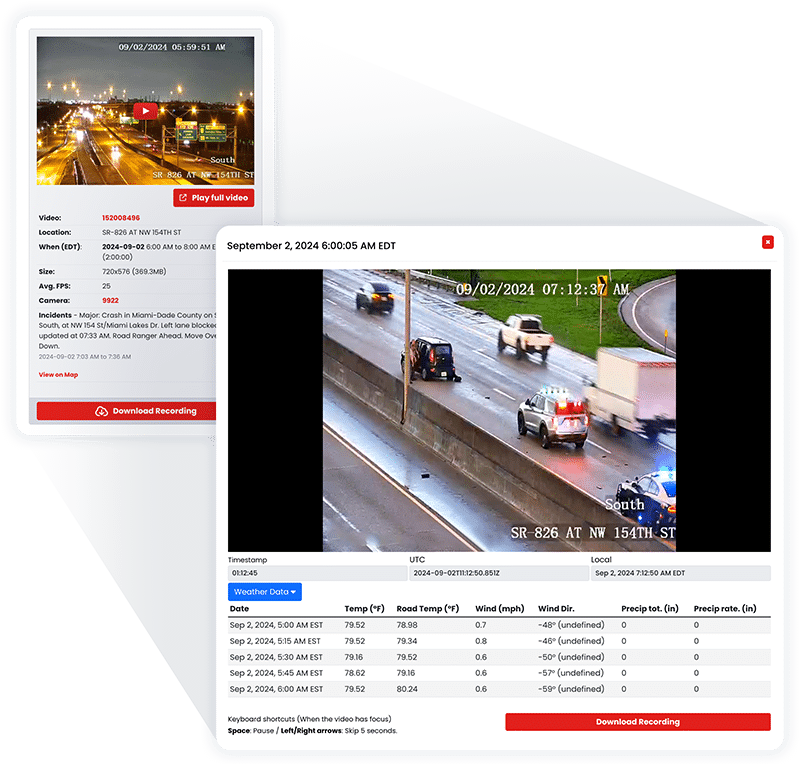
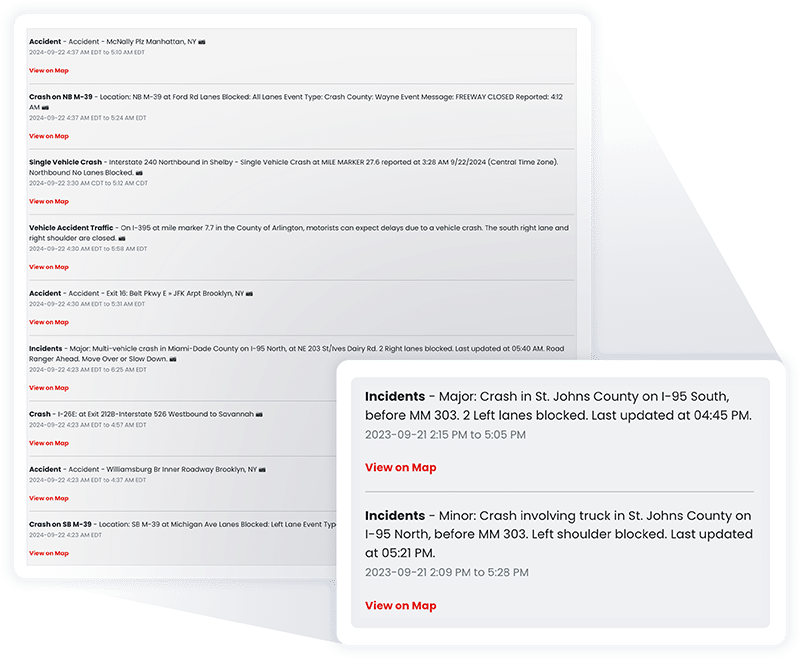
RoadProof offers a truly unique data set combining archived traffic video and a running incident feed available in most states on the system.
All of this data together allows you to get the whole picture, from the initial incident to the final outcome.
“IT WINS THE CASE. We saw the value of RoadProof immediately, you settle your cases 50% faster and for full value.”
Brian Labovick
Labovick Law Group – Florida
With our automated intelligence system, we’re able to match video footage from cameras nearby to any reported incident, and ensure that those vital video recordings are preserved in our archive for a minimum of one year.
While other systems only keep video footage for a couple of months, we keep the video footage that’s critical to your cases for much longer.
“Our case management department (which handles hundreds of cases each month) has nothing but praise for RoadProof.”
Kendra Fike
Bighorn Law – Nevada
Get started now to see how RoadProof can help you get the video data you need.
Get StartedAlready a member of RoadProof? Login here
“One of the first things I do when investigating a crash is obtain and preserve as much evidence as possible. Even before knowing all the parties involved, I immediately pull the RoadProof footage. Seeing the crash firsthand through the video is incredibly powerful. Having this video footage from the start really helps level the playing field between the plaintiff and the trucking company, which often delays or refuses to provide the truck camera video if at all.”
Jamie Mazzeo, Litigation Paralegal
The Truck Accident Law Firm – Florida


Get started now to see how RoadProof can help you get the video data you need.
Get StartedAlready a member of RoadProof? Login here
A number of crashes have occurred on I-75, the Lodge Freeway, and various busy intersections along Woodward Avenue. There’s a reasonable likelihood some type of camera was positioned to capture images of those accidents. It may be difficult, however, to determine which agency (or individual) retains this footage, if it still exists when you go searching for it. This is essentially what a “Detroit Traffic Camera Archive” represents – a list of all agencies/individuals retaining video from cameras located throughout the city and freeways and for how many months this retained footage is available prior to being deleted.
There are numerous valid reasons why people seek access to traffic footage archives. Perhaps your insurance carrier is disputing fault. Or maybe you were struck by another vehicle, and the offending party fled the scene. In either case, an attorney requires evidence of events as they transpired rather than simply hearing two different accounts of the incident. Regardless of the reason, the odds are against you since most traffic recordings are purged after only a few days.
RoadProof provides this service. RoadProof houses a library of over 50 million hours of recorded traffic video; uses computerized algorithms to match videos to reports of incidents occurring on roads under their coverage; and allows users to preserve such footage for no less than 1 year. Most other systems allow video to be purged after only a couple of days.
RoadProof offers law enforcement agencies, insurance carriers, attorneys, etc. instant access to requested footage in place of having them search through multiple agencies/departments for the desired footage. For individuals seeking footage related to their personal accident, RoadProof will provide you with contact information for a licensed attorney in your local community who will pursue recovery of the footage for you.
Traffic cameras in Detroit are not run by one organization. Instead, they are a mix of different organizations, and knowing what each is responsible for will save you a lot of time wasted on phone calls. The state highway system cameras that MDOT owns can be found via the MiDrive website and are located at major interstates and state lines that travel through Detroit. Most of these cameras were installed for traffic management purposes; therefore, they will not show you an accident unless it is blocking the highway.
The city of Detroit has its own camera system as well. Some of them are traffic light cameras that are located at intersections. Many more of them are part of the larger camera system operated by the Detroit Police Department’s (DPD) Real-Time Crime Center. This system collects feed from all of the Project Green Light business partner cameras along with the license plate readers that the city of Detroit has placed at numerous locations around town.
Some traffic and public safety cameras exist as part of the responsibilities of Wayne County or other local counties. They operate independently of the city and state systems.
Additionally, there are privately owned cameras. These are cameras located at gas stations, retail stores, apartment complexes, and so forth. While many of them are part of Project Green Light and send live video to the police department when something occurs at those locations, most people just use their cameras for general security purposes and would never even know if a car crashed in front of their building.
It depends. It may depend on where the incident happened and who owned the camera. If the camera records and saves its video (a lot do not), the video will have been deleted long ago. Some cameras never save their recordings.
How long the recording is kept also depends on what kind of organization has the cameras. A small business may only keep their recordings for two weeks. The city may keep them longer if they were used as part of an investigation. Without a way to identify a recording that is no longer streaming live, they tend to replace older recordings with newer ones.
If you want to try and obtain recordings yourself, you’ll find out quickly how difficult it can be. You’ll need the date, time, and location, and even then, you may end up contacting someone who doesn’t own the camera you think you want to see.
Your only real hope is to get archived versions of footage that is already over a week or so old. That is exactly what we created RoadProof to do – automatically match an incident to nearby cameras that captured it and save those recordings before they disappear.
Raw footage of traffic accidents is typically off-limits to the public. In most cases, traffic accident footage taken by cameras operated by local governments is treated like government documents and requires a Freedom of Information Act-style request. Other footage (for example, privately-owned or law enforcement) may not be available to the general public at all.
Generally, the length of time for which footage from cameras used to monitor traffic will be kept is very limited. Typically, when live feeds are recorded at all (the majority of live feeds are not), most of them are wiped out within days, sometimes even hours, as this type of continuous video requires considerable expense to store.
Storage costs can vary based upon several factors such as ownership of the camera; how much data storage capability the owner has available to use; and if the owner has established an internal policy to retain footage associated with a reported accident or criminal activity for a longer period than normal. Cameras owned by businesses, such as the Project Green Light system, typically rely on the business’ cloud storage program and its terms.
The reason most people don’t think about this issue is that once footage is removed, it is simply deleted. No one is actively trying to delete evidence. Continuous recording, however, requires that old footage be continually replaced so as to allow space for new recordings.
Because most cameras, both public and privately owned, are set up to continuously record, and then automatically remove the oldest files to create room for new ones, it is essential to act quickly when seeking footage. When you delay requesting access to your footage until weeks after an incident occurred, you may be unable to obtain the footage you need, as it will likely have been removed. This is precisely why RoadProof was created to provide a service that preserves evidence immediately after an incident occurs.
The areas that have the highest concentration of cameras are where the freeways intersect with each other and with main arterials.
Find the location of your collision. Identify the street or highway intersection, exit number, and/or milepost of your collision, and also identify which direction you were traveling. Identifying these details is usually the difference between getting Footage that will help support your insurance or legal claims versus nothing.
Identify cameras near your collision site. On highways, look for MDOT (Michigan Department of Transportation) poles supporting cameras. On side streets and intersections, there are typically city traffic signal cameras. If your collision site is close enough, check for Project Green Light signs and take pictures of them. While still at the accident scene is ideal to do so.
Check for archive availability. Not all cameras capture video, and even those that do may not retain their archives after a period of time. Most people get stopped up at this stage because they have no idea who owns the cameras near their collision, how to contact the owners, and whether the recordings are available. That’s why we created our platform to match cameras with incidents quickly and efficiently.
Document evidence. Report your accident to law enforcement and include in your incident report any visible cameras that captured your collision. Also document the locations of nearby businesses that you believe had cameras directed towards the road.
File a request. Depending upon the owner of the camera(s), submit a FOIA (Freedom of Information Act) request to either MDOT or your city; submit a public record request to Wayne County; send a direct inquiry to the business owner; or use an attorney working with RoadProof if you plan on filing an injury lawsuit.
Obtain Footage. Upon approval, most requests result in obtaining the digital Footage file(s). Always save multiple versions of the footage files and preserve the original file as received in order to protect against tampering issues in future litigation.
Video greatly reduces “guesswork” that is generally done by jurors and insurance adjusters based upon assumptions as opposed to evidence.
A common problem in insurance claims is that they usually end up being an individual’s word against an opposing party’s word. With video evidence, it is possible to provide conclusive proof that will determine who has the green light and/or who failed to use their signals when changing lanes, thereby settling disputes that could potentially take many weeks to resolve.
The instances in which video evidence is particularly important are hit-and-run accidents; the reason is that there may not be enough evidence to identify the driver(s) involved in such incidents. In addition to identifying the driver(s), the video could also capture the license plates associated with the vehicle(s).
In disputed liability situations (i.e., both parties claim fault), video evidence provides the clarity necessary to eliminate “gray areas.” Instead of having to rely upon the testimony and recollections of witnesses, individuals can simply review the actual event through the video.
Traffic signal cameras frequently catch red-light running vehicles, providing confirmation of which driver ran the red light.
Footage of left-turn accidents typically provides clarification regarding right-of-way issues. The video evidence can indicate if the driver making the left-hand turn had a clear lane prior to proceeding into traffic or if he/she cut off oncoming traffic.
The areas of roadway that experience a disproportionate number of crashes are no surprise, as to why the highest concentration of cameras exists here. The crash locations in Detroit can also be found at intersections where several highways intersect (e.g., I-75 / I-696), and at major roadways with high volumes of traffic (Woodward, Gratiot, and Jefferson) where both pedestrians and other drivers are present and making turns into or across lanes of travel. In these high-density areas, multiple factors come together, creating a perfect storm; i.e., poor signal timing, heavy pedestrian presence, and conflicting vehicle movement.
Agencies install cameras on freeways and major downtown corridors because the cost justifies installing cameras to monitor the congestion and incidents that occur in those areas. Therefore, quiet residential streets are less likely to have cameras installed.
RoadProof is helping to close that gap by matching footage with incidents and preserving it automatically.
The chain of custody also matters once you have footage. Documentation shows how video was captured, stored, and transferred. This ensures it will hold up if challenged in court.
If your footage has been properly preserved from a documented source, it holds far more weight than a shaky phone recording of a screen.
Footage often uses expert witnesses (e.g., accident reconstruction specialists) to calculate speed, reaction time, and point of impact. These expert witnesses take raw video and turn it into testimony for jurors to follow step by step.
If you are dealing with the aftermath of a crash and think a camera might have caught it, the sooner you start asking, the better your odds of getting something usable. RoadProof works with attorneys, insurers, and law enforcement across the U.S. To track down and preserve exactly this kind of footage before it’s gone.
Get started now to see how RoadProof can help you get the video data you need.
Get StartedAlready a member of RoadProof? Login here
We will review your request within 1-2 business days and will contact you by either phone or email, or both. In the meantime, learn more about your team!