Already a member? Log into your account
Get instant access to millions of hours of recorded video & incident data from thousands of traffic cameras in Chicago, Illinois.
Get Started TodayRoadProof is trusted by the best organizations across America.

















Are you part of a law enforcement agency? Get Roadproof now, for FREE. Click here to sign up.
With RoadProof, you can save thousands of dollars and hundreds of hours of time tracking down the video data you need, for whatever your end use case might be – whether it’s an accident case or criminal investigation.
Recorded video data that used to take days or weeks to find, can now be searched for, located and downloaded in a matter of minutes using the platform.
“The platform continues to be vital and a remarkable tool. It’s a great asset to our agency for all of our cases.”
Master Sergeant John A. Boos
Traffic Homicide Investigation, Florida Highway Patrol – Florida
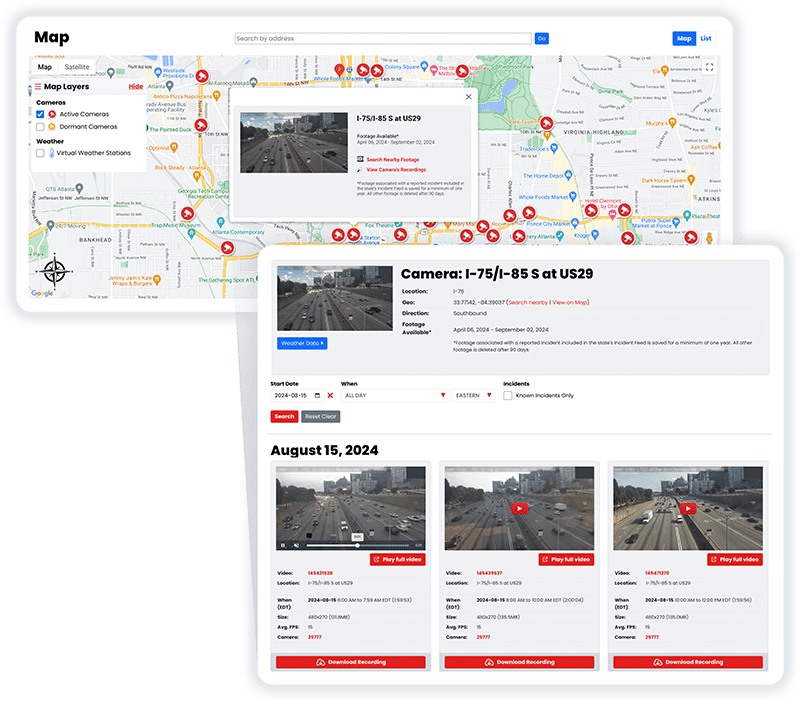
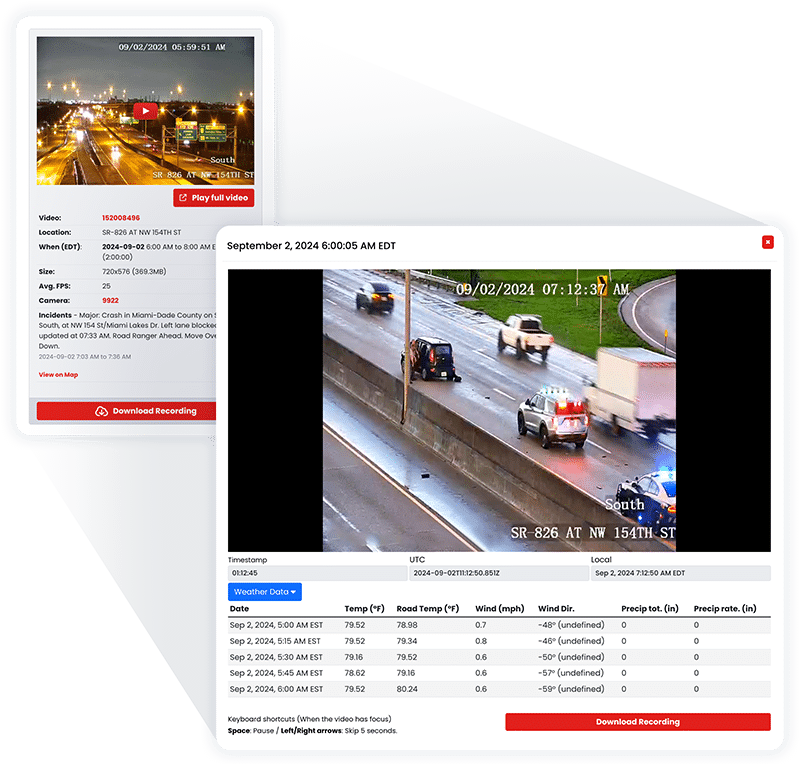
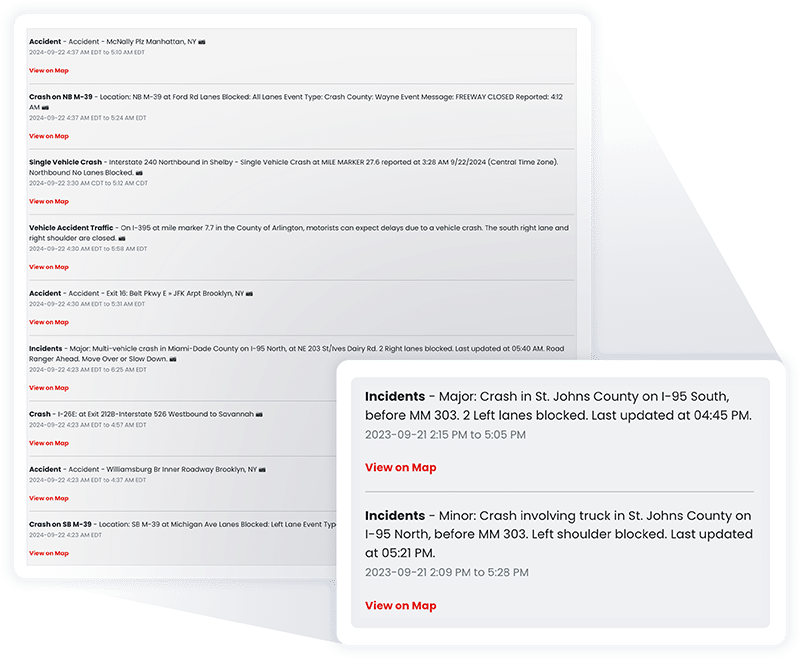
RoadProof offers a truly unique data set combining archived traffic video and a running incident feed available in most states on the system.
All of this data together allows you to get the whole picture, from the initial incident to the final outcome.
“IT WINS THE CASE. We saw the value of RoadProof immediately, you settle your cases 50% faster and for full value.”
Brian Labovick
Labovick Law Group – Florida
With our automated intelligence system, we’re able to match video footage from cameras nearby to any reported incident, and ensure that those vital video recordings are preserved in our archive for a minimum of one year.
While other systems only keep video footage for a couple of months, we keep the video footage that’s critical to your cases for much longer.
“Our case management department (which handles hundreds of cases each month) has nothing but praise for RoadProof.”
Kendra Fike
Bighorn Law – Nevada
Get started now to see how RoadProof can help you get the video data you need.
Get StartedAlready a member of RoadProof? Login here
“One of the first things I do when investigating a crash is obtain and preserve as much evidence as possible. Even before knowing all the parties involved, I immediately pull the RoadProof footage. Seeing the crash firsthand through the video is incredibly powerful. Having this video footage from the start really helps level the playing field between the plaintiff and the trucking company, which often delays or refuses to provide the truck camera video if at all.”
Jamie Mazzeo, Litigation Paralegal
The Truck Accident Law Firm – Florida


Chicago has one of the most camera-dense road networks in the country. Between the Illinois DOT’s expressway infrastructure, the City of Chicago’s roughly 7,000 intersection cameras, and feeds from the Illinois Tollway and Chicago Skyway, there are eyes on nearly every major corridor in and around the city.
But if you’re here because something happened on one of these roads and you need the recorded footage, that’s a different conversation. Live feeds show you what’s happening right now. Recorded video, the kind that can actually help an attorney, investigator, or law enforcement agency build a case, disappears fast. Most agencies overwrite it within days. RoadProof exists to capture and preserve that footage before it’s gone for good.
Chicago’s camera infrastructure is split across multiple agencies, which matters a lot when you need to find out who owns a specific camera.
The Illinois Department of Transportation manages cameras along major expressways and state routes. The City of Chicago operates its own network of approximately 7,000 intersection cameras throughout the metro area. The Illinois Tollway runs cameras on its toll road network. The Chicago Skyway covers the southeast corridor into Indiana. And regional data from Indiana DOT and Wisconsin DOT feeds into the broader Travel Midwest system that aggregates conditions across the tri-state area.
On the technology side, these systems don’t rely on video alone. Detection happens through a combination of inductive loops buried in the pavement, radar sensors, infrared and ultrasonic detectors, acoustic monitors, and video image processing algorithms. All of that feeds into central systems that update every few minutes.
What gets published publicly are snapshot images, not continuous video. Images typically refresh every five minutes. If you’re trying to check road conditions before a commute, that’s plenty. If you need actual recorded footage from a specific camera at a specific time, the live feed isn’t going to help you. That footage exists at the agency level and will soon be accessible through RoadProof’s archive for verified professionals.
I-90/94 Kennedy Expressway — One of the busiest stretches in the metro, running from O’Hare southeast toward the downtown split. Camera coverage is dense, particularly between the I-290 junction and the river.
Cameras along this route:
I-94 Dan Ryan Expressway — Runs south from the Loop toward the Indiana border. Heavy volume through the city, with known congestion points near the I-90 interchange and Chinatown.
Cameras along this route:
I-290 Eisenhower Expressway — Heads west from the Loop into the western suburbs. The stretch between the I-90/94 junction and I-294 is one of the most consistently congested corridors in the region.
Cameras along this route:
Lake Shore Drive — Follows the lakefront from the South Side to the North Shore. Moves well most of the time, but has no good alternatives when it doesn’t.
Loop and downtown intersections — Dense coverage reflecting the pedestrian and vehicle volume downtown. Michigan Avenue cameras are covered in their own section below.
Michigan Avenue is one of the busiest and most camera-covered streets in Chicago. It runs through the tourism and retail heart of the city, past Millennium Park, the Art Institute, and the Magnificent Mile, and carries a constant mix of local traffic, commuters, rideshare vehicles, and tourists.
Camera coverage on Michigan Avenue includes intersections along the full stretch of the downtown corridor, with key monitoring points at major cross streets including Chicago Avenue, Grand Avenue, and the approaches to the Chicago River bridge. Cameras capture both the northbound and southbound flow on Michigan itself and the intersection activity at cross streets.
Michigan Avenue gets particularly congested during predictable, recurring events: the Magnificent Mile Lights Festival in November, the Chicago Marathon weekend in October, summer lakefront festivals, and any large gathering at Grant Park or the Museum Campus. If you’re traveling through the area during any of these, checking the cameras before you leave can save real time.
Michigan Avenue is the most-watched corridor downtown, with cameras at multiple intersections from Wacker Drive north through the Magnificent Mile. State Street through the Loop, Wacker Drive along the river, and the Lake Shore Drive ramps near Grant Park are all covered. The Michigan Avenue bridge over the Chicago River is worth a specific check on warmer-weather days, since river traffic can cause bridge openings during peak hours.
Kennedy Expressway (I-90/94) covers the northwest corridor from O’Hare into downtown. The worst congestion tends to concentrate between the I-290 junction and the downtown split.
The Dan Ryan Expressway (I-94) runs south from the Loop. The interchange at I-90 near the Robert Taylor area is a consistent trouble spot, and the corridor picks up again near the Indiana border.
Eisenhower Expressway (I-290) sees the heaviest congestion between the I-90/94 junction and I-294. Construction has been ongoing in sections for several years, which affects both traffic flow and sensor data availability.
Stevenson Expressway (I-55) generally moves better than the other main expressways, with the main exception being the area near the I-90/94 interchange and the Midway Airport access points.
Cameras along this route:
Edens Expressway (I-94 North) serves the North Shore suburbs. The junction with I-294 near Skokie is where backups most commonly develop.
Reagan Memorial Tollway (I-88) heads west toward Aurora and the western suburbs. The I-290 junction area is the most-monitored section.
Cameras on this route:
Camera coverage on the North Side focuses on major arterial intersections in Lincoln Park, Wrigleyville, and Uptown. Clark Street, Broadway, and Sheridan Road have coverage at key points. The streets around Wrigley Field have particularly thorough monitoring given the frequency of games and events.
Hyde Park, Bronzeville, and South Shore are covered primarily at major intersections and along arterial routes. Lake Shore Drive cameras continue through this corridor down to the South Side, providing visibility along the lakefront all the way south.
Camera coverage extends into the near suburbs along the expressway and tollway corridors. Naperville, Schaumburg, and Elk Grove Village all have coverage along the major interstates, though density is lower than within city limits.
Are Chicago traffic cameras live or snapshots? The publicly available feeds are snapshots that update on a regular cycle, typically every five minutes. You’re seeing a series of refreshed still images, not a continuous video stream. Some interfaces display these rapid updates in a way that looks like video, but the underlying data is snapshot-based.
Where does the data come from? Camera data is aggregated through the Travel Midwest / Gateway system, which pulls from multiple transportation agencies, including Illinois DOT, Indiana DOT, Wisconsin DOT, the Illinois Tollway, and the Chicago Skyway. Detection technologies include inductive loops, radar, infrared, acoustic sensors, and video image processing, all computed centrally and updated every few minutes.
Can I get video from a Chicago traffic camera? If you need recorded footage from a specific camera for an accident case, legal matter, or investigation, you typically need to go through the agency that owns the camera, typically via a FOIA request. Alternatively, if you’re an attorney, law enforcement agency, or investigator, RoadProof will soon provide direct access to archived footage from cameras across Illinois without the FOIA process. You can search by location and time and download footage in minutes.
Do cameras show accidents? They show current road conditions, which can include the visible aftermath of an accident or the backup it causes. Travel Midwest operators also manually supplement the automated data with incident information when they observe or receive reports of crashes. The cameras themselves don’t flag accidents automatically.
What if I were in an accident and needed camera footage? If you were injured in an accident and believe a nearby camera captured it, your best move is to contact an attorney as quickly as possible. Footage gets overwritten fast, sometimes within hours. RoadProof works exclusively with licensed attorneys and law enforcement; if you don’t have an attorney yet, RoadProof can connect you with a partner attorney in your area who has platform access and can check for available footage on your behalf.
Who owns the cameras? The cameras belong to the relevant transportation agencies: Illinois DOT, the City of Chicago, the Illinois Tollway, and other local and regional authorities, depending on the specific location. RoadProof aggregates publicly available data from these sources for the live feeds and maintains an independent archive of recorded footage for professional access.
RoadProof was built to solve a specific problem: traffic camera footage disappears before most people know they need it.
When something happens on the road, whether it’s an accident, a criminal incident, or an event under investigation, the video evidence is almost always somewhere in the camera network. The problem is finding it, identifying which of dozens of agencies owns the relevant camera, submitting the right request to the right department, and doing all of that fast enough that the footage hasn’t already been overwritten. Most governmental systems keep footage for a matter of days. The FOIA process often takes longer than that.
RoadProof eliminates that gap. Attorneys, law firms, accident reconstruction specialists, law enforcement agencies, and insurance professionals across Illinois use RoadProof to search for footage by location and time, identify which cameras captured an incident, and download the video they need without navigating agency bureaucracy. Footage that previously took days or weeks to obtain now takes minutes. RoadProof also preserves matched footage in its archive for a minimum of one year, far longer than most agency retention schedules.
RoadProof is free for law enforcement agencies. Attorneys, law firms, and businesses access the platform through a subscription. If you were involved in a vehicle collision, contact RoadProof to be connected with a partner attorney in your area.
Get started now to see how RoadProof can help you get the video data you need.
Get StartedAlready a member of RoadProof? Login here
We will review your request within 1-2 business days and will contact you by either phone or email, or both. In the meantime, learn more about your team!