Already a member? Log into your account
Get instant access to millions of hours of recorded video & incident data from thousands of traffic cameras in Louisville, Kentucky.
Get Started TodayRoadProof is trusted by the best organizations across America.

















Are you part of a law enforcement agency? Get Roadproof now, for FREE. Click here to sign up.
With RoadProof, you can save thousands of dollars and hundreds of hours of time tracking down the video data you need, for whatever your end use case might be – whether it’s an accident case or criminal investigation.
Recorded video data that used to take days or weeks to find, can now be searched for, located and downloaded in a matter of minutes using the platform.
“The platform continues to be vital and a remarkable tool. It’s a great asset to our agency for all of our cases.”
Master Sergeant John A. Boos
Traffic Homicide Investigation, Florida Highway Patrol – Florida
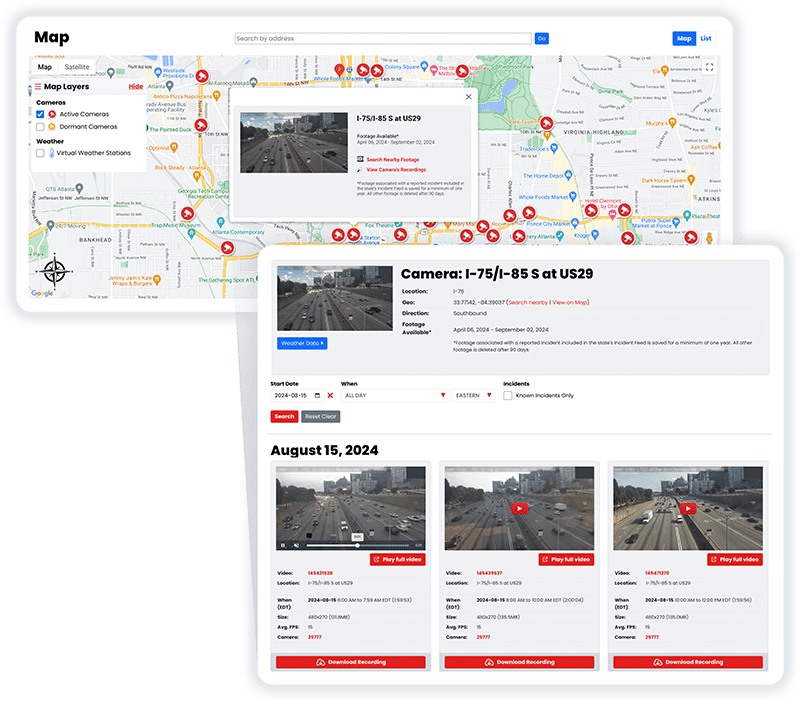
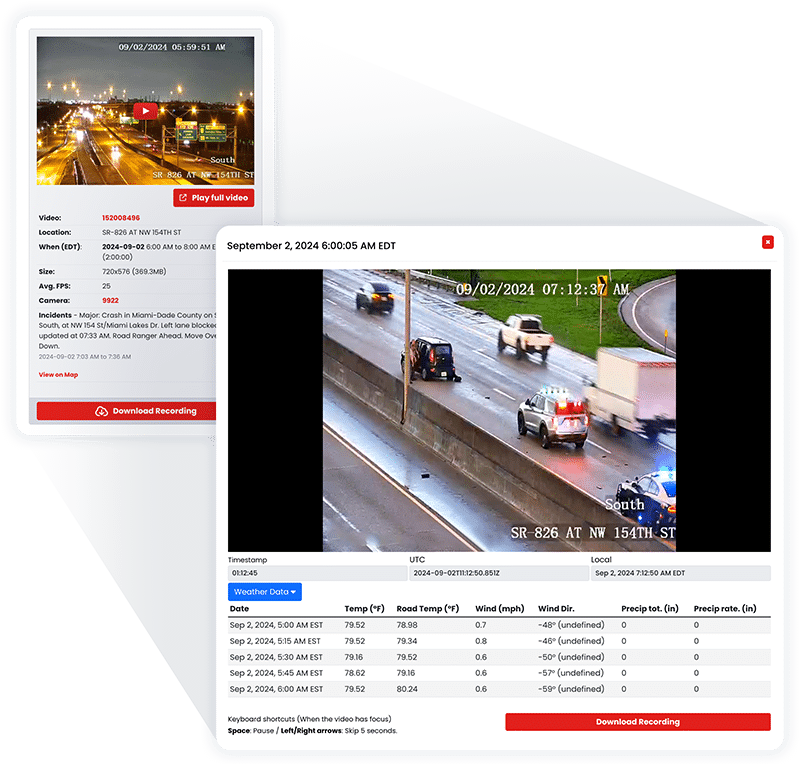
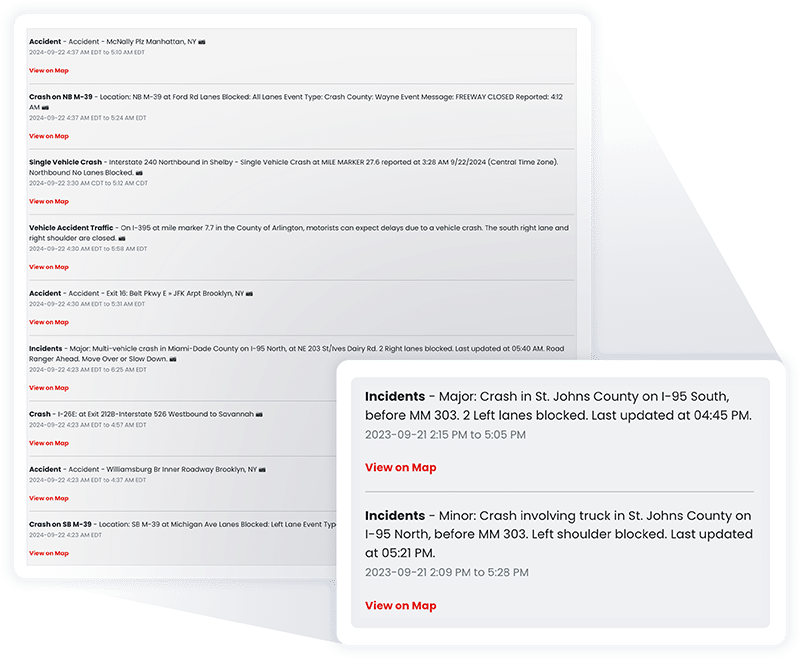
RoadProof offers a truly unique data set combining archived traffic video and a running incident feed available in most states on the system.
All of this data together allows you to get the whole picture, from the initial incident to the final outcome.
“IT WINS THE CASE. We saw the value of RoadProof immediately, you settle your cases 50% faster and for full value.”
Brian Labovick
Labovick Law Group – Florida
With our automated intelligence system, we’re able to match video footage from cameras nearby to any reported incident, and ensure that those vital video recordings are preserved in our archive for a minimum of one year.
While other systems only keep video footage for a couple of months, we keep the video footage that’s critical to your cases for much longer.
“Our case management department (which handles hundreds of cases each month) has nothing but praise for RoadProof.”
Kendra Fike
Bighorn Law – Nevada
Get started now to see how RoadProof can help you get the video data you need.
Get StartedAlready a member of RoadProof? Login here
“One of the first things I do when investigating a crash is obtain and preserve as much evidence as possible. Even before knowing all the parties involved, I immediately pull the RoadProof footage. Seeing the crash firsthand through the video is incredibly powerful. Having this video footage from the start really helps level the playing field between the plaintiff and the trucking company, which often delays or refuses to provide the truck camera video if at all.”
Jamie Mazzeo, Litigation Paralegal
The Truck Accident Law Firm – Florida


If you were injured in a car or truck crash, a Louisville traffic camera archive may help your attorney find video that clarifies what happened. RoadProof’s injury inquiry process can connect you with a licensed personal injury attorney in your area who can check for available footage. A recording is not guaranteed, so start with the crash location, date, and time.
RoadProof is a video evidence platform, not a law firm. An attorney can evaluate your injury claim and explain how any recording fits with the other evidence.
The individual inquiry process on RoadProof is for those who were injured in an auto accident. As outlined above, our policy excludes inquiries about accidents where there was only property damage; it also excludes inquiries about tickets and any other non-injury-related issues, and will not download any video from its archives directly to any individual.
If you have already retained a lawyer, contact that lawyer and request that he/she check the possible existence of video with RoadProof. If you have not yet retained a lawyer, you may enter your details into RoadProof’s referral form to inquire if a lawyer would be interested in your case based upon the information entered. There are two distinct considerations; i.e., will a lawyer want to represent you regarding this accident, and did they capture useful video?
It is not necessary for you to determine which camera captured the accident prior to submitting your initial inquiry. Enter all details known, but instead of guessing, describe what is unknown.
The TRIMARC Traffic Monitoring Project currently has real-time information about what’s happening with traffic in Louisville. It offers users access to live camera images and incident reports through its public website.
You should know how the TRIMARC system handles video recording as part of your post-accident investigation process. TRIMARC does not capture video from its cameras. This means seeing a camera listed on the TRIMARC map does not give you permission to request a recorded copy of the event in which you crashed.
The Jefferson County traffic camera dataset for Louisville contains all the camera locations, including their names, the direction they are facing, and a link to see a photo of each location. While this is a static extract that gets reviewed by someone for updates (so use it as a resource to find out where there might be possible views), it will not confirm if the camera was working at the exact time of your wreck.
Your attorney will still need to verify whether the lanes involved in your wreck or the specific intersection was within the view of the camera.
Gather all information about how the car wreck occurred so you can limit your search. This will also assist in helping your attorney when they are trying to locate the correct videotape.
Direction is very important. TRIMARC has a Q&A section that states the camera labeled “Interstate 64 East @ Cannons Lane” is looking eastward. Do not rely solely on the name of the camera to determine which lanes are being recorded.
If possible, provide a wide enough time frame to allow for a successful search. If you wait too long after the collision to make contact with emergency services, the time you contacted them may be greater than the actual time of the collision. A time frame that is too narrow will result in missing footage that may prove useful.
Footage from a useful recording could provide clarification on whether one of the two vehicles involved in the crash was traveling in its respective lane when it crossed over into the other’s path; whether traffic had come to a stop at the time of the incident; or how a tractor/trailer combination was navigating a curve when it made contact with another vehicle. The same footage could aid in establishing the order in which impacts occurred if multiple vehicles were involved.
For example, suppose a driver is disputing your claim that they struck your vehicle after you suddenly merged into their path. Footage recorded prior to the actual time of the impact could assist in showing whether or not you were already established within your lane of travel. Conversely, there is no way to determine this question using a recording that begins immediately after the impact. Your attorney will likely review the video footage together with all of the evidence collected (i.e., vehicle damage photos, witness statements, police report) to determine what information the video provides.
While video is often very helpful in determining the cause of a motor vehicle crash, it is not without limitations. Video limitations include distance, lack of lighting, obstructed views, and/or large gaps between individual frames of video. These factors can result in many important details being difficult to determine. A collision between two or more vehicles does not always clearly indicate the color of the traffic signal(s) at the time of the incident nor the speed at which either vehicle was traveling.
If a tractor/trailer combination is involved in a motor vehicle crash, an outside view of the tractor/trailer may give your attorney ideas for potential additional evidence to pursue, including but not limited to, viewing recordings obtained from cameras mounted on the tractor/trailer.
The state of Kentucky offers basic personal injury protection (PIP), which is usually referred to as “no-fault” coverage. This type of Insurance typically covers up to $10,000 in total per accident for qualified medical costs, lost wages, and other qualified financial losses. Whether you are at fault does not affect the payment of these benefits. Your eligibility to receive this benefit, along with any other factors that pertain to your election regarding coverage, will be important, including whether you have waived the typical no-fault limitation.
In addition to receiving basic benefits for your injuries, you may also want to consider seeking compensation for those losses that exceed what is provided by the basic benefits. If you reside in an area where you are limited from bringing a tort action under the provisions of Kentucky’s motor vehicle tort reform law, then recovery of non-economic damage claims (pain and suffering) generally requires evidence of qualifying medical expenses in excess of $1,000 or evidence of a qualifying injury. The types of qualifying injuries include but are not limited to: bone fractures, permanent disfigurement, or permanent injury. There are other qualifying conditions and exceptions identified within the statute.
Your attorney will need to review all medical bills, loss of income, and how your injuries impact your quality of life in order to determine potential recoverable damages. Videos can provide documentation explaining how the accident occurred, and medical records and employment documents will assist in identifying the losses resulting from the accident.
In Kentucky, the court assigns responsibility for injuries to all of the individuals involved. Even though there may be blame (or “fault”) on both sides of the case, having some degree of fault will likely limit the amount of money awarded for injuries or losses. However, the fact that one has fault will not mean that he/she cannot make a claim against another party for causing their injuries.
For example, let’s say your total damage was $100,000 and the Court finds that you are 20 percent at fault for your own injuries. Your damages would normally be reduced by 20 percent ($20,000) from the original award, leaving you with $80,000 before other reductions might occur. Again, this is only an example and could vary depending upon how much time passed prior to settling, how long it takes to settle, etc. The record can help prove who did what, so a dispute over who caused which percentage of the accident/ incident may require testimony from each side.
As soon as possible after an accident, ask for footage (because most sources of footage will only keep it for a limited time). Do not automatically assume that other video from a private archive, local business, or vehicle-mounted camera has the same retention schedule as another.
If there exists the possibility of a recording by a business or a driver, let your attorney know so that he/she can seek a prompt preservation order. Store all of the files you currently have in their original format along with the source, download date, and attached message. In addition, make a separate “working” file if you need to look at or comment on the media.
Preservation is just as much about the content of what was recorded as it is about the amount of time it captures. For example, a brief clip may miss the lane change or traffic delay leading up to the crash, so be sure to inquire whether there exist recordings of both prior to and immediately after the collision as well.
Many times in cases involving auto accidents in Kentucky where you were injured, the time to bring a lawsuit is 2 years from the date of the injury (the “statute of limitations”) or 2 years from the date of the last reparation check issued by the carrier (basic or additional), whichever comes last. This statute provides some very specific guidelines and does NOT automatically extend the statute with each insurance payment made.
Have your lawyer compute this date based on your particular situation, especially when there was a death involved in the accident or other complicating factors. In addition, it would be wise to have an attorney review your automobile insurance policy to determine what type of notice must be provided to your insurance company before receiving certain benefits, and whether there are any negotiations still ongoing with your insurance company that could delay your receipt of compensation.
Eligible citizens of Kentucky have the right to receive public documents as permitted under Kentucky’s Open Records Act. Written requests for all KTC-maintained records should be sent directly to the Office of Legal Services at KTC.
A general rule is that an agency has five working days (Saturdays, Sundays, and Holidays excluded) after receiving a request to send the requesting party a written decision. This time frame has no bearing on when you will receive the record(s).
This is about obtaining actual records. A cabinet or agency cannot produce something that was not produced; this includes the fact that there are cases decided by the Attorney General regarding requests for police videos where agencies have indicated they did not record anything. Your lawyer can assist you in finding additional documentation that might help you understand what happened.
The missing video does not by itself make it impossible for you to bring a valid claim. The lawyer would assess the claim’s viability based upon the statements made by witnesses (the number and credibility), photos, the physical evidence at the scene, medical documents related to injuries and treatment, as well as any additional information that may exist in record form. Rather than waiting until a recording of the incident exists, tell the lawyer what you do have.
RoadProof is operated under subscription, with RoadProof providing no case investigation services to non-members. Before committing to the representation of an attorney, ask him/her about his/her fee schedule, how he/she will charge for all evidence obtained, and any potential financial obligations prior to hiring him/her.
Although TRIMARC provides feeds from several Indiana partners as part of their traffic map, being displayed on the same traffic map does not establish which jurisdiction has the authority to apply its respective laws. Since this webpage deals specifically with accidents occurring within Kentucky, an injury accident occurring outside of Kentucky (Indiana) requires both a different application of jurisdiction and time limitations. Provide the attorney with specific details regarding where the vehicle collision occurred.
If an injury crash has left you searching for a Louisville traffic camera archive, start with the facts you know. Submit your accident details through
RoadProof’s injury inquiry process to request a connection with a local licensed personal injury attorney who can check for available footage and discuss your case.
If you already have an attorney, share RoadProof with them and ask about an evidence search. The priority is finding out what is available while your lawyer evaluates the next steps.
Get started now to see how RoadProof can help you get the video data you need.
Get StartedAlready a member of RoadProof? Login here
We will review your request within 1-2 business days and will contact you by either phone or email, or both. In the meantime, learn more about your team!