Already a member? Log into your account
Get instant access to millions of hours of recorded video & incident data from thousands of traffic cameras in Denver, Colorado.
Get Started TodayRoadProof is trusted by the best organizations across America.



















Are you part of a law enforcement agency? Get Roadproof now, for FREE. Click here to sign up.
With RoadProof, you can save thousands of dollars and hundreds of hours of time tracking down the video data you need, for whatever your end use case might be – whether it’s an accident case or criminal investigation.
Recorded video data that used to take days or weeks to find, can now be searched for, located and downloaded in a matter of minutes using the platform.
“The platform continues to be vital and a remarkable tool. It’s a great asset to our agency for all of our cases.”
Master Sergeant John A. Boos
Traffic Homicide Investigation, Florida Highway Patrol – Florida
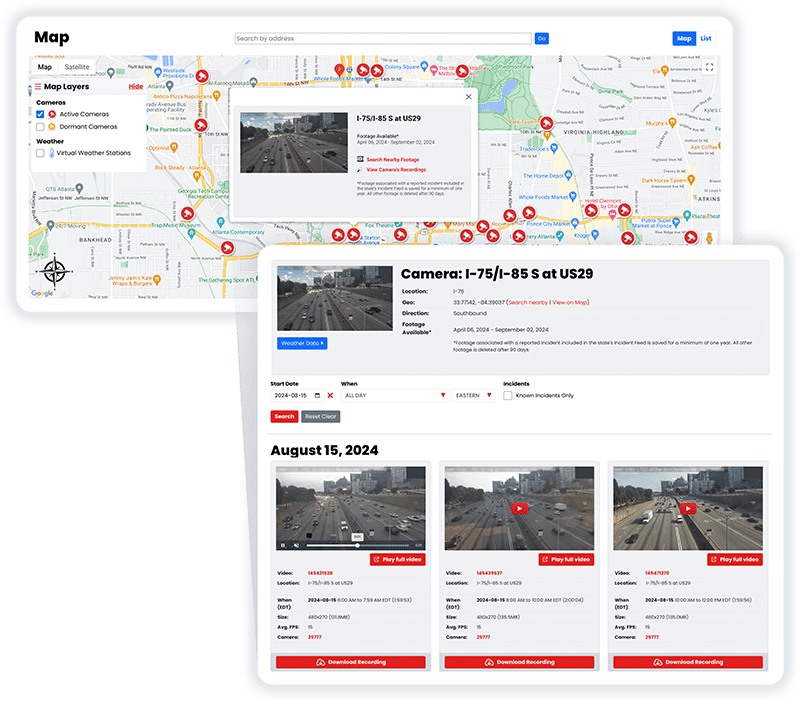
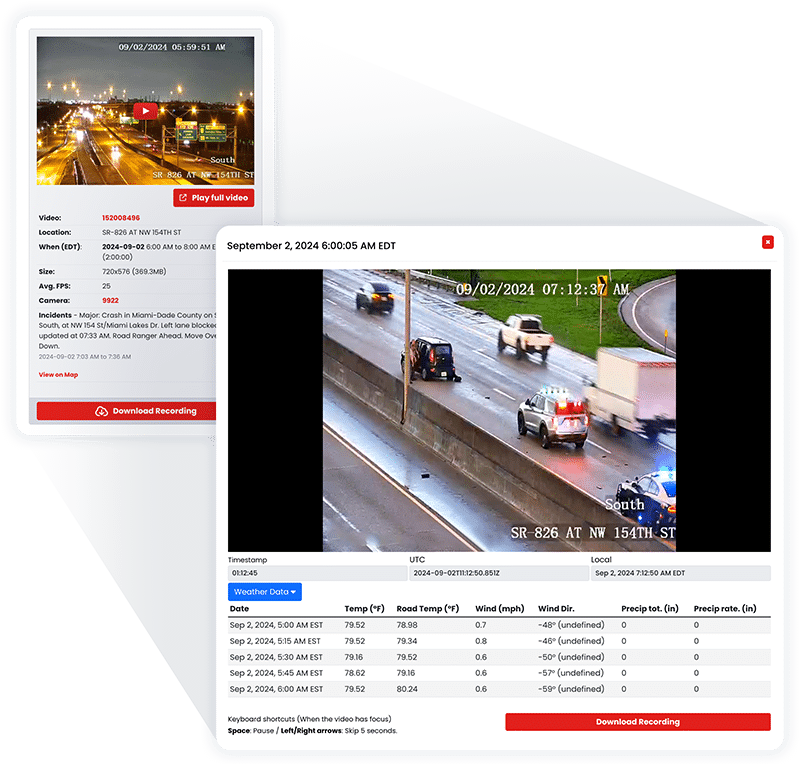
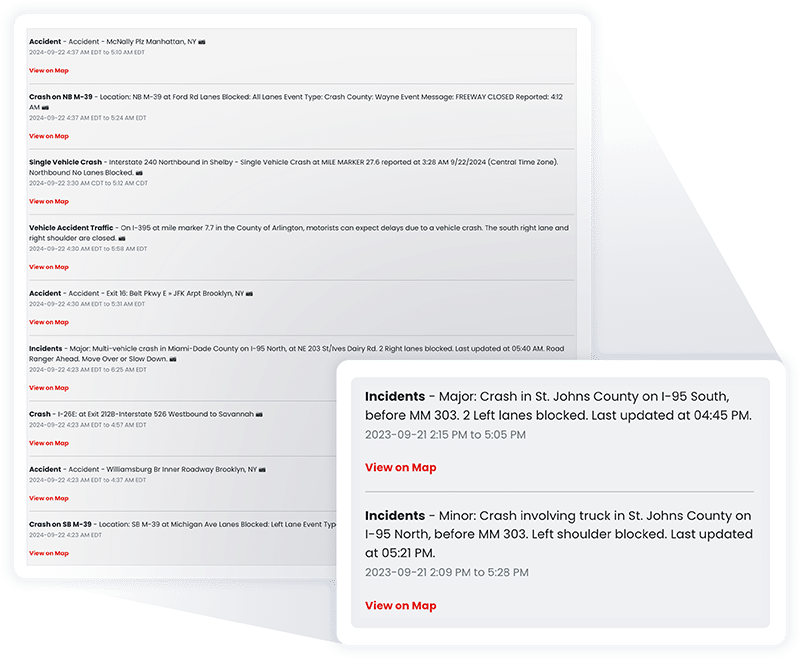
RoadProof offers a truly unique data set combining archived traffic video and a running incident feed available in most states on the system.
All of this data together allows you to get the whole picture, from the initial incident to the final outcome.
“IT WINS THE CASE. We saw the value of RoadProof immediately, you settle your cases 50% faster and for full value.”
Brian Labovick
Labovick Law Group – Florida
With our automated intelligence system, we’re able to match video footage from cameras nearby to any reported incident, and ensure that those vital video recordings are preserved in our archive for a minimum of one year.
While other systems only keep video footage for a couple of months, we keep the video footage that’s critical to your cases for much longer.
“Our case management department (which handles hundreds of cases each month) has nothing but praise for RoadProof.”
Kendra Fike
Bighorn Law – Nevada
Get started now to see how RoadProof can help you get the video data you need.
Get StartedAlready a member of RoadProof? Login here
“One of the first things I do when investigating a crash is obtain and preserve as much evidence as possible. Even before knowing all the parties involved, I immediately pull the RoadProof footage. Seeing the crash firsthand through the video is incredibly powerful. Having this video footage from the start really helps level the playing field between the plaintiff and the trucking company, which often delays or refuses to provide the truck camera video if at all.”
Jamie Mazzeo, Litigation Paralegal
The Truck Accident Law Firm – Florida


If you were injured in a Denver car or truck crash and believe a camera saw what happened, footage may still be available, but it should be searched for immediately. A Denver traffic camera archive may contain video from a nearby roadway camera, while Denver Police may hold separate HALO or traffic camera recording footage. The Denver Police records page warns that unpreserved video can be overwritten within 15 to 30 days.
RoadProof helps licensed attorneys, insurers, and law enforcement search archived traffic video. RoadProof does not provide footage directly to members of the public. If you were injured and do not have counsel, its published process allows you to submit your accident details and consent to a referral to one licensed attorney in your area, who can assess the claim and check for available video.
A driver’s version of a car wreck accident can come down to seconds. In many cases, drivers will dispute who had the right of way at an intersection, if one vehicle moved into another lane, or why traffic came to an abrupt stop.
Video footage may show all parties’ vehicles (at the time of the accident), the sequence of events, as well as what was happening immediately prior to or subsequent to the accident, including traffic patterns. Footage is considered evidence and does not automatically decide who is negligent. Cameras are often located at some distance, may be pointing in a different direction, may be blocked by vehicles, or cannot capture images of traffic signals. Further, cameras may provide evidence that negatively impacts the injured party’s case. A lawyer should consider and weigh the crash report, photos taken by witnesses, vehicle information obtained through black boxes, the injured party’s medical records, and any other forms of evidence in conjunction with the video footage.
A complete picture helps when determining liability under Colorado law, since liability may be apportioned. Under Colorado Civil Jury Instructions regarding Comparative Negligence, an injured plaintiff generally cannot recover damages unless their own negligence contributes no greater than 49% of his/her injuries. If the plaintiff’s negligence contributed 50% or more to her/his injuries, she/he will receive nothing. On the other hand, if the plaintiff’s negligence is found to have contributed less than 50%, then that portion of negligence will reduce her/his total damages award by that same amount.
If you were injured as the result of another person’s or business’s negligence (i.e., lack of due care), such as a driver for a trucking company, car owner, employer or any other responsible entity, then you could potentially have a personal injury Claim. Some examples of negligent acts include running through red lights; failure to yield; following too close to the vehicle in front of them; changing lanes without checking first; being distracted at the time they are driving; or driving a commercial vehicle in a dangerous manner. The facts surrounding your claim will ultimately determine whether there is sufficient basis for a valid claim, and this is not solely based upon the existence of video footage.
Video traffic footage is likely to provide the most assistance with proving liability and causation. Video footage may help link the actions of a driver involved in the collision to the accident itself. However, the video footage will not assist in determining the extent of your medical and/or financial impact resulting from an injury. Your treatment records, billing information, work records, expert analysis and/or testimony may still be required to support your claim for compensation.
In Colorado, our civil jury instructions regarding damages for personal injury claims indicate that various types of damages may be awarded where supported by evidence.
These categories of damages include:
Any specific type(s) of damage or the amount(s) thereof is impossible to guarantee because each Claim will be affected by factors which include the limits of insurance coverage of all liable entities, the identification of all liable entities, the severity of injury sustained by the claimant, and the quality of evidence presented in support of the Claim.
All cameras that are placed on roads do different jobs. Therefore, one of your first challenges will be identifying which company owns the camera and its intended use.
The Denver police department has placed high-activity location observation cameras throughout public locations. The police department also provides a web-based request form to obtain HALO or recorded traffic camera video based upon certain restrictions. Currently, the department states it will initially assess a twenty-dollar fee to research a request, and if necessary, additional fees may be assessed for preserving and producing the requested footage.
Access to these videos is not automatically provided. Under Colorado Law, criminal justice records custodians have discretion to deny an individual’s right of inspection of records where disclosure would violate or could result in violating a legal prohibition against disclosure, or where disclosure would be contrary to the public interest; this is outlined within the Colorado Judicial Branch Access Guide. Factors such as privacy considerations, an ongoing investigation, and/or legal protection afforded to some information may restrict the release of the video footage or require portions of the video footage to be redacted.
Denver has a real-time view of Denver traffic conditions by way of a live traffic map. In addition, over 1,000 cameras statewide operated by CDOT offer current views of roads and weather through COtrip, as noted in an April 2026 CDOT Update. While you can see where there is a camera and possibly a live feed, seeing one or both does NOT mean that the responsible agency is recording or retaining historical video.
Red Light/School Zone Speed Cameras, as well as other types of enforcement cameras for speeding, are also different from all other cameras for monitoring traffic. These systems are referred to by Colorado as Automated Vehicle Identification Systems (AVIS). The summary provided by the Colorado General Assembly concerning the AVIS statute provides details about restrictions placed upon agencies when capturing images/video using AVIS technology; accessing those captured images/videos; and utilizing/releasing those captured images/videos. Therefore, a camera issuing citations should NOT be presumed to be simply an archive of potentially releasable footage related to your accident.
A nearby store, parking garage, apartment complex (residence), bus, rideshare vehicle, delivery van, or commercial truck may have taken a different view of your accident than an available public camera. All types of truck video, dash cam files, and business security camera files are easily overwritten, so the sooner you get them, the better off you will be. They may provide a copy of their own volition; however, in many cases you will need to send them a formal Preservation Request for the footage or go through a legal process to obtain it.
You can have an attorney make a request to each likely custodian at one time. This will usually protect you from making a wrong assumption about which camera provided your best option.
The accuracy of a search is based upon exact information. Even an error as slight as time or a specific location may be incorrect enough to refer to the wrong camera or recording time frame.
Document the date, time, the intersection or highway where the accident occurred, your direction of travel, the lane you were in, and document briefly what each vehicle looked like. If there was a police case #, save it. Document photographs of nearby signs (i.e., street signs), poles, storefronts, and buildings will assist you with possible cameras when you are leaving the area.
In Colorado, all motorists who are involved in an automobile accident are required to stop, provide personal identification, and file a report unless they have complied with Denver’s Accident Alert process.
The attorney can obtain records from RoadProof regarding historical traffic recordings. The attorney can independently ask for police recordings related to this incident. The attorney can issue preservation requests to all business entities; property owners; transit authorities; vehicle fleets; and/or any/all other entities with potential access to either video or electronically recorded information about the vehicle involved.
RoadProof preserves the collected video footage associated with an accident report for at least 1 year after the collection. It does NOT mean every crash that occurred in Denver has been caught on tape; it does NOT mean all cameras are included; nor does it mean there will always be video showing the collision.
Save the original recording in its original form. Make no cuts. Add nothing. Change no playback rates. Overwrite with nothing. If you want to work with an alternative version of the video, create a copy for your own use and keep the originals safe; specifically keep the source file, information about how it was downloaded (including link), ID for the camera(s) that recorded the event, all times related to the video, and all communication relating to the video request.
Context is important as well. While a short video segment might exclude what happened before the accident or after, counsel could ask you for recordings over a longer time frame of events surrounding the accident, additional recordings from other cameras at the scene, traffic light activation/expiration timing information, etc., so they can determine what parts of the recording are correct.
Evidence will likely have been deleted by the Denver Police Department (the department responsible for preserving all HALO recordings) in less than 30 days after they are recorded, depending upon whether they were preserved. Additionally, although there are two retention periods listed for HALO video in the Denver Public Safety Records Schedule, one of those (30 days) is subject to being automatically destroyed if not retrieved under department policy. Therefore, the evidence deadline is the shorter of the two published retention periods (15-30 days). It would be wise to seek preservation of relevant data as soon as reasonably possible.
There is also a significant difference between the deadline to obtain relevant evidence and the general statute of limitations for filing a lawsuit. The 2025 Colorado Court of Appeals decision in Rinker v. City & County of Broomfield explains how the three-year statutory limitation period set forth at C.R.S. § 13.80.101 generally controls most personal injury claims arising out of motor vehicle accidents in Colorado. However, exceptions exist, and therefore each situation should be evaluated as soon as possible based on its own facts to determine which deadlines may be applicable.
Additionally, in cases where a government agency or employee may be found liable, the Colorado Governmental Immunity Act requires written notification to the governmental agency within 182 days of discovering an injury. The failure to provide such written notification may result in barring the claim, as was held by the Colorado Supreme Court in Mostellar v. City of Colorado Springs. The deadlines to file a lawsuit do not stop running simply because you initiate a RoadProof search, submit a records request, or make an insurance claim.
An insurance company does not have to agree with another person’s interpretation of a video. An insurance company could claim the video does not depict the signal; the time stamp on the video is incorrect; the vehicles in question cannot be identified; or the video was started too late. An insurance company could also claim the injured party shared some degree of fault using the same video.
A lawyer can assess whether a video establishes anything about an accident and how much is left open for debate. Counsel could determine if additional footage exists from nearby cameras, draft an affidavit or receive a records response from the originator of the footage, hire a reconstruction expert, and compare the video footage to damage to vehicles and the data collected by onboard event data recorders. Counsel could also review onboard camera footage, electronic logs, dispatch records, and information collected from various electronic systems within a truck in a truck accident.
Counsel may find legal assistance beneficial to an individual if there are significant injuries to their client; the other driver disputes liability; multiple vehicles were involved in the accident; a commercial carrier maintains control over the evidence; or an administrative record request was denied. A lawyer can assist clients even when the camera captured no part of the actual impact. The pre-impact or post-impact footage of a vehicle may provide sufficient information to establish where it was going, whether it was present at the scene, or how it moved around the scene.
No. According to RoadProof, they only allow viewing of video footage by law enforcement, insurance agencies, and licensed attorneys. An injured party who does not currently have legal representation can input their accident information into the website and authorize RoadProof to share this information with a single licensed attorney in the area. They do not assist individuals requesting assistance with only property damages, tickets, traffic violations, or other issues unrelated to injuries.
No. Not all cameras are designed to capture images; some are equipped with sensors to detect traffic flow and/or control signals, while others only offer a live feed of what is happening at the time and don’t retain records. Also, even if a device captures images, there is no guarantee that those images would be retained. Therefore, prior to seeking out recorded footage, you must confirm (1) if the owner of the camera actually records activity at the intersection and (2) how long those recordings are maintained.
Yes and no. While a video may sometimes show evidence of speeding, viewers should not rely solely upon appearance when determining speed, as they cannot accurately estimate speed simply by viewing a video. Only a qualified reconstructionist can examine multiple pieces of evidence, including road measurements, distance, timing, frame rate, etc., to arrive at a reasonable determination of speed. Videos are generally more effective in demonstrating the actions of vehicles involved and in illustrating the order of events rather than providing an accurate measurement of speed.
No. Even though the police report indicates fault on the part of the other driver, the insurance company may perform an independent review of liability. Further, reports may be prepared based upon statements taken by law enforcement subsequent to the crash. Preserving available video enables your attorney to utilize this additional resource to support or refute claims made within the police report as well as other evidence that may exist.
Your claim can still be supported through various forms of evidence such as witness testimony, photographs of the scene of impact, 911 calls and/or audio, police video footage, vehicle event data, medical documents, repair estimates, and expert analysis. The lack of archival footage will not determine whether you have a valid claim.
A Denver traffic camera archive search is most useful when it begins before recordings disappear. If you were injured in a Denver car or truck accident, use RoadProof’s Get Started form to provide the date, time, precise location, and basic crash details. If you consent to the referral, RoadProof states that one licensed attorney in your area will contact you about the injury claim and check for available video.
Submitting information does not guarantee that footage exists or that you have a compensable claim. It gives the attorney the details needed to begin a timely review.
Get started now to see how RoadProof can help you get the video data you need.
Get StartedAlready a member of RoadProof? Login here
We will review your request within 1-2 business days and will contact you by either phone or email, or both. In the meantime, learn more about your team!