Already a member? Log into your account
Get instant access to millions of hours of recorded video from hundreds of traffic cameras in Norfolk, Virginia.
Get Started TodayRoadProof is trusted by the best organizations across America.

















Are you part of a law enforcement agency? Get Roadproof now, for FREE. Click here to sign up.
With RoadProof, you can save thousands of dollars and hundreds of hours of time tracking down the video data you need, for whatever your end use case might be – whether it’s an accident case or criminal investigation.
Recorded video data that used to take days or weeks to find, can now be searched for, located and downloaded in a matter of minutes using the platform.
“The platform continues to be vital and a remarkable tool. It’s a great asset to our agency for all of our cases.”
Master Sergeant John A. Boos
Traffic Homicide Investigation, Florida Highway Patrol – Florida
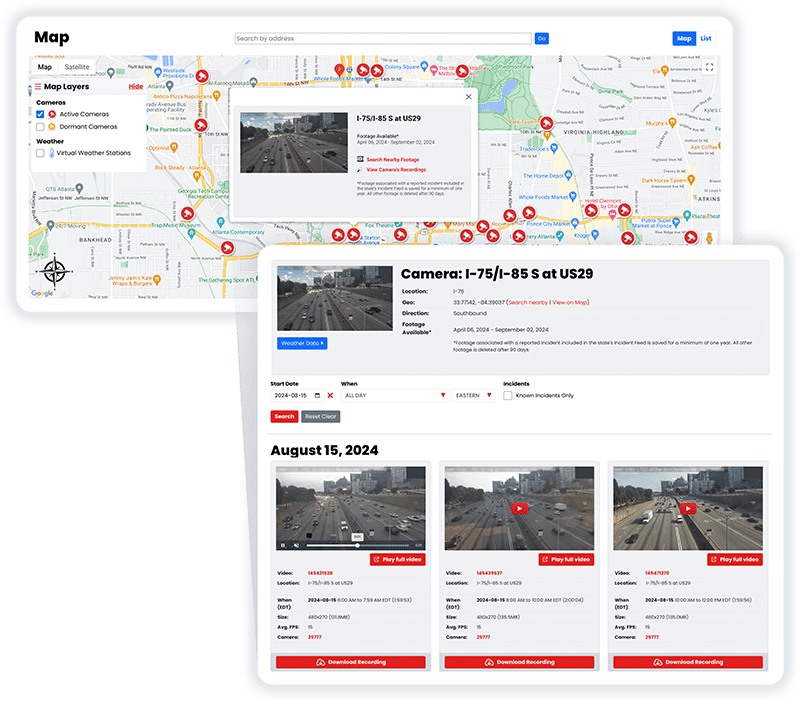
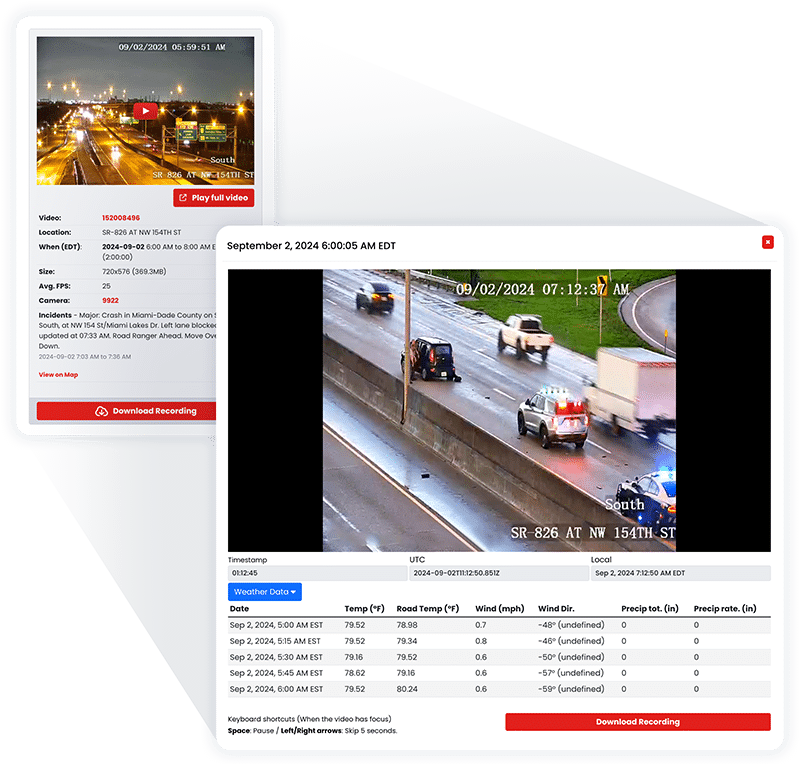
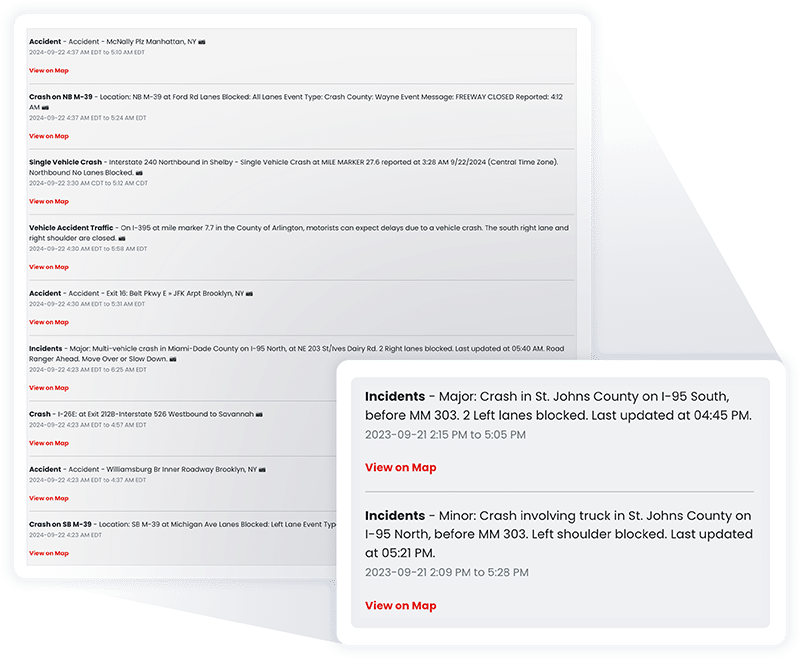
RoadProof offers a truly unique data set combining archived traffic video and a running incident feed available in most states on the system.
All of this data together allows you to get the whole picture, from the initial incident to the final outcome.
“IT WINS THE CASE. We saw the value of RoadProof immediately, you settle your cases 50% faster and for full value.”
Brian Labovick
Labovick Law Group – Florida
With our automated intelligence system, we’re able to match video footage from cameras nearby to any reported incident, and ensure that those vital video recordings are preserved in our archive for a minimum of one year.
While other systems only keep video footage for a couple of months, we keep the video footage that’s critical to your cases for much longer.
“Our case management department (which handles hundreds of cases each month) has nothing but praise for RoadProof.”
Kendra Fike
Bighorn Law – Nevada
Get started now to see how RoadProof can help you get the video data you need.
Get StartedAlready a member of RoadProof? Login here
“One of the first things I do when investigating a crash is obtain and preserve as much evidence as possible. Even before knowing all the parties involved, I immediately pull the RoadProof footage. Seeing the crash firsthand through the video is incredibly powerful. Having this video footage from the start really helps level the playing field between the plaintiff and the trucking company, which often delays or refuses to provide the truck camera video if at all.”
Jamie Mazzeo, Litigation Paralegal
The Truck Accident Law Firm – Florida


Get started now to see how RoadProof can help you get the video data you need.
Get StartedAlready a member of RoadProof? Login here
If you’re looking to obtain access to traffic camera archives in Norfolk, Virginia, the quick version is that while much of what you’ll be looking for will not be available on your own, much of what you want won’t be easily accessible. While Norfolk’s cameras are designed to aid in managing traffic flow and assist in enforcement efforts by providing a photographic record of vehicles running red lights, speeding in school zones, etc., they were not created to provide the general public with the ability to access their records. Additionally, many systems delete footage on very short cycles, while others may not record at all, and systems that do record and store data are not typically designed to provide that data promptly.
That’s where RoadProof can come into play: to provide immediate access to recorded video data related to traffic accidents for attorneys, insurance companies, law enforcement agencies and investigators so they wouldn’t have to spend multiple days or weeks tracking down information that might exist somewhere.
The purpose of this page is to provide answers to every question you should ask yourself regarding Norfolk’s traffic camera system: what type of cameras are being utilized, what they capture, and how to utilize RoadProof to access recorded archival data.
Traffic cameras serve several functions. They can be utilized as a tool for engineers to monitor and control traffic flow and provide them with real-time information regarding the extent of congestion and the operation of signals. In addition, traffic cameras can also serve as enforcement tools by photographing vehicles that run red lights or travel at excessive speeds in school zones. More recently, the city of
Norfolk has installed traffic cameras that are specifically designed to assist law enforcement in identifying and tracking vehicles.
While traffic cameras can be useful for determining liability in traffic accidents, the primary issue is that most systems were not developed with archival in mind. For example, Virginia Department of Transportation (VDOT) cameras broadcast live video feeds but do not retain that information once the event is completed. Most other systems record video but typically have policies and practices in place that result in erasing old footage on a continuous basis. Oftentimes, this occurs within a matter of days.
RoadProof takes a different approach. The company collects recorded video from thousands of cameras throughout Virginia, combines it with incident data, and retains relevant video footage for a period of one year. Therefore, if a car crash occurred at an intersection in
Norfolk six months prior to today, it is possible that the video footage documenting the occurrence remains in RoadProof’s archive, even though it has been erased from nearly every other source.
The city of Norfolk utilizes PhotoSafe cameras at select intersections to capture photographs of vehicles that fail to come to a complete stop before entering the intersection after the red light has changed. A photo and/or a short video of the vehicle and its license number are taken. The owner of the vehicle receives a notice of violation in the mail advising of a fine.
It is worth noting that PhotoSafe does not provide a real-time video feed; nor does the city maintain footage beyond processing each citation. If you attempt to locate video footage associated with a vehicle involved in an automobile accident weeks or months subsequent to receiving a PhotoSafe violation notice, you are unlikely to be able to obtain such footage through normal avenues.
Intersections equipped with PhotoSafe cameras in Norfolk have included high-traffic locations throughout the city. However, as the city continually updates and modifies the program, the exact listing of intersections utilizing PhotoSafe technology can fluctuate. If you wish to determine if an intersection was using PhotoSafe technology on a certain day, RoadProof provides assistance in researching this information.
In 2023, the city of Norfolk deployed 172 Flock Safety ALPR cameras throughout the city. Unlike standard cameras that merely collect visual images of vehicles passing through designated areas, ALPRs both capture images and read license numbers. Each vehicle is identified based on manufacturer, model, color, and license number. All collected data is compared to databases containing lists of stolen vehicles, individuals wanted on outstanding warrants, or other law enforcement indicators.
ALPR systems function primarily as investigative tools. Following a criminal act, police investigators can enter criteria into the ALPR database to discover which vehicles traveled past a particular point during a specified time frame. In cases involving civil disputes, ALPR data may support establishing that a particular vehicle existed at or proximate to an area in dispute surrounding a traffic accident.
There are valid concerns regarding individual rights associated with ALPRs. In Virginia, state law dictates how ALPR data can be maintained and applied. There are restrictions placed on third-party access to ALPR information for purposes outside law enforcement. Understanding these constraints is crucial if you are an attorney or investigator seeking to utilize ALPR data for litigation purposes.
As part of an effort to reduce vehicle speeds adjacent to schools during arrival/dismissal hours, Norfolk Public Schools has implemented 19 speed cameras located at ten separate school sites. These cameras are operational during established school hours and capture images/video of vehicles traveling at speeds greater than the speed limit posted at each site.
Similar to red-light cameras, school zone speed cameras are primarily enforcement devices. Data obtained by these cameras (video/image) is processed solely for generating fines/citations and not normally preserved for extended periods of time for public access.
Virginia Department of Transportation (VDOT) maintains a large network of cameras positioned along main roads/highways in and around Norfolk, including interstates, bridge-tunnels, and heavily trafficked corridors. Real-time images produced by these cameras enable VDOT personnel to manage traffic flow patterns/conditions, deploy resources for responding to incidents occurring on the highway network, and inform the public via mobile applications/web-based services such as 511 Virginia.
A common misconception among motorists regarding obtaining footage from VDOT Traffic Monitoring Cameras is that since a camera exists at a location where an automobile accident occurred, it follows that a recording exists as well. Unfortunately, this assumption is incorrect. VDOT’s cameras produce real-time video feeds, and those feeds are continuously replaced by new footage after they cease transmitting.
Consequently, regardless of how hard you search or who you contact, if you cannot obtain a copy of a video recording from VDOT personnel within 24 hours of the time an incident occurred at a VDOT-monitored location (such as on the Hampton Roads Bridge-Tunnel or I-64), then it did not exist.
One way RoadProof remedies this deficiency is by collecting recorded video from cameras located throughout Virginia (including nearby VDOT-monitored locations).
Video is the tiebreaker when two drivers give conflicting stories. Video provides views of vehicles’ positions, speeds, signals, and sequences of events far more effectively than either eyewitness testimony or police reports. When video exists of the accident itself or of the seconds before impact, the direction of a personal injury case is dramatically changed.
For example, consider a rear-end accident occurring on a busy street in Norfolk. The driver responsible for the collision claims that the other vehicle suddenly came to a stop without warning. However, a traffic camera shot of the approaching vehicle and its braking lights tells a different story. On the other hand, if there are two vehicles involved in a T-Bone intersection collision where each driver claims they received the green light, then the video does not make arguments. It simply shows what occurred.
RoadProof connects video with event data so that you can see what the camera saw but also see it within the context of those elements. Was it raining? Were conditions impaired due to limited visibility? Was there an active incident report at that location during that time? These elements build upon one another to provide a more comprehensive view for reconstructionists, attorneys, and insurance companies.
Insurance adjusters operate with incomplete information by default. Without video to assist them, claims are processed slowly, disputes occur more frequently, and too many times, settlements do not accurately reflect the true facts of the matter. Those attorneys utilizing RoadProof routinely indicate they experience resolution of cases much faster and at greater value to their clients.
Brian Labovick of Labovick Law Group stated, “IT WINS THE CASE. We saw the value of RoadProof immediately; you settle your cases 50% faster and for full value.”
This type of result is not coincidental. Instead, this is what occurs when you can provide objective evidence to an adjuster rather than solely providing conflicting statements.
In addition to aiding in the investigation of accidents, the archival traffic camera footage utilized by RoadProof has great value for transportation researchers and city planners. By analyzing long-term patterns of traffic movement, evaluating how signal timing affects traffic flow, and studying pedestrian movements at various intersections, researchers are able to benefit from video data within RoadProof archives that extend well past a single photo opportunity. With over 40 million hours of recorded video within RoadProof’s archive, researchers are able to conduct longitudinal studies in ways that cannot be accomplished through real-time-only platforms.
Below is a list of primary camera-equipped intersections/corridors in Norfolk. This list was developed using publicly available City data, Virginia Department of Transportation (VDOT) records, and RoadProof’s archives. This is not an inclusive listing because camera installations may continue to evolve as new programs develop and/or change. If you feel a location should be included in the list, you can contact RoadProof directly to inquire about a potential search.
| Location / Intersection | Camera Type | Purpose |
| Granby St & 21st St | Red-Light (PhotoSafe) | Red-light enforcement |
| Military Hwy & Little Creek Rd | Red-Light (PhotoSafe) | Red-light enforcement |
| Hampton Blvd & 35th St | Red-Light (PhotoSafe) | Red-light enforcement |
| Tidewater Dr & Bayview Blvd | Red-Light (PhotoSafe) | Red-light enforcement |
| Virginia Beach Blvd & Newtown Rd | Red-Light (PhotoSafe) | Red-light enforcement |
| Sewells Point Rd & E Little Creek Rd | ALPR (Flock Safety) | Vehicle identification |
| Norview Ave & Orcutt Ave | ALPR (Flock Safety) | Vehicle identification |
| Church St & Brambleton Ave | ALPR (Flock Safety) | Vehicle identification |
| Various Norfolk Public School locations (10 sites) | Speed Camera | School-zone speed enforcement |
| I-64 / Hampton Roads Bridge-Tunnel approaches | VDOT Monitoring | Real-time traffic management |
| I-264 corridor (Downtown Norfolk) | VDOT Monitoring | Real-time traffic management |
| Midtown Tunnel / Downtown Tunnel approaches | VDOT Monitoring | Real-time traffic management |
VDOT monitors cameras with no footage retention. To find archived video near VDOT camera locations, type in RoadProof’s database searching by date, time, and location.
If you think there may be a camera at a location not listed here, reach out to RoadProof. Their database contains thousands of cameras across Virginia, and their team can usually locate footage at many intersections that don’t appear on any publicly maintained list.
The concept behind RoadProof is simple: the video you need should be found in minutes, not days. Once you’ve been granted access with a full unlimited membership, you’ll simply enter the date, time, and location. From there, your search will yield all video from nearby cameras as well as incident data as reported from the cameras.
According to the platform itself, you receive “instant access to millions of hours of recorded video data from thousands of traffic cameras in Virginia.” This isn’t simply marketing jargon; this is the actual difference between spending a week filing public records requests to numerous agencies to download what you need in one afternoon.
One thing that clearly sets RoadProof apart from its competition- many other camera systems that do record, either city-owned or state-ops, only retain footage between 30 and 90 days. Many overwrite even faster than that. So when someone finally retains an attorney, and then the attorney begins asking for footage, there usually isn’t any more.
RoadProof retains footage related to incidents for a minimum of one year. That window is the difference between having evidence & having no evidence.
Law firms, insurance companies, and accident investigation professionals can receive membership access to RoadProof. All state and local law enforcement agencies have free access (no subscription costs or fees).
If you were involved in an accident and want to see if there is any footage related to your vehicle or injury, RoadProof will still work with you. Due to the fact that access to this type of footage is restricted for both privacy and security purposes, RoadProof connects you with an attorney in your area who has a license to practice law in your jurisdiction. If you’re already working with an attorney, simply point them to the platform.
To learn more or schedule a demo, visit RoadProof.com.
VA Code Sec 46.2-833.1 authorizes cities/towns to operate traffic light signal monitoring systems (red light cameras). Norfolk’s PhotoSafe program is authorized under these terms. While penalties for red light violation infractions are capped at the state level, programs must be reviewed in accordance with legislative requirements periodically.
Virginia laws govern how long plate reader data may be retained & who can access it. As of 2024, VA law enforcement agencies may retain ALPR data up to 60 days unless it has been linked to ongoing investigations; then the time frame may extend beyond 60 days. However, private usage of ALPR data is much more restricted than that. Users of ALPR data in civil matters should consult with an attorney familiar with Virginia-specific laws.
Video from traffic cameras obtained via RoadProof should only be used for professional purposes: accident investigation, legal claims, insurance claims, and law enforcement. Do not use this platform for tracking individuals, surveillance, or to harass anyone. Limitations on uses are clearly stated in RoadProof’s terms of service, and users are responsible for complying with applicable state and federal privacy laws when using video in their work.
If you have questions regarding permissible use, contact RoadProof directly or consult with a VA attorney who is familiar with data privacy law.
Get started now to see how RoadProof can help you get the video data you need.
Get StartedAlready a member of RoadProof? Login here
We will review your request within 1-2 business days and will contact you by either phone or email, or both. In the meantime, learn more about your team!