Already a member? Log into your account
Get instant access to millions of hours of recorded video from hundreds of traffic cameras in Dallas, Texas.
Get Started TodayRoadProof is trusted by the best organizations across America.


















Are you part of a law enforcement agency? Get Roadproof now, for FREE. Click here to sign up.
With RoadProof, you can save thousands of dollars and hundreds of hours of time tracking down the video data you need, for whatever your end use case might be – whether it’s an accident case or criminal investigation.
Recorded video data that used to take days or weeks to find, can now be searched for, located and downloaded in a matter of minutes using the platform.
“The platform continues to be vital and a remarkable tool. It’s a great asset to our agency for all of our cases.”
Master Sergeant John A. Boos
Traffic Homicide Investigation, Florida Highway Patrol – Florida
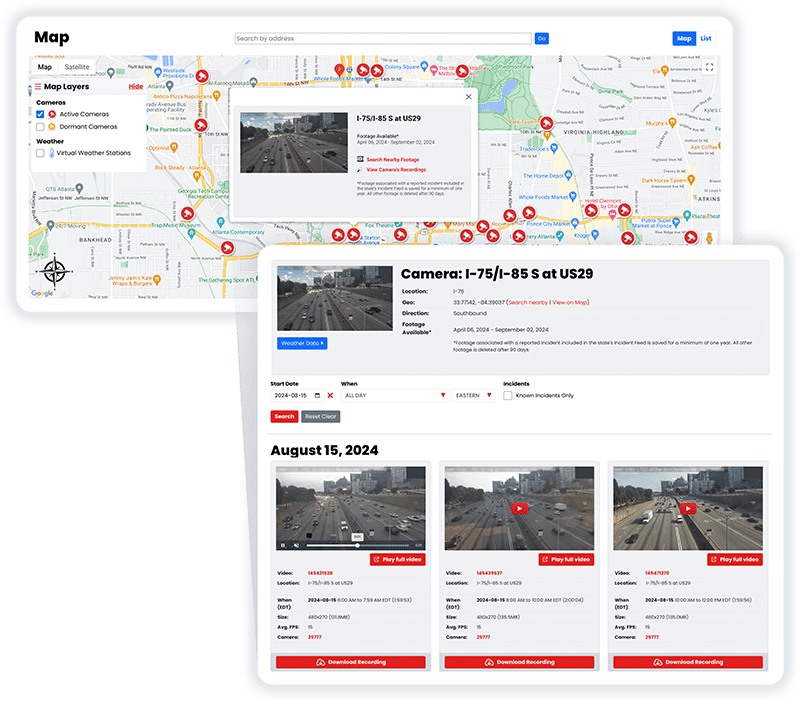
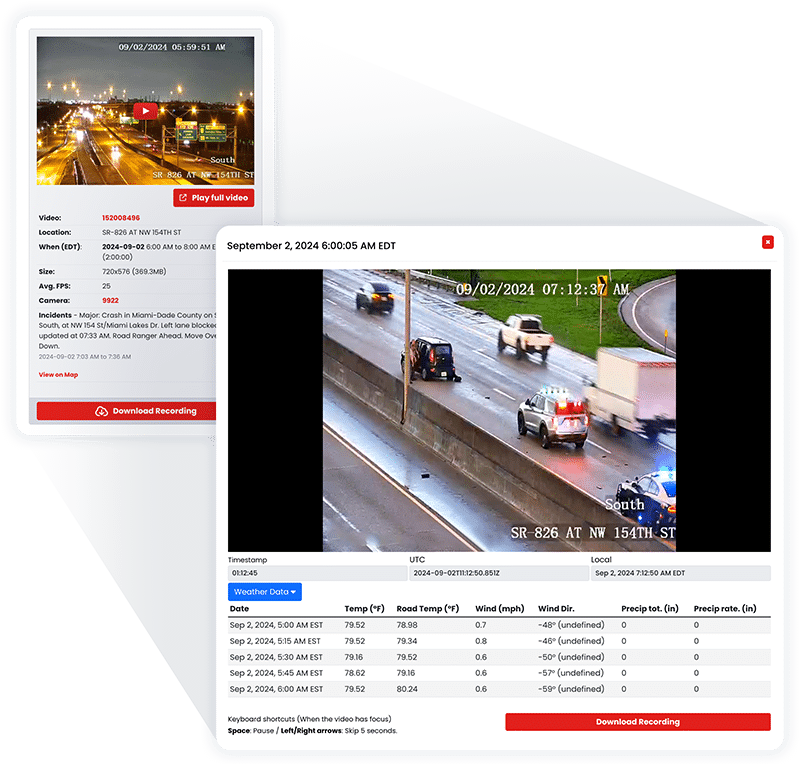
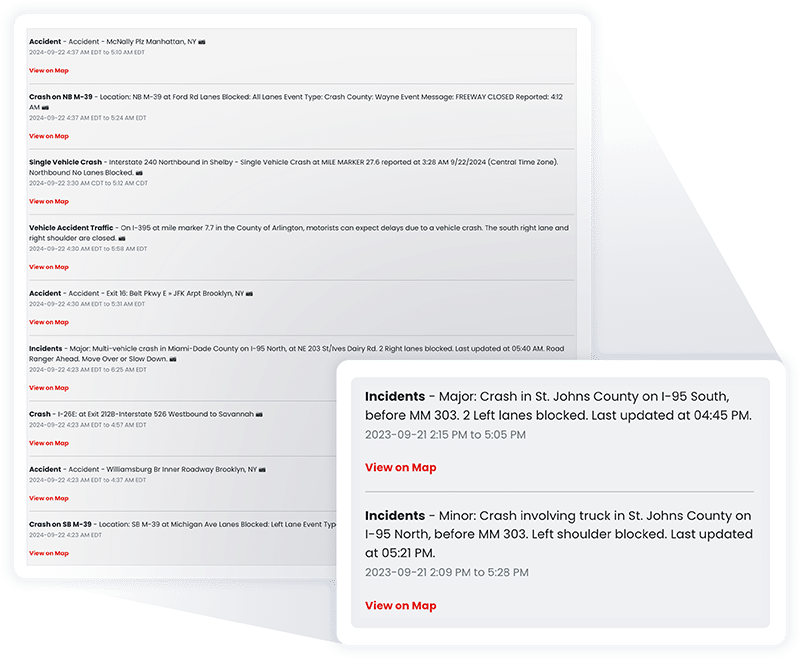
RoadProof offers a truly unique data set combining archived traffic video and a running incident feed available in most states on the system.
All of this data together allows you to get the whole picture, from the initial incident to the final outcome.
“IT WINS THE CASE. We saw the value of RoadProof immediately, you settle your cases 50% faster and for full value.”
Brian Labovick
Labovick Law Group – Florida
With our automated intelligence system, we’re able to match video footage from cameras nearby to any reported incident, and ensure that those vital video recordings are preserved in our archive for a minimum of one year.
While other systems only keep video footage for a couple of months, we keep the video footage that’s critical to your cases for much longer.
“Our case management department (which handles hundreds of cases each month) has nothing but praise for RoadProof.”
Kendra Fike
Bighorn Law – Nevada
Get started now to see how RoadProof can help you get the video data you need.
Get StartedAlready a member of RoadProof? Login here
“One of the first things I do when investigating a crash is obtain and preserve as much evidence as possible. Even before knowing all the parties involved, I immediately pull the RoadProof footage. Seeing the crash firsthand through the video is incredibly powerful. Having this video footage from the start really helps level the playing field between the plaintiff and the trucking company, which often delays or refuses to provide the truck camera video if at all.”
Jamie Mazzeo, Litigation Paralegal
The Truck Accident Law Firm – Florida


Get started now to see how RoadProof can help you get the video data you need.
Get StartedAlready a member of RoadProof? Login here
If you’ve ever been in a crash on I-35E or gotten rear-ended on US-75 and wondered whether a traffic camera caught the whole thing, you’re not alone. Dallas drivers, commuters, and investigators ask this question constantly, and the answer is more complicated than most people expect. This guide walks you through how Dallas traffic cameras actually work, where to watch live feeds, whether any of it gets recorded, and what your real options are for finding archived footage after an incident. For professionals who need that footage in a legal or investigative capacity, we’ll also cover how RoadProof gives you direct access to a massive archive of recorded video alongside incident data.
The cameras you see mounted on poles and gantries around Dallas are not recording everything for later review. They exist to help traffic operators watch congestion, detect incidents, and adjust signal timing in real time. That’s their job. They are not surveillance cameras in the traditional sense, and they are not enforcement cameras.
On the enforcement side, it’s worth knowing that Texas banned red-light cameras in 2019. Cities that had them were required to shut down their programs, so there are no longer active red-light cameras issuing tickets anywhere in the state.
Three main entities run the camera infrastructure in and around Dallas. The City of Dallas Traffic Management Center handles local arterials and signal coordination within city limits. TxDOT manages the highway network, including I-35E, US-75, I-635, and other major corridors. And DriveTexas, TxDOT’s statewide road conditions platform, pulls from many of those same cameras and makes the feeds accessible to the public.
These systems are designed for operational use. The operators watching them are looking for accidents, debris in the road, and backup building at interchanges, not building a video archive for future reference.
If you want to check conditions before you get on the highway, or you’re trying to see what’s happening at a specific location right now, these are your best options:
TxDOT Dallas ITS Portal – TxDOT operates an interactive map that shows camera icons at major highway locations across the Dallas metro. You can click any camera icon to pull up a live feed for that stretch of road. It covers I-35E, US-75, I-635, SH-183, and other major corridors. There’s no search bar and no archive. What you see is what’s happening right now.
TxDOT’s “See Live Traffic Cameras” Page – TxDOT also maintains a statewide page with links to camera feeds organized by metro area. You can find the Dallas section and jump directly to live video. Again, these are live-only feeds with no recording capability on the public side.
DriveTexas.org – DriveTexas is TxDOT’s public road conditions tool. It’s map-based, and camera icons will appear once you zoom in on a specific area. The data can run a few minutes behind, so it’s more useful for general trip planning than for watching an incident unfold in real time.
City of Dallas Traffic Management Center – For incidents within Dallas city limits, local news stations frequently use Dallas TMC camera feeds in their traffic coverage. If you’re trying to watch conditions on a city street rather than a highway, checking a local TV station’s traffic page is often your most practical option.
One important note for all of these: none of them record or store footage. You can watch live, but there’s nothing to go back and review.
The short answer is no, and TxDOT is clear about it. Their cameras are built for real-time traffic monitoring. The video streams are not archived, and there is no database of footage from past days or weeks that anyone can request access to.
This is consistent with how similar systems work elsewhere. Houston TranStar, which runs the camera network for the Houston area, says the same thing about their feeds. These platforms are tools for traffic operators, not evidence preservation systems. The infrastructure is optimized for speed and coverage, not storage.
It’s also worth distinguishing between the different types of cameras that exist in public spaces. TxDOT traffic monitoring cameras, city TMC cameras, and the now-defunct red-light cameras all serve different purposes and operate under different policies. The monitoring cameras are live-only. The red-light cameras no longer exist in Texas. And any other government-owned cameras in special locations, like construction zones or certain downtown corridors, operate under their own agency policies, which may or may not include recording.
The bottom line: if you’re hoping that TxDOT or the City of Dallas has a recording of your crash sitting in a server somewhere, that’s very unlikely. Which brings us to what actually might exist.
Because the official traffic camera system doesn’t retain footage, most people need to look elsewhere. And speed matters more than almost anything else. Private cameras, whether at a gas station, apartment complex, or on someone’s dash, generally overwrite their recordings within a few days to a few weeks. If you wait too long, the footage is gone, and there’s no recovering it.
Private businesses and residential security cameras are often your best starting point. Gas stations, convenience stores, fast food restaurants, and retail parking lots along major roads almost always have exterior cameras. If your crash happened near any of those, there’s a real chance one of them caught it. Homeowners near busy intersections sometimes have doorbell or driveway cameras that capture street activity as well.
Dash cams and witness smartphones are increasingly common sources. More drivers have dash cams now than ever before, and bystanders often pull out their phones when they see a crash.
Canvassing the scene or checking with anyone who stopped can turn up footage you’d never find through official channels.
Commercial fleet and ride-share vehicles are another underutilized source. Trucking companies, delivery fleets, and Uber and Lyft drivers typically have onboard cameras running continuously. If any of those vehicles were in the area when your crash happened, their footage could be valuable.
Private networks like RoadProof occupy a different category entirely. Rather than relying on sources that may or may not have captured the incident, RoadProof actively preserves archived traffic camera footage from thousands of cameras across the country, matched to incident reports. That infrastructure exists specifically so that evidence is there when someone needs it.
Start by nailing down the exact time and location. “Sometime in the afternoon near the highway” won’t get you far. You need the date, the time down to the nearest few minutes, and the specific intersection or mile marker. The police report is usually your most reliable source for this.
Next, canvass the area. Walk or drive the block and look for cameras. Note the name of every business that might have had a view of the crash. Approach them promptly and politely, explain what happened, and ask whether they can preserve and share the footage before it’s overwritten. Most businesses will cooperate if you ask quickly and professionally.
If there’s any chance a government-owned camera recorded the incident, file an open records request with the relevant agency. Under Texas law, you can request records from state and local government entities. Success isn’t guaranteed, especially given that most traffic cameras don’t record, but it’s worth pursuing in cases where a specialized camera (such as one in a construction zone) might have been in operation.
For high-stakes situations, working with an attorney or accident reconstruction professional is the right move. They can send spoliation letters to businesses and fleet operators, issue subpoenas, and ensure that any footage obtained is properly authenticated for use in court.
Trying to do this yourself in a significant injury case is usually a mistake.
RoadProof is a platform built around a problem that everyone in the accident investigation space knows well: finding video evidence is slow, fragmented, and often fruitless by the time someone starts looking. The platform maintains a library of over 40 million hours of archived traffic camera footage from thousands of cameras across the United States, combined with a live incident feed that’s available in most states.
The incident feed is one of the more useful features. RoadProof’s automated system matches video from nearby cameras to reported incidents and preserves those recordings for a minimum of one year.
While other systems may keep footage for a month or two at most, RoadProof retains the clips most likely to be relevant to active cases for long enough to actually be useful.
As Jamie Mazzeo, a litigation paralegal at The Truck Accident Law Firm in Florida, put it: “One of the first things I do when investigating a crash is obtain and preserve as much evidence as possible. Even before knowing all the parties involved, I immediately pull the RoadProof footage. Seeing the crash firsthand through the video is incredibly powerful.”
RoadProof is designed for professionals. That means law enforcement, licensed attorneys, insurance companies, and accident reconstruction firms. For law enforcement agencies, access is completely free. For attorneys and other professionals, membership gives you the ability to search for, locate, and download footage in minutes rather than spending days tracking down the right agency contact or canvassing a neighborhood.
For individuals who were injured in an accident and want to know if footage exists, RoadProof works through a referral process. If you’re already working with an attorney, point them to RoadProof. If you’re not, the platform can connect you with a personal injury attorney in your area who has access to the system.
Relying on TxDOT’s live feeds gets you nothing after the fact. Canvassing businesses and requesting footage manually is time-consuming, and you’re in a race against automatic deletion cycles. Sending open records requests to government agencies is worth trying but rarely produces results in the Dallas traffic camera context.
RoadProof’s archive exists specifically to close that gap. The footage is already preserved, and already matched to incident data at the time of the crash. Brian Labovick of Labovick Law Group in Florida summarized it directly: “It wins the case. We saw the value of RoadProof immediately. You settle your cases 50% faster and for full value.”
For anyone working accident cases in Dallas or anywhere else in Texas, that’s the kind of tool worth knowing about before you need it, not after.
Get started now to see how RoadProof can help you get the video data you need.
Get StartedAlready a member of RoadProof? Login here
We will review your request within 1-2 business days and will contact you by either phone or email, or both. In the meantime, learn more about your team!