Already a member? Log into your account
Get instant access to millions of hours of recorded video & incident data from hundreds of traffic cameras in Houston, Texas.
Get Started TodayRoadProof is trusted by the best organizations across America.


















Are you part of a law enforcement agency? Get Roadproof now, for FREE. Click here to sign up.
With RoadProof, you can save thousands of dollars and hundreds of hours of time tracking down the video data you need, for whatever your end use case might be – whether it’s an accident case or criminal investigation.
Recorded video data that used to take days or weeks to find, can now be searched for, located and downloaded in a matter of minutes using the platform.
“The platform continues to be vital and a remarkable tool. It’s a great asset to our agency for all of our cases.”
Master Sergeant John A. Boos
Traffic Homicide Investigation, Florida Highway Patrol – Florida
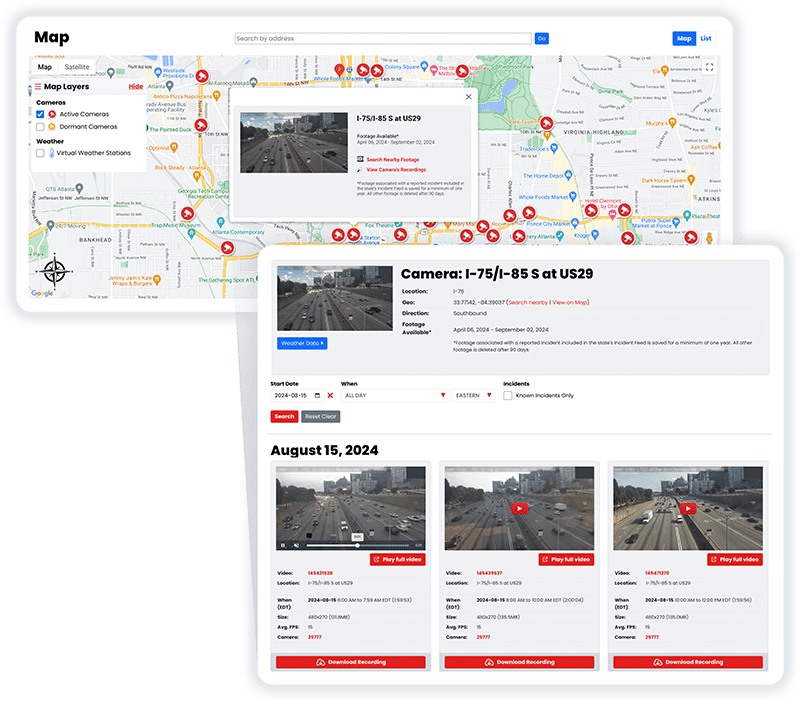
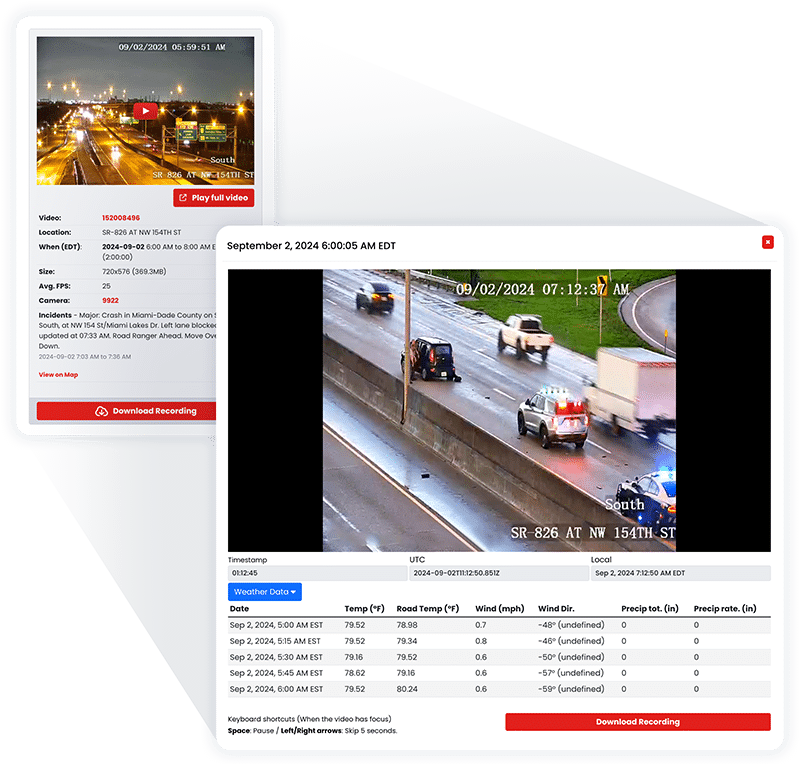
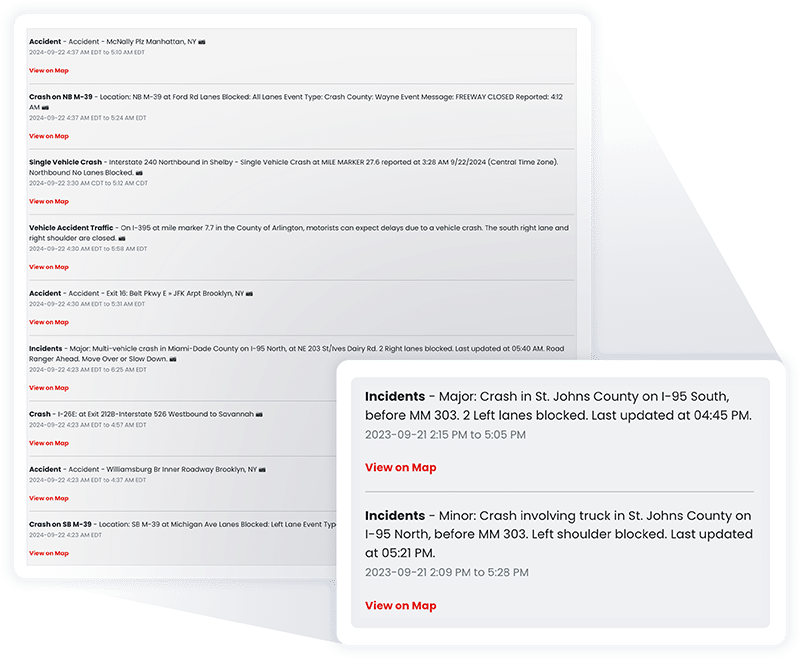
RoadProof offers a truly unique data set combining archived traffic video and a running incident feed available in most states on the system.
All of this data together allows you to get the whole picture, from the initial incident to the final outcome.
“IT WINS THE CASE. We saw the value of RoadProof immediately, you settle your cases 50% faster and for full value.”
Brian Labovick
Labovick Law Group – Florida
With our automated intelligence system, we’re able to match video footage from cameras nearby to any reported incident, and ensure that those vital video recordings are preserved in our archive for a minimum of one year.
While other systems only keep video footage for a couple of months, we keep the video footage that’s critical to your cases for much longer.
“Our case management department (which handles hundreds of cases each month) has nothing but praise for RoadProof.”
Kendra Fike
Bighorn Law – Nevada
Get started now to see how RoadProof can help you get the video data you need.
Get StartedAlready a member of RoadProof? Login here
“One of the first things I do when investigating a crash is obtain and preserve as much evidence as possible. Even before knowing all the parties involved, I immediately pull the RoadProof footage. Seeing the crash firsthand through the video is incredibly powerful. Having this video footage from the start really helps level the playing field between the plaintiff and the trucking company, which often delays or refuses to provide the truck camera video if at all.”
Jamie Mazzeo, Litigation Paralegal
The Truck Accident Law Firm – Florida


Get started now to see how RoadProof can help you get the video data you need.
Get StartedAlready a member of RoadProof? Login here
If you’ve been in an accident in Houston, one of the first questions you’ll ask is: Was there a camera nearby? It’s a reasonable instinct. Houston has one of the most heavily monitored road networks in the country, and camera footage is about as close to objective evidence as you’re going to get. It doesn’t misremember details. It doesn’t have a stake in the outcome. It shows what happened.
The problem is getting your hands on it.
Houston’s traffic cameras are managed by a mix of agencies, each with its own rules about what gets recorded, how long it’s kept, and how you can request it. Most of the time, even if a camera was pointed directly at the moment of your crash, the footage is already gone before you know you need it.
Houston’s traffic camera network is bigger than most people realize, but it’s also more fragmented. There’s no single agency running everything. Instead, cameras are operated by several different entities with different purposes and different policies.
Houston TranStar is the most visible piece of the puzzle. It’s a joint operation between Harris County, the City of Houston, TxDOT, and METRO, and it monitors freeways and major surface streets across the region. If you’ve ever checked traffic conditions online before a commute, you’ve probably used TranStar’s live feeds. The cameras are real, they’re pointed at busy corridors, and operators watch them in real time. What TranStar does not do is store video. The feeds are live-only. Once the moment passes, it’s gone.
TxDOT operates its own cameras along state highways and entrance ramps throughout the Houston district. Same situation: live monitoring, no recording for public access.
Beyond those two, there are city-operated intersection cameras, law enforcement cameras like HPD dashcams, red-light enforcement systems managed by private contractors, and private cameras on businesses, gas stations, parking lots, and apartment complexes. Each one operates under different rules.
Here’s a quick breakdown:
| Camera Type | Operator | Recorded? | Accessible? |
| TranStar freeway cameras | TranStar (multi-agency) | No | Live only |
| TxDOT highway cameras | TxDOT | No | Live only |
| City intersection cameras | City of Houston | Sometimes | Varies by location |
| Red-light cameras | Private contractors | Enforcement only | Generally no |
| Law enforcement cameras | HPD / Harris County | Yes | Via public records request |
| Private / business cameras | Property owners | Usually yes | By request or legal action |
| RoadProof archive | RoadProof | Yes | Via attorney or law enforcement |
The most common misconception people have after an accident is that traffic cameras must have recorded it. The truth is, for the major public systems in Houston, they almost certainly didn’t.
TranStar and TxDOT cameras were built for traffic management, not evidence preservation. Storing continuous video from hundreds of cameras across a major metro area would require enormous infrastructure and ongoing costs. The agencies made a practical decision: don’t record it. Operators watch the feeds in real time, and that’s where the footage’s useful life ends.
Even for cameras that do record, the retention windows are short. Many private systems overwrite footage within 24 to 72 hours. Some cycle even faster. By the time you’ve dealt with the immediate aftermath of an accident, gotten medical attention, filed an insurance claim, and thought to ask about camera footage, it may already be gone.
If you decide to pursue an official public records request, the process has its own obstacles. Under the Texas Public Information Act, you have the right to request records from government agencies, but the request only works if the footage actually exists. You also need to know exactly which agency owns the camera at that specific location, which isn’t always obvious. A camera that looks like a TranStar camera might belong to a different entity entirely. Each agency has its own submission process, its own fees, and its own timeline for responding, and responses can come back denying the request simply because there was never anything recorded to begin with.
If you want to try the official route, here’s how to do it in a way that gives you the best possible shot.
Step 1: Identify the exact camera location and time. Before you contact anyone, nail down the specifics. Where exactly did the accident happen? What time? In which direction were you traveling? If you were on a freeway, note the highway name and any nearby mile markers or exit ramps. If you were at an intersection, get the street names. The more specific you are, the better.
Step 2: Figure out who owns the camera. For freeways and major corridors, start with TranStar’s camera map at houstontrafficmap.org. For state highways, check TxDOT’s Houston district information. If the location is a city street, the City of Houston’s traffic engineering department may be the right contact. Keep in mind that you may not be able to determine ownership without making a few calls.
Step 3: Send a Texas Public Information Act request immediately. This is time-critical. Even agencies that do record footage won’t hold it indefinitely. Your request should include: your name and contact information, the specific camera location (as detailed as possible), the date and time of the incident, and a clear statement that you’re requesting any recorded video from that camera during that window. Send it via certified mail or the agency’s official online submission portal so you have a paper trail. A sample opening line: “Pursuant to the Texas Public Information Act, I am requesting any recorded video footage from [camera location] on [date] between [time range].”
Step 4: Submit to the right place. TxDOT public information requests go through their district office. TranStar requests typically route through the City of Houston or Harris County, depending on the camera’s jurisdiction. Don’t send a single request to one agency and assume it covers all of them.
Step 5: Follow up. Agencies have 10 business days to respond under Texas law, but follow-up often matters. If you don’t hear back, call. Track your request number.
One important note: there’s a real chance this process comes back empty-handed, either because the footage was never recorded or because it was already overwritten by the time your request arrived. That’s not a failure on your part. It’s just how these systems work. The official route is worth attempting, but it shouldn’t be your only plan.
If TranStar and TxDOT can’t help, you’re not out of options. You just need to think broader.
Private business cameras are often the most useful alternative. Gas stations, fast food restaurants, banks, pharmacies, and strip malls frequently have exterior cameras pointed at their parking lots and nearby streets. If your accident happened near any commercial property, it’s worth approaching the business manager directly and asking whether they have footage and whether they’ll preserve it. Be polite, be quick, and get there before they cycle it out.
Dashcam footage from other drivers is increasingly available. More people have dashcams than ever, including witnesses who may not have stopped. If anyone saw your accident or was driving near the area, there’s a chance they have footage they don’t even know is relevant.
METRO bus and rail cameras can be useful if the accident occurred near a bus route or transit corridor. METRO operates its own recording systems, and those records can be requested through the agency.
Eyewitness accounts and accident reconstruction become more important when no video exists. Physical evidence at the scene, including skid marks, vehicle damage patterns, and debris fields, can tell a story that supports your version of events. An experienced accident reconstruction expert can work with this evidence to build a credible timeline.
The same urgency applies here as it does with official cameras. Private footage disappears fast. If you think there’s a camera that might have caught something, get to it within hours if possible, not days.
Here’s the core problem with Houston’s camera landscape: the cameras exist, but the footage doesn’t get preserved. RoadProof was built specifically to solve that.
RoadProof ingests live camera streams from public traffic networks, including TranStar and TxDOT feeds, and archives that footage continuously. If there was a camera near your accident, RoadProof has likely been recording it. That footage is stored for a minimum of one year, which is a fundamentally different retention policy than anything the public agencies maintain.
The platform is also more than just stored video. RoadProof combines archived footage with a running incident feed. That matters in a case context because it lets investigators see the full picture: what the road conditions were, what other incidents were reported nearby, and what the cameras actually captured in the moments around the crash. If there was a prior incident that backed up traffic and contributed to the chain of events, that’s documented too.
RoadProof works with law enforcement, attorneys, insurers, and accident reconstruction experts. Licensed professionals can search the platform by location and time, identify which cameras were in the area, and download footage in minutes rather than waiting weeks for a records request to come back denied. Law enforcement access is free.
Attorneys and law firms access the platform through a subscription.
For individuals involved in accidents, RoadProof access runs through your attorney or insurance representative. If you don’t have an attorney yet, RoadProof can connect you with one in the Houston area who has platform access and can start pulling footage on your behalf right away.
Consider a situation that plays out regularly in Houston: a driver is rear-ended on I-10 near the Beltway, a stretch of highway well-covered by TranStar cameras. The at-fault driver disputes liability. The injured driver’s attorney contacts TranStar to request footage and gets back what has become a familiar answer: TranStar cameras don’t record. There is no footage to provide.
Without video, the case comes down to competing accounts. But the attorney knows about the location, checks RoadProof’s archive, and finds that a camera in the area had been ingesting that same live stream. The footage exists in the archive. It shows the sequence of events clearly: a lane change, a sudden reduction in speed, and the collision. There’s no dispute about what happened after that.
This isn’t a hypothetical process. It’s what RoadProof was built for. The public agencies weren’t designed to be evidence repositories, and expecting them to function that way sets most accident victims up for disappointment. RoadProof doesn’t replace the official process. It fills the gap that the process leaves open.
Regardless of what camera footage does or doesn’t exist, what you do in the immediate aftermath of an accident matters. Here’s what to prioritize:
Get to safety first, then call 911. Don’t move vehicles unnecessarily if doing so would destroy evidence, but your physical safety comes first.
Take photos of everything: vehicle positions, damage, road conditions, skid marks, traffic signals, and any cameras you can see mounted nearby. Even knowing a camera’s location and approximate angle can help investigators figure out what it may have captured.
Write down or record the time on your phone immediately. Exact timestamps matter when pulling footage.
Collect witness information. Names and phone numbers from anyone who stopped or saw what happened.
Get the police report number before you leave or ask the responding officer how to obtain it.
Note any nearby businesses or properties with visible cameras. You don’t need to approach them right away, but documenting their locations gives you something to work from later.
Then contact an attorney as quickly as possible. The legal preservation process, including sending formal letters to agencies and businesses requiring them to retain footage, can only start once someone is working on your behalf. The sooner that happens, the better your chances of finding a video that still exists.
Do Houston TranStar cameras record video? No. TranStar cameras provide live feeds for traffic monitoring purposes. The streams are not archived, and there is no stored footage available for public records requests.
Does TxDOT keep traffic camera footage in Houston? No. TxDOT cameras along Houston-area highways are also live-only monitoring systems. They do not maintain recorded archives for public access.
How long does any recorded footage last? It depends on the source. Private business cameras typically retain footage for 24 to 72 hours before overwriting. Law enforcement cameras may retain footage longer depending on agency policy. RoadProof archives footage for a minimum of one year.
Can I get red-light camera footage in Houston? Generally, no. Red-light cameras in Houston and surrounding areas are contracted for enforcement purposes only. The footage is used to issue citations and is not typically made available for civil litigation or individual records requests.
Is there a fee to request official footage? Public information requests under the Texas Public Information Act may involve administrative fees, particularly if the search and retrieval require significant staff time or the material is voluminous.
What if multiple agencies might have cameras at the same location? You would need to submit separate requests to each agency. The jurisdictional overlap in Houston, between TranStar, TxDOT, the city, and Harris County, means a single request won’t cover all possibilities. RoadProof simplifies this because its archive pulls from multiple camera networks and can be searched by location without needing to know in advance which agency owns which camera.
I’m not sure which direction the camera was pointed. Can RoadProof still help? Yes. RoadProof’s platform and support team can help identify which cameras were in the vicinity of a reported incident and what angles they covered. You don’t need to have everything figured out before reaching out through your attorney.
Does RoadProof work with individual accident victims directly? Not directly. For privacy and security reasons, RoadProof works with licensed attorneys, law enforcement agencies, insurers, and investigators. If you’ve been in an accident and don’t yet have an attorney, RoadProof can connect you with a partner attorney in the Houston area who can access the platform on your behalf.
Houston’s traffic camera network is extensive and genuinely useful for managing traffic. As an evidence source, though, it has a fundamental limitation: almost none of it is recorded. TranStar and TxDOT cameras stream live and overwrite constantly. Public records requests for camera footage succeed less often than people expect, and when they do succeed, timing is everything.
The practical path forward for anyone involved in a serious accident in Houston is this: act quickly, document everything you can at the scene, reach out to an attorney early, and ask about RoadProof. The footage you need may already be sitting in an archive, waiting to be found. The question is whether you find it before it’s gone, and whether you have the right people looking.
Get started now to see how RoadProof can help you get the video data you need.
Get StartedAlready a member of RoadProof? Login here
We will review your request within 1-2 business days and will contact you by either phone or email, or both. In the meantime, learn more about your team!