Already a member? Log into your account
Get instant access to millions of hours of recorded video & incident data from thousands of traffic cameras in Seattle, Washington.
Get Started TodayRoadProof is trusted by the best organizations across America.



















Are you part of a law enforcement agency? Get Roadproof now, for FREE. Click here to sign up.
With RoadProof, you can save thousands of dollars and hundreds of hours of time tracking down the video data you need, for whatever your end use case might be – whether it’s an accident case or criminal investigation.
Recorded video data that used to take days or weeks to find, can now be searched for, located and downloaded in a matter of minutes using the platform.
“The platform continues to be vital and a remarkable tool. It’s a great asset to our agency for all of our cases.”
Master Sergeant John A. Boos
Traffic Homicide Investigation, Florida Highway Patrol – Florida
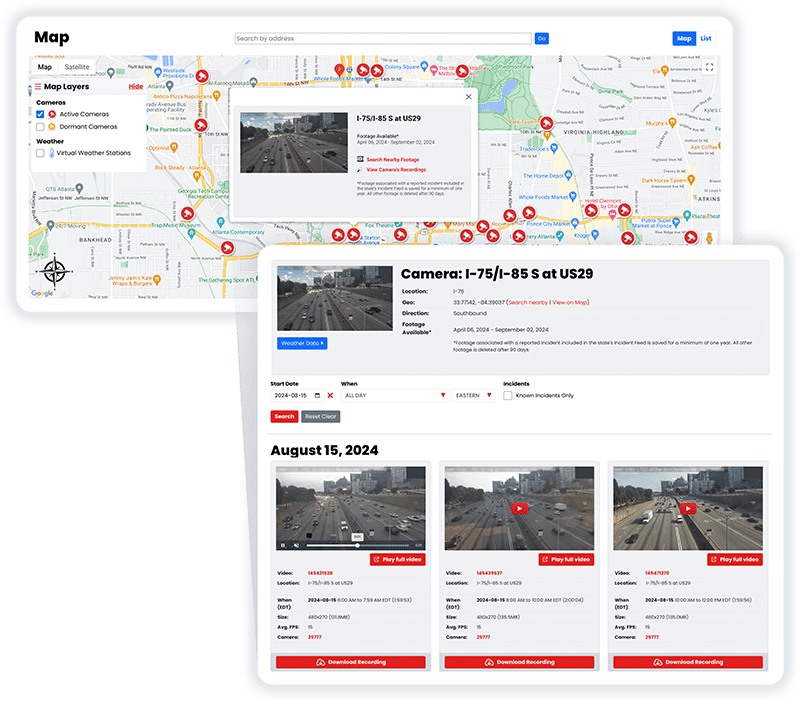
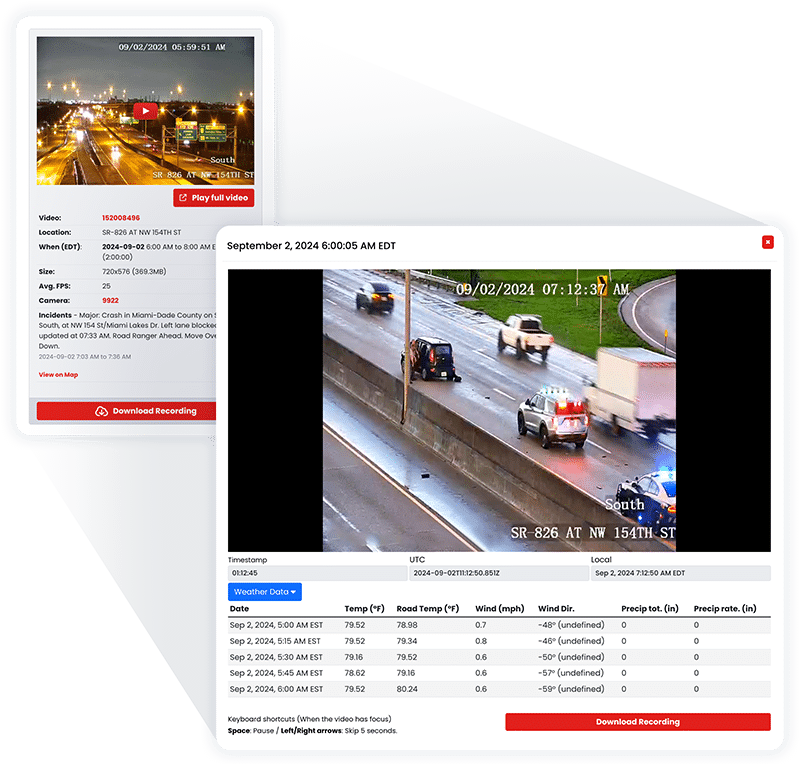
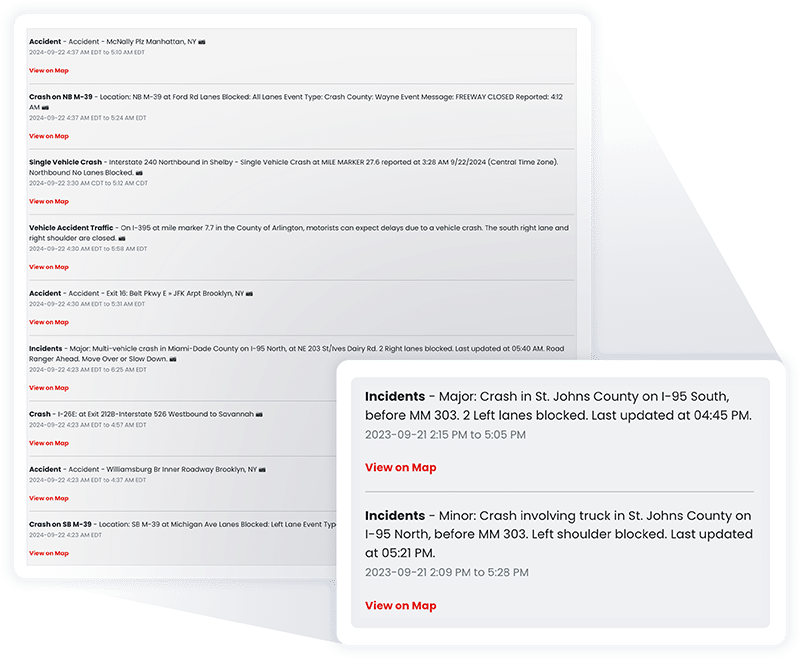
RoadProof offers a truly unique data set combining archived traffic video and a running incident feed available in most states on the system.
All of this data together allows you to get the whole picture, from the initial incident to the final outcome.
“IT WINS THE CASE. We saw the value of RoadProof immediately, you settle your cases 50% faster and for full value.”
Brian Labovick
Labovick Law Group – Florida
With our automated intelligence system, we’re able to match video footage from cameras nearby to any reported incident, and ensure that those vital video recordings are preserved in our archive for a minimum of one year.
While other systems only keep video footage for a couple of months, we keep the video footage that’s critical to your cases for much longer.
“Our case management department (which handles hundreds of cases each month) has nothing but praise for RoadProof.”
Kendra Fike
Bighorn Law – Nevada
Get started now to see how RoadProof can help you get the video data you need.
Get StartedAlready a member of RoadProof? Login here
“One of the first things I do when investigating a crash is obtain and preserve as much evidence as possible. Even before knowing all the parties involved, I immediately pull the RoadProof footage. Seeing the crash firsthand through the video is incredibly powerful. Having this video footage from the start really helps level the playing field between the plaintiff and the trucking company, which often delays or refuses to provide the truck camera video if at all.”
Jamie Mazzeo, Litigation Paralegal
The Truck Accident Law Firm – Florida


While we’ve seen many people wonder if a traffic camera witnessed an accident in Seattle, the true mystery lies in whether the footage still exists by the time they’re ready to look for it. In terms of size, Seattle’s camera network is among the largest in the Pacific Northwest. However, since both SDOT and WSDOT run parts of Seattle’s camera network, figuring out whose cameras are capturing your accident and determining whether those cameras are retaining footage creates additional complexity.
We’ll break down how Seattle’s traffic camera systems operate (including SDOT vs. WSDOT), which cameras are most critical in areas like Northgate and Fremont, what information is available about each camera location (and the availability of this information), and what your options are for obtaining archived footage.
SDOT (the Seattle Department of Transportation) manages city street cameras, while WSDOT (the Washington State Department of Transportation) oversees freeway cameras. Since these two agencies manage such different types of cameras, it is essential to understand what type of camera was present during your Accident and which agency maintains responsibility for that camera.
SDOT provides an updated list of SDOT-managed camera locations via the City of Seattle open data portal. While this allows users to locate cameras easily and obtain accurate locations, accessing the actual images obtained by these cameras will require contacting each respective agency and making a formal request.
Here are some of the important traffic cameras in this area:
WSDOT manages over 700 freeway cameras along I-5 (approximately 140 cameras exist solely between Seattle and Tacoma). Like SDOT cameras, WSDOT also makes its real-time camera feeds available to the public. They offer both a traveler map and a real-time freeway map. Both maps allow users to view current conditions based on the location entered. Each map typically updates every 2-4 minutes. Neither the WSDOT nor the SDOT cameras provide archived footage.
One issue that affects all public traffic cameras is their inability to archive footage. According to the SDOT website, “we do not retain images from our traffic cameras.” This policy is explicitly stated on SDOT’s website regarding its own policies. As soon as the live feed refreshes, the previous frame disappears and is never restored. The WSDOT cameras that monitor the highways follow the same policy. Users can see current conditions in real time, but once that instant has passed, the footage disappears forever from the public system. This is common across America. The majority of cities’ public traffic camera systems are established to assist with traffic flow rather than to store evidence of incidents. The cost associated with archiving continuous video from hundreds of cameras far exceeds what most cities are willing to spend. Therefore, tens of thousands of accidents occur, but the related footage is deleted without ever being requested.
By the time someone identifies which agency operates which cameras, prepares a records request, and submits it to the correct department, the footage has usually been deleted. The timeframe within which this occurs varies depending upon several factors (i.e., how quickly an individual identifies the cameras, drafts a proper records request, etc.) but generally ranges anywhere from a few hours to a week.
There are numerous ways in which preserved traffic camera footage can be utilized. Attorneys and investigators utilize video recordings from traffic cameras to determine precisely what occurred at the site of an accident. Witnesses frequently disagree on what they observed, police reports are commonly incomplete and contain inaccuracies, and video footage cannot be disputed. For example, in automobile accidents where there was an intersection camera nearby, it could potentially display a sequential account of the events surrounding a collision (vehicle speed approaching/after impact, traffic light phase, driver behavior prior to contact) in addition to other potential contributing factors. Evidence that supports or disproves a legal case can resolve issues rapidly in many instances.
Police departments utilize real-time access to cameras to remain informed of the situation during emergencies and to conduct reviews after incidents. Following an Accident or crime, investigators utilize preserved footage from cameras to develop timelines, identify vehicles, and confirm/dispute witness testimony.
Insurance providers retrieve footage to verify claims and defend against fraudulent claims. A video that conflicts with a fabricated report of an incident can prevent costly settlements and liability from litigation.
Engineers responsible for managing traffic flows and urban planners utilize regular footage from cameras to assess congestion patterns, examine signal timing at specific intersections, and pinpoint hazardous intersections. Many of Seattle’s most congested intersection areas have been designated for new camera installations due in part to insights provided by past footage collected at those areas regarding driver behavior.
RoadProof was created to fill the gap left by the lack of retention by Seattle’s public traffic cameras.
RoadProof captures the same real-time feeds from SDOT and WSDOT cameras as does the general public. In contrast to sdot/wsdot’s systems, RoadProof archives the footage. RoadProof stores the footage for a minimum of 1 year. The city/state typically only retains footage for much shorter periods than RoadProof.
With RoadProof, you won’t have to attempt to identify which agency controls which camera(s) in relation to your Accident; draft separate requests for records for each agency; wait weeks or months for each agency to respond, stating that the footage has been deleted. Instead, you can use a simple map interface to discover which cameras are located closest to your accident location; access archived footage; select the time period you wish to view; and review video from applicable times.
RoadProof was developed in cooperation with law enforcement and crash reconstruction experts. Consequently, RoadProof’s design reflects input from these disciplines. Its primary purpose is to provide legal professionals with dependable, date/time-stamped evidence they can utilize. Any law enforcement agency is granted complimentary access to RoadProof. Legal teams utilizing RoadProof can rapidly offset manual efforts required to chase down archived footage from various agencies.
For attorneys working accident cases in Seattle, the practical benefits derived from using RoadProof for accident cases in Seattle are substantial. Upon experiencing an accident on Mercer Street or an incident involving a vehicle on I-5, the relevant footage from any camera situated at or proximate to your accident location can be accessed by performing a single search, regardless of whether SDOT/WSDOT retains said footage.
If you’ve been in an accident and you think a traffic camera may have recorded it, the clock starts immediately. Don’t wait to see how the insurance claim develops before looking for footage.
Get started now to see how RoadProof can help you get the video data you need.
Get StartedAlready a member of RoadProof? Login here
We will review your request within 1-2 business days and will contact you by either phone or email, or both. In the meantime, learn more about your team!